
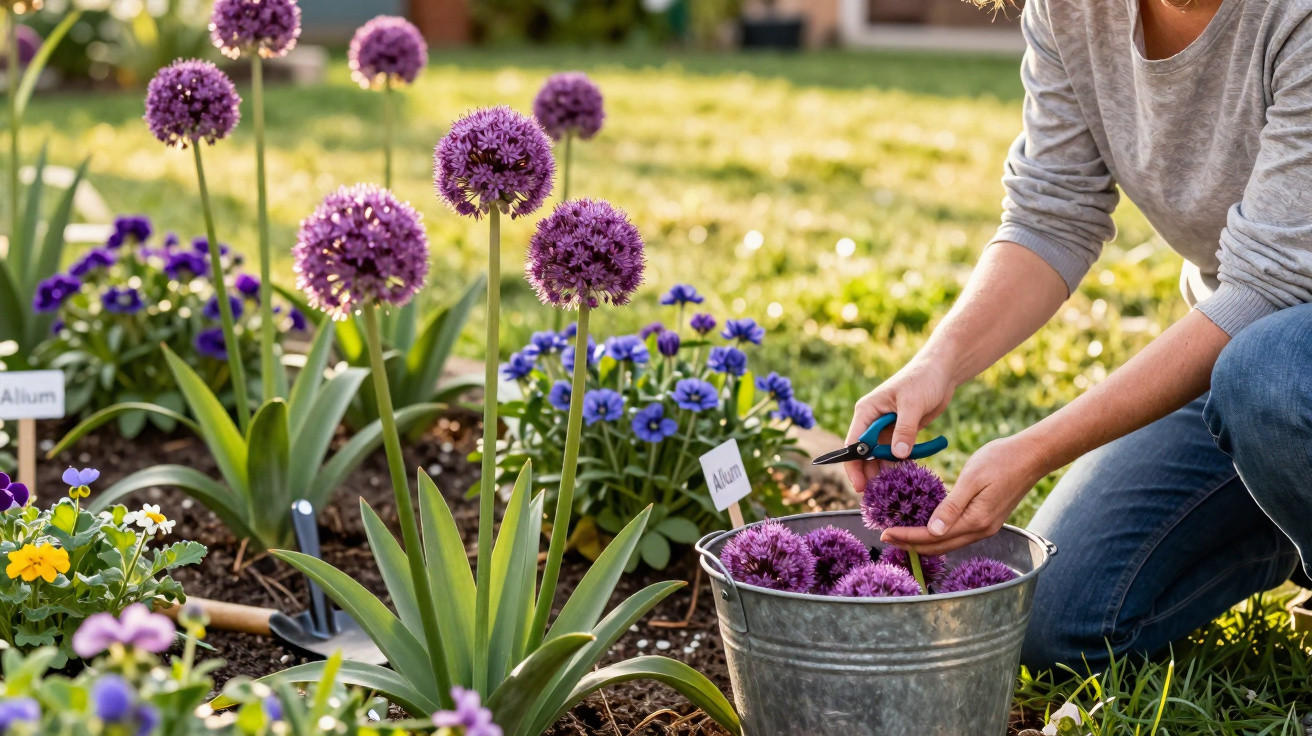
Between perennials, in the rose bed, even right in the middle of the lawn.
Plenty of gardeners know the pattern: plant ornamental allium once, and in the years that follow it seems to pop up in every corner. Those purple allium globes look fantastic, attract bees and cope surprisingly well with heat. But if you do nothing, it can quickly feel as though ornamental allium has taken over the garden. The good news is that with a few targeted actions you can keep its spread in check-without having to give up the flowers.
Why purple ornamental allium suddenly appears everywhere
Ornamental allium sits within the large Allium family-so it’s related to kitchen onions, garlic and chives. Many varieties behave themselves in the garden, but others spread noticeably over time. How strongly that happens depends on the climate, the soil and, above all, the cultivar.
"Ornamental allium multiplies in several different ways-once you understand them, you can keep the plants under control."
Three ways it multiplies
Those violet spheres may look innocent, but behind the scenes they’re very efficient:
- By seed: Once flowering finishes, the heads dry out. Seeds drop to the soil or get blown about, producing seedlings in new spots.
- By daughter bulbs: Underground, the main bulb continually forms small new bulbs around itself. As the clump becomes denser, leaf growth increases while flower numbers tend to decline.
- By bulbils above ground: Some species form tiny bulbils in the flower head instead of seed. When they fall, they can root wherever they land.
In mild areas with loose, well-drained soil, these plants find near-perfect conditions. That’s when allium shoots suddenly show up between perennials, in the veg patch or right in the lawn. In wildlife-friendly gardens this can be welcome; if you prefer crisp planting schemes, it’s more likely to feel like a nuisance.
Why you still shouldn’t banish ornamental allium
Even with its enthusiasm for multiplying, ornamental allium has major strengths-especially with climate change in mind.
- Tolerant of drought: The bulbs come through very dry summers remarkably well.
- A magnet for bees: The nectar-rich flowers provide reliable food for solitary bees, bumblebees and butterflies.
- Low maintenance: Once established, it needs little care and rarely requires extra feeding.
- Design impact: The clean, spherical heads create bold accents among perennials, grasses or roses.
So the aim isn’t to get rid of ornamental allium altogether, but to choose suitable varieties for the right place-and then follow a few routines so it doesn’t get out of hand.
It all starts with choosing the right variety
If you’re planting from scratch, this is your biggest lever. Some ornamental alliums multiply aggressively, while others barely spread at all. Many garden centres don’t state this clearly on the label, yet the difference can be huge.
Sterile varieties for easy-going borders
Some hybrid ornamental alliums are sterile. They produce showy blooms, but no viable seed and no bulbils in the flower head. Examples include:
- Allium ‘Globemaster’
- Allium ‘Mount Everest’ (white spheres)
- ‘Summer Beauty’
- ‘Tumbleweed’ and some other large-flowered types
These varieties largely stay where you plant them. They will still form more bulbs over the years, but they don’t leap around the garden.
Semi-sterile varieties-manageable spread
Other ornamental alliums are only partially sterile and therefore produce far fewer viable seeds. These include, for example:
- ‘Millenium’
- ‘Pink Planet’
- ‘Chivette’
- ‘Dallas’
Over time, these can form small tussocks, but they create noticeably fewer unwanted seedlings nearby. If you like a bit of natural variation and keep an eye on things, they’re usually easy to live with.
The right position prevents an “allium avalanche”
Ornamental allium prefers sunny sites and free-draining soil. In heavy clay or consistently wet corners, bulbs can rot. If you want controlled growth, a little strategic planning pays off.
Plant ornamental allium in groups, not scattered around
Rather than dotting single bulbs across the whole garden, it’s more effective to concentrate them deliberately:
- Defined beds: For instance as a border along a path, contained by a solid edge made from stone or metal.
- Large pots: Ornamental allium looks elegant in containers and can be moved entirely if needed.
- Raised beds: Near the veg garden, allium flowers add colour and draw pollinators without wandering into the lawn.
"If you plant ornamental allium in purposeful groups, you get striking blocks of colour-and it becomes far easier to spot and remove escapees."
The most important routine: cut off the flower heads in time
As soon as the purple heads begin to dry, seed ripening starts. Leave it too long and you effectively sow the plant around the garden yourself. The simplest countermeasure is:
- Cut off flower heads once they turn brown and the first pods begin to open.
- Snip the stems right down at the base so no more energy goes into seed production.
- Dispose of the heads in the compost bin-or better, with general waste; don’t leave them lying on the ground.
This small habit dramatically reduces unwanted seedlings. Leave the leaves in place, though, until they yellow naturally-this is how the bulb rebuilds its reserves for the following year.
Divide bulbs before the clump gets out of control
Even sterile ornamental allium produces more and more daughter bulbs over the years. When a clump becomes too crowded, the flowers get smaller and some plants may only make leaves. Dividing every two to three years is worthwhile.
- After flowering or in late summer, push a digging fork in generously around the clump.
- Lift the whole root ball carefully.
- Clean and sort the bulbs-keep firm, healthy ones and discard any that are soft or rotten.
- Replant only what you need; the rest can be given away or potted up.
This keeps the bed airy and brings back stronger flowering. If you don’t want to pass spare bulbs on, don’t simply throw them on the compost-otherwise they can reappear later in completely different parts of the garden.
If ornamental allium is already everywhere: what helps now
Many people only notice the issue once allium shoots are already growing among perennials, in a gravel path or in the lawn. It takes a bit of patience, but there’s a clear approach.
In borders: dig deep and don’t snap the bulb
Bulbs can regrow from any piece left behind. If you only pull at what’s above ground, you’ll get-at best-a brief reprieve. Instead:
- Use a narrow spade or a weeding tool and go in deep.
- Cut a generous circle around the plant to catch the entire bulb.
- Loosen the bulbs carefully and check for damage-remove any broken pieces as well.
It’s fiddly work, but it’s effective. Plan one or two focused sessions in spring and you can noticeably reduce the population.
In the lawn: let the mower do the work
In turf, digging bulbs out is rarely ideal because it quickly leaves bare patches. Here, the weakness of bulb plants works in your favour: they need their leaves to replenish the bulb. If the foliage is repeatedly cut early, the bulb gradually runs down.
- Mow regularly and fairly short as soon as allium leaves appear.
- Don’t allow flower stems to develop-the mower needs to be used sooner.
- Keep at it consistently over several years and many self-sown bulbs will disappear on their own.
Practical extra tips for a balanced garden look
Once you’ve got ornamental allium under control, you can combine it purposefully with other plants. Strong-structured companions that hide the dying-back foliage after flowering work especially well, such as:
- airy ornamental grasses
- fragrant perennials such as catmint
- roses that flower at the same time or shortly afterwards
- summer perennials such as coneflower or sage
This creates lively planting where the lilac globes take centre stage for a few weeks, then other plants carry the display. The garden stays dynamic without any one species calling all the shots.
If you’re new to bulbs, it’s worth asking about terms such as “sterile” or “semi-sterile” when you buy. Specialist retailers can often tell you whether a variety self-seeds heavily or tends to stay put. When in doubt, check gardeners’ experiences from similar climate zones, because a cultivar’s behaviour can differ greatly between northern Germany and a warmer, wine-growing climate.
In the end, purple ornamental allium shows how fine the line can be in a garden: what’s admired as an ornament today can feel like an invasion tomorrow. If you understand what drives it, you can take control again-and enjoy those impressive spheres without finding fresh surprises in the lawn every year.



Comments
No comments yet. Be the first to comment!
Leave a Comment