
Many people reach for a pan of boiling water and hope for a quick fix. It can look dramatic at first, but the green layer often returns sooner than you would like. Experienced gardeners have long since switched to a different, surprisingly straightforward approach - one that is kinder on your nerves and on the paving slabs.
Why boiling water usually only tackles moss for the short term
Pouring hot water over moss creates a kind of shock treatment. The top growth is scalded and the green seems to vanish almost instantly. The underlying cause, however, remains.
Moss is not dirt you can simply “boil away”; it’s a sign of areas that stay damp, shady and poorly ventilated.
These spots are particularly prone:
- shady areas behind the house or beneath trees
- tight joints and corners with little air movement
- places where rainwater sits for a long time after a shower
In those conditions, moss quickly returns after the boiling-water routine. Anyone who treats the same patches every spring knows the never-ending cycle: clean, hope, wait - and a few weeks later, it starts all over again.
Risk to joints and natural stone
Boiling water does not only attack the moss. The sudden heat can dry out jointing material or make it brittle. Natural stone and more delicate concrete slabs can also react badly (depending on quality) to abrupt temperature changes.
There is another issue many people overlook: slipping. After using boiling water, a thin film of dead growth is often left behind. Combined with moisture, it can create a greasy surface. The area may look clean, but in everyday use it can be deceptively slippery.
The gardener’s trick: damp slabs and a little bicarbonate of soda
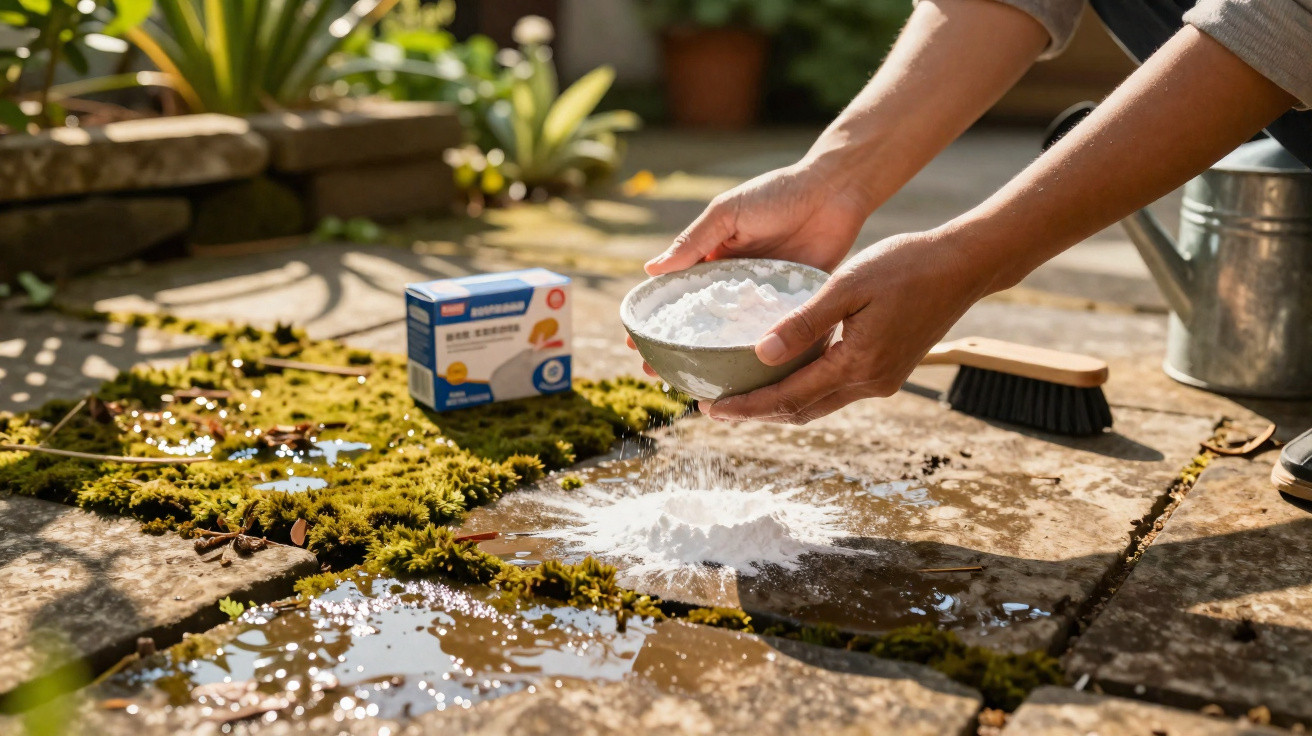
That is why professional gardeners often use a calmer, but very effective method: bicarbonate of soda - specifically sodium hydrogen carbonate, commonly sold as “baking soda” or food-grade bicarbonate of soda - applied to damp slabs.
Damp patio, a light sprinkling of bicarbonate of soda, 48 hours of patience - and the moss almost lifts off by itself.
Moisture is the key. On wet slabs, the powder clings to the surface and stays where it needs to work. The grains sit directly on the moss and in the joints, rather than flowing away like water and disappearing too quickly.
Step by step: how the bicarbonate-of-soda method works
- Dampen the slabs: Lightly wet the patio or path with water, for example using a garden hose. The surface only needs to be damp - no pressure washing, no scrubbing.
- Sprinkle bicarbonate of soda: Apply the powder precisely to the mossy areas. Do not dust the entire surface; focus on the visible green - especially in joints, corners and along shaded edges.
- Leave it for 48 hours: Over this period, the surface gradually dries while the bicarbonate remains in place and steadily deprives the moss of what it needs to thrive.
- Brush off the moss: After two days, the moss should come away much more easily. A stiff brush with a handle or a joint brush is usually sufficient.
- Rinse gently: Finish by rinsing with a small amount of water to remove loose debris, without washing out the joints again.
The process is not flashy, but it works with impressive reliability. The slabs come up clean, without heat or harsh cleaners.
How much bicarbonate of soda is sensible - and where mistakes happen
A common mistake is thinking “more is better”. With bicarbonate of soda, restraint pays off.
A rough guide for a patio:
| Area | Amount of bicarbonate of soda (approx.) |
|---|---|
| 1 m² heavily covered in moss | 2–3 tablespoons |
| Lightly affected joints | 1–2 tablespoons for several metres of joints |
| Small problem patch in a corner | 1 teaspoon, applied locally |
More important than an exact weight is how evenly you apply it: the powder should lightly cover the moss cushions, not sit across the whole patio like a blanket of snow.
Three typical stumbling blocks
- Applying too thickly: This creates unnecessary residue and does not improve effectiveness.
- Scrubbing too soon: If you reach for the brush after only a few hours, you lose most of the benefit. The 48 hours are a core part of the method.
- Rinsing with a strong jet: A powerful stream can wash out jointing material. A gentle flow of water, or a watering can, is the better option.
The right timing: work with the weather instead of fighting it
With the bicarbonate-of-soda trick, the weather matters. The best conditions are a dry spell without prolonged rain forecast, along with mild temperatures. That way, the powder can stay in place and do its job, rather than being washed away.
If you treat moss when the slabs are already damp, you take advantage of a natural boost - for example after a shower or early in the morning.
If you have very pale natural stone or older, more delicate slabs, it is worth doing a small test first: treat an inconspicuous area and wait a day. This helps you judge how the material responds and how intensive you can be later.
How to stop moss coming back quickly
Bicarbonate of soda deals with the current growth, but it does not, by itself, change the conditions moss likes best. If you want a longer break from it, take a closer look at what surrounds the patio or garden path.
Reduce shade and move moisture away
Useful garden adjustments include:
- Cutting back shrubs and bushes: More light and airflow makes the area less inviting for moss.
- Directing rainwater away: Small channels, a slight adjustment to the slope, or an additional drain can prevent standing puddles.
- Clearing leaves and soil: Organic debris left on slabs holds moisture and provides an ideal starting point for new moss.
Often, just a few targeted changes are enough to help the surface dry more quickly. The shorter the slabs stay wet after rain, the harder it is for moss to establish.
A short routine instead of a major spring clean
Rather than one big, exhausting clean-up once a year, a small, regular check usually works better. After a wet week, a quick look will show exactly where the first green patches are returning.
If you treat those early with a little bicarbonate of soda and run a brush along the joints now and then, you prevent dense carpets from forming. The patio stays presentable for longer, without sacrificing half a day each spring to a “moss battle”.
Why bicarbonate of soda has so many fans in the garden
Bicarbonate of soda is already seen as a household all-rounder. In the garden, it stands out for being simple to use and comparatively gentle. Unlike a pressure washer or aggressive cleaners, it is more likely to preserve the texture and colour of many types of slabs.
Even so, it should not be applied carelessly: in large quantities it can alter the soil’s pH. So if you have borders or sensitive plants next to the patio, try to ensure as little as possible is rinsed into them.
Ideally, the treatment stays on the slabs and in the joints. If you have an edging of gravel or chippings, that area can act as a useful “buffer zone” so nothing runs straight into planting beds.
When moss is welcome - and when it isn’t
Moss is not automatically the enemy in a garden. In shady corners, on old natural stone, or on a dry-stone wall, it can look beautifully decorative and create a calm, aged feel. On patios, driveways or steps, however, slip resistance is what matters most.
If you want to balance both, decide by the surface’s purpose: walkways and seating areas are best kept low in moss, while decorative corners can be allowed to “go wild” on purpose. The bicarbonate-of-soda approach is well suited to that kind of divide because it can be used precisely and locally - without having to treat the entire surface every time.
If you move away from boiling water and instead let damp slabs, a little bicarbonate of soda and time do the work, patio maintenance suddenly feels far more relaxed. The green layer disappears, the stone is treated more gently - and spring feels a little less like a chore and a little more like something to enjoy.

Comments
No comments yet. Be the first to comment!
Leave a Comment