
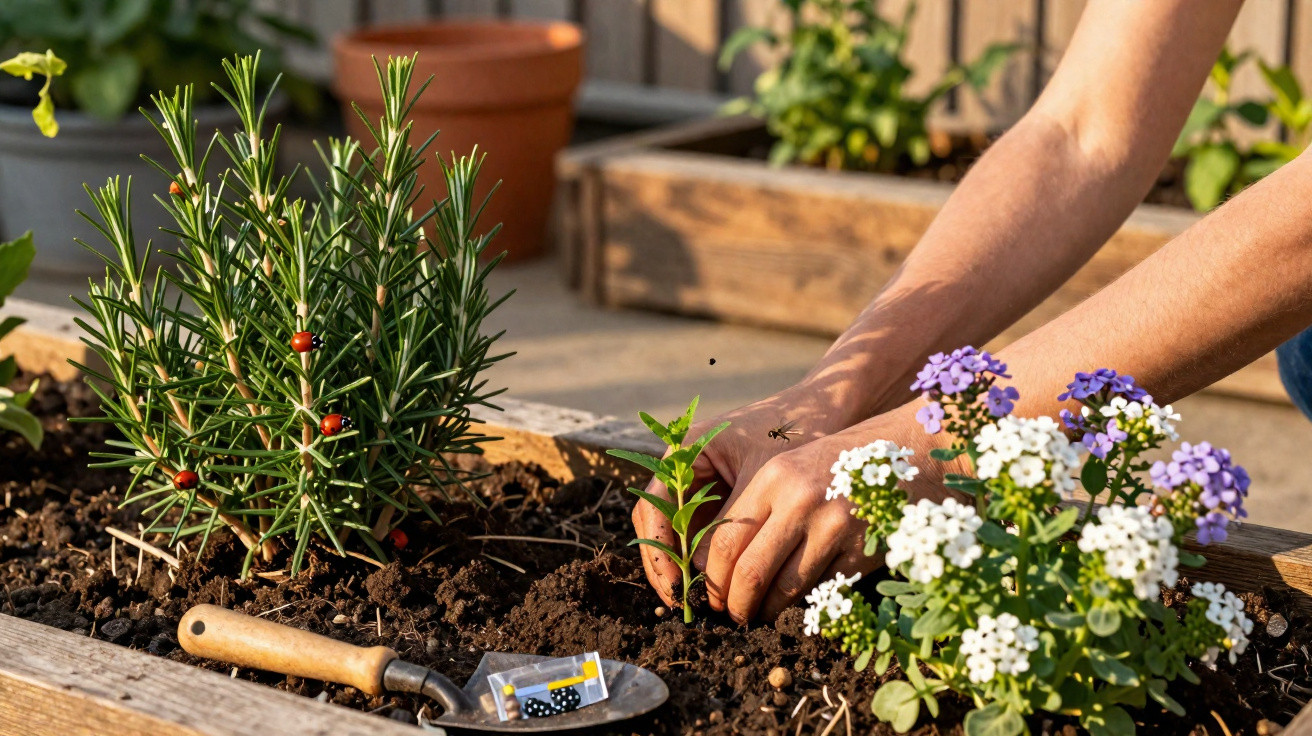
An aromatic shrub, a tiny flower – and suddenly the balance of power in the garden shifts in favour of beneficial insects.
Many home gardeners rely on rosemary to keep pests at bay. Yet aphids, whiteflies and small caterpillars still return during a mild spring. The answer is not another pesticide, but an unobtrusive annual flower planted at the rosemary’s feet – it turns the bed into a genuine magnet for beneficial insects.
Why rosemary alone will not stop an aphid infestation
Rosemary is regarded as a tough, aromatic all-rounder for the garden. It thrives in full sun, light and fairly lean soil, but hates waterlogged conditions. In heavy clay soil or pots that remain constantly damp, it struggles, turns yellow and grows poorly.
When it is healthy, it releases essential oils. Their scent deters certain pests while attracting bees and butterflies. Even so, this fragrant shield is not enough to hold back every attacker. Aphids, whiteflies and some caterpillars in particular continue to find their way onto young shoots.
“Rosemary is more of a watchdog than a defensive wall: it raises the alarm and attracts pollinators – but it does not bring enough hungry helpers into the bed.”
For reliable protection, the shrub needs support. The ideal plant companion flowers for a long time, provides plenty of nectar and therefore continuously attracts predators of aphids and other pests.
Alyssum: the small cloud of flowers that attracts bodyguards
This is where alyssum, also called sweet alyssum or Alysson maritimum (Lobularia maritima), comes in. It stays low, usually reaching 10 to 20 centimetres, and forms dense cushions. Its tiny flowers can be white, pink or violet, appearing from spring well into autumn when treated correctly.
Its fragrance is delicate and sweet, with a slight honey-like note. For insects, it provides an ongoing buffet. Bees and hoverflies are particularly drawn to it. In turn, an entire garden security team moves in:
- Ladybirds and their larvae consume large quantities of aphids.
- Hoverfly larvae clear whole shoots of aphid colonies.
- Parasitic wasps parasitise caterpillars and whiteflies.
- Lacewings lay their eggs near prey, and their larvae also feed on aphids.
In other words, alyssum turns the area around rosemary into an insect canteen – for precisely the helpers needed in the vegetable garden.
Combining rosemary and alyssum correctly
Choosing the site and preparing the soil
Rosemary sets the conditions. It requires:
- a position in full sun
- well-drained, fairly dry soil
- no constant moisture around its roots
For a garden bed, many gardeners prepare a loose growing medium:
| Component | Proportion | Purpose |
|---|---|---|
| Garden soil | 3 parts | Basic structure and nutrients |
| Coarse sand | 2 parts | Drainage and aeration |
| Mature compost | 1 part | A moderate nutrient supply |
Plant the rosemary first, ideally on a small mound or slightly raised spot so rainwater can drain away. Position alyssum around 20 to 30 centimetres from the stem rather than directly beside it. This keeps air around the base of the plant and makes fungal problems less likely.
Growing in a pot or window box
If you do not have garden soil, choose terracotta pots with a diameter of at least 30 to 40 centimetres. Drainage holes are essential so excess water can escape.
Proceed as follows when planting in a pot:
- Line the pot with a drainage layer, such as expanded clay pellets.
- Fill it with the loose growing medium described above.
- Plant the rosemary in the centre.
- Sow alyssum around the pot edge, or plant small seedlings roughly 20 to 25 centimetres apart.
Water sparingly. Allow the top layer of compost to dry before watering again. During hot periods, one thorough watering each week is often enough, depending on the position and wind exposure.
“One common mistake is treating rosemary like a balcony petunia. Too much water weakens the shrub and opens the door to pests.”
After each substantial flush of flowers, alyssum can be lightly trimmed. It will then grow again and continue flowering, keeping beneficial insects in place until autumn.
Where the rosemary and alyssum combination excels in the vegetable garden
The rosemary-alyssum pairing is more than an attractive feature: it also works as functional companion planting in a kitchen garden. Its effect is particularly noticeable in these locations:
- At the edge of cabbage beds: fewer aphids and cabbage white caterpillars, with more natural predators.
- Around peppers and chillies: hoverflies and lacewings reduce thrips and whiteflies.
- Along rows of carrots or strawberries: a lively border, more pollinators and lower pest pressure.
Pests will not disappear altogether. However, they spread more slowly and the ecological balance becomes more stable. Sprays are often unnecessary because beneficial insects intervene early.
Variety choice, common mistakes and practical tips
Low-growing alyssum varieties are especially suitable for planting beside rosemary. One popular option is the compact ‘Carpet of Snow’, which creates dense carpets of white flowers. It does not overrun the rosemary and provides very little shade.
Sow it directly into the bed or pot in spring. Alyssum can self-seed readily, so individual plants may reappear the following year depending on the climate. For a dense, controlled floral cover, however, it is still worth sowing again.
There are several pitfalls to keep in mind:
- Neighbours that need too much water: herbs such as basil, or thirsty perennials planted directly alongside rosemary, disrupt its dry conditions.
- Saucers holding water: permanently wet saucers beneath containers cause waterlogging – toxic for rosemary.
- Cold: in exposed areas, rosemary is better in a movable container that can be kept protected over winter.
For pots in cooler regions, this approach works well: overwinter the rosemary in its container, then sow fresh alyssum in spring. That way, the team starts each growing season afresh.
Why this method suits natural gardeners so well
Anyone wishing to use fewer chemicals in the garden needs strong allies – and they have six legs. Beneficial insects need food or they disappear. Alyssum supplies nectar and pollen for months, while rosemary provides structure, fragrance and a dry, warm site that many insects enjoy.
Together, they work like a small, simple building-block system for a resilient garden: the shrub supplies aroma and basic protection, while the flower cushions provide a steady supply for predators. Gardeners reach for sprays less often because many issues can be contained early by natural enemies.
Those who enjoy the results can extend the principle: additional nectar-rich, low-growing flowers nearby – such as marigolds or small native perennials – enhance the effect. The crucial point is to avoid making the area around the rosemary too damp or too densely planted, so it retains its strength.
With just a few simple steps, this creates a garden area that smells good, looks attractive and noticeably eases pest pressure. A small annual flower and an aromatic shrub are often all it takes to leave aphids with suddenly very poor odds.



Comments
No comments yet. Be the first to comment!
Leave a Comment