
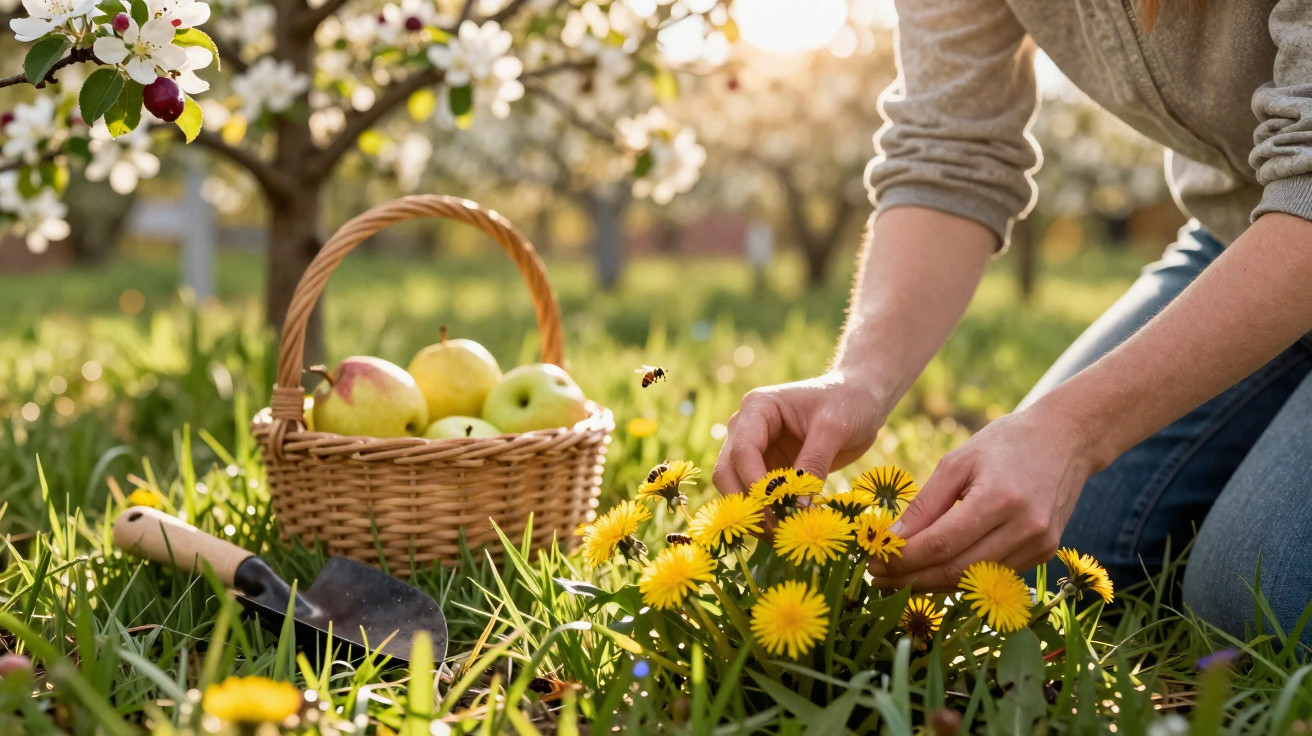
A neighbour stops a gardener while they are weeding – and turns out to be right: the inconspicuous yellow flowers in the lawn often help determine the harvest of cherries, apples and pears.
Anyone proudly pulling every yellow flower from the lawn in March may sometimes be harming the very plants that matter most to them: their fruit trees. Behind the argument over a “tidy” patch of green lies a surprisingly direct link between dandelions, bees and overflowing fruit baskets.
The overlooked start of spring
At the end of winter, honey bees and wild bees emerge from their shelters hungry. They need fresh nectar and pollen immediately, rather than several weeks later. This is exactly where dandelions come in: they often flower well before cherry, apple or pear trees.
Pulling out these first blooms too soon removes one of the year’s most important refuelling stops for insects. They then have to travel further, use more energy – and some colonies may no longer make it through to the fruit blossom in time.
A “perfectly” manicured spring lawn can become a desert for bees – and a lean period for fruit trees.
Many amateur gardeners equate neatness with usefulness: no “weeds”, everything short and uniform. From an ecological perspective, however, such a garden is often barren. It provides very little food at the crucial point when pollinators are becoming active again.
How bees determine what ends up in your fruit bowl
The principle is straightforward: without pollination, there is little or no fruit. A bee carries pollen from one flower to another, allowing fruit to develop later. If this pollen transfer does not happen, branches may still bloom magnificently, but the harvest will be sparse.
Dandelions function like a starter buffet before the main meal. They keep insects in the garden, provide energy and bridge the gap until apple, cherry and other trees come into bloom. Removing this intermediate food source risks leaving far fewer pollinators available when they are most needed.
The quiet professionals: wild and solitary bees
Honey bees from hives often receive most of the attention. Yet wild and solitary bees carry out a huge proportion of the work in gardens and small orchards. They fly in cooler weather, are active early and are remarkably efficient.
- Solitary bees visit many flowers in a short time.
- They forage within tightly defined areas – ideal for small gardens.
- They respond strongly to the flowers available to them.
If they lack a dependable food source at the start of the season, their populations can quickly decline. The consequences only become apparent weeks later: fewer apples on the tree, more bare spaces among the branches and smaller fruits.
What dandelions really contribute to the garden
Dandelions have a poor reputation. Many people see only yellow patches across the lawn, followed later by the dreaded seed heads. Botanically, though, the plant does more than many people realise.
Its deep taproot gently breaks up compacted soil. It draws nutrients from deeper layers towards the surface. As parts of the root die back, they leave small channels that help water and air penetrate the soil more easily.
Finding large numbers of dandelions in a lawn does not necessarily mean the garden is “neglected”; it is often an indication of:
- heavily compacted soil, for example from frequent foot traffic or heavy equipment;
- nutrient imbalance, particularly excessive nitrogen;
- poor crop rotation or monotonous lawn use.
There are ecological benefits too: the flowers provide an early food source for countless insects. Later, some bird species feed on the seeds. A garden with a few dandelions feels more alive, is more stable and is usually more resilient to pests.
Dandelions are not the enemy of a beautiful garden; they are often an indicator – and a free canteen for pollinators.
How much “weed” is still acceptable?
No one has to let their entire garden become overgrown. The key is timing and choosing specific areas. A thoughtful approach can retain a well-kept appearance while still creating islands of nectar.
A practical method is to designate a few zones in early spring where dandelions may remain – preferably close to fruit trees and berry bushes. In heavily used areas, such as seating spaces or play areas, it is reasonable to manage them more strictly.
Once other plants are flowering later on – including fruit trees, early-flowering plants and perennials – dandelions become less important. They can then be reduced selectively without cutting off insects’ food supply altogether.
Strategies for a “tidy” yet useful garden
- Deliberately leave patches of dandelions around fruit trees during March and April.
- Maintain paths, areas close to the patio and prominent spaces more carefully.
- Remove plants gradually later in the year, once other flowers take over as food sources.
- Use alternative flowering plants such as crocuses, grape hyacinths, lungwort and phacelia.
This creates a compromise: no wilderness of dandelions, but no sterile lawn that offers bees nothing either.
A simple rule for full fruit baskets
Anyone wanting to support their fruit harvest deliberately can follow one simple rule of thumb: allow dandelions to remain until the fruit trees have largely finished flowering.
- Do not remove the plants across whole areas in spring before fruit blossom begins.
- Provide new flowering options, such as perennial beds or flower strips.
- Do not automatically regard every yellow flower as a nuisance.
This small change to the maintenance calendar barely alters everyday gardening, but it can significantly improve pollination among fruit trees. Many amateur gardeners report fuller trees, fewer misshapen fruits and more reliable yields year after year.
Anyone who tolerates dandelions until the end of the fruit blossom is, in reality, helping to build their harvest – at no extra cost.
When your neighbour notices more than you do
Almost everyone knows the scene: you are kneeling on the lawn with a weeding tool when a neighbour passes by the fence and dryly says: “Leave them standing a little longer.” At first it may feel like interference, but later it proves to be valuable advice.
Many older garden owners have spent decades observing shifts in flowering periods, insect activity and harvest quantities. They understand that “tidy” does not automatically mean “better”. Those willing to learn from that experience will more quickly see how sensitive the chain linking flower, pollinator and fruit can be.
A carpet of yellow flowers can therefore be more than a visual irritation. It often marks the point at which the season truly begins – for bees, for fruit trees and, ultimately, for every bowl of cherries or apples on the kitchen table.
Practical tips for a bee-friendly orchard
To turn the theory into practical steps, a small annual plan can help. It avoids complicated measures and can be put into practice in almost any garden.
| Period | Action |
|---|---|
| Late winter | Prune fruit trees, work the soil gently and avoid clearing whole areas |
| March/April | Leave islands of dandelions and plant or add more early-flowering plants |
| Fruit blossom | Mow as little as possible, avoid insecticides and maintain flowering plants around the trees |
| After flowering | Reduce dandelions in a controlled way and encourage perennial flowering plants |
Following this routine does not merely improve conditions for fruit trees. It also reduces maintenance because nature takes on part of the work. Greater diversity in the soil and among flowers strengthens the overall system and makes the garden more resilient to extreme weather, pests and diseases.
Why it pays to look more closely at “weeds”
The word “weed” is often misleading. Many supposedly troublesome species have clear roles: they loosen the soil, protect it from drying out, provide food or indicate deficiencies. Becoming a little familiar with these plants enables you to read your garden like a book.
In the case of dandelions, this means that where they occur in large numbers, it is worth checking the soil structure. Mowing less often, reducing foot traffic or adding compost may already be enough to restore balance. Some of the plants will then disappear naturally, without chemicals or a constant battle.
These observations pay off over the long term, especially in an orchard. Stable, well-supplied soils, enough pollinators, a considered flowering plan and a slightly more relaxed attitude to “weeds” – all of this produces more yield than the next specialist fertiliser from the garden centre.
Comments
No comments yet. Be the first to comment!
Leave a Comment