
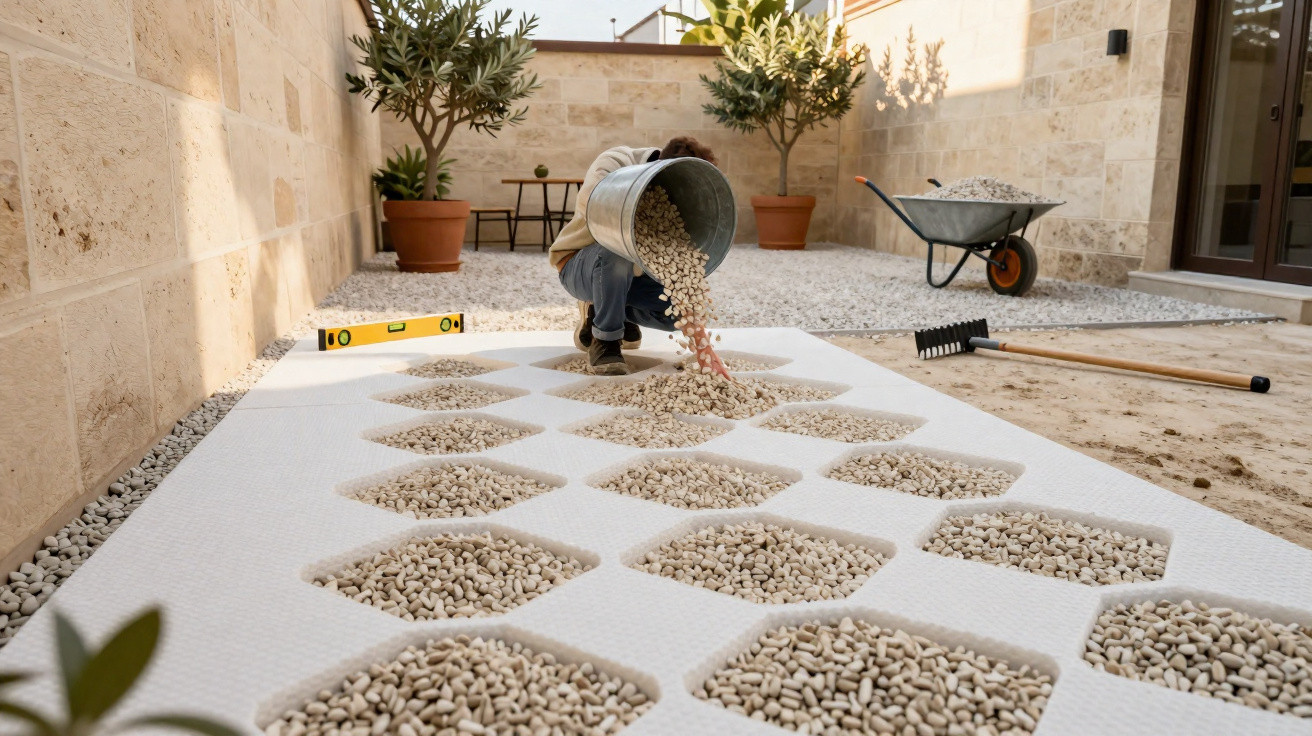
A homeowner completely revamped a gravel courtyard without slabs or built edging, using an unobtrusive material that keeps the stones in place.
A report by home and gardening specialist Maison & Travaux describes how a homeowner refurbished a roughly 30 m² gravel courtyard without using concrete or rigid edging. At the centre of the project was a panel-based material, available for a few euros per square metre, which provides lasting gravel stabilisation and prevents the stones from spreading.
A 30 m² courtyard renovation without concrete or major work
According to Maison & Travaux, the project involved a small courtyard of around 30 m² used as a thoroughfare and for light vehicle parking. The old gravel had compacted, potholes had appeared in several places, soil was showing through, and stones regularly ended up along the edges and in front of the door.
The owner was looking for several things:
- a stable surface that would not become pitted after every spell of rain;
- a neat finish, with gravel kept where it belongs;
- no concrete slab, considered expensive, unattractive and difficult to remove when selling the property;
- a controlled budget, using an affordable material priced by the square metre;
- a project that could be completed independently, without heavy machinery.
They therefore chose a gravel stabilisation solution increasingly used for driveways and domestic courtyards.
The key material: honeycomb gravel grids that lock the stones in place
The project is based on honeycomb panels, often known as stabilising grids or gravel stabilisation slabs. These are rigid panels made from durable plastic, containing numerous cells that hold the stones in place.
“Sold for a few euros per square metre, these honeycomb panels create a honeycomb structure that stops gravel from shifting and spreading.”
In practical terms, each panel generally covers around 1 m². They are laid edge to edge on prepared ground and then filled with gravel. Weight is distributed evenly, wheels do not form tracks and footsteps no longer create ruts. The edges of the panels interlock, reducing movement within the structure over time.
Why does gravel spread without this type of support?
Without stabilisation, a gravel bed behaves like a loose material. Repeated traffic from cars or pedestrians pushes the stones out towards the sides. They eventually collect against walls, in flower beds and on the pavement. Puddles further erode the ground, while small stones rise towards higher areas.
With a honeycomb structure, every stone is contained within a cell. Horizontal movement is greatly reduced, preventing:
- wheel ruts;
- holes in front of the door or in the middle of the courtyard;
- exposed patches of soil;
- the effect of “marbles rolling underfoot”.
Main stages of the project described by Maison & Travaux
The publication explains that the owner did not simply lay the panels over the old gravel. Proper ground preparation remains essential if the system is to work.
Preparing and levelling the ground
First, the homeowner removed some of the existing gravel and soil to restore a consistent overall level. Potholes were filled in and raised sections were levelled. For this kind of job, a careful DIYer needs only a rake, shovel and spirit level.
Once the ground had been prepared, a bed of crushed aggregate or coarser gravel was added to create the base layer. This sub-base serves to:
- provide rainwater drainage, allowing water to soak in rather than remain on the surface;
- improve the courtyard’s load-bearing capacity, particularly where vehicles are parked;
- create a stable surface for the honeycomb panels.
Laying the honeycomb panels
The homeowner then placed the honeycomb panels on this compacted base. They can easily be cut with a saw or utility knife around the edges to follow the exact shape of the courtyard, especially alongside walls or planted beds.
The panels are laid tightly together, then lightly secured by their own weight and, depending on the model, sometimes with a few pegs or staples. The aim is to form one continuous surface without any unsupported areas, so gravel cannot escape beneath the panels.
Filling the grids with gravel
Once the “grid” was in place, the owner poured gravel directly over the panels and raked it out to fill every cell. A thin additional layer was then spread over the top to conceal the structure completely.
“Once the work is finished, the courtyard has the classic appearance of a gravel driveway, but behaves like an almost hard surface beneath feet and tyres.”
Maison & Travaux notes that this type of system makes it possible to walk in heels or use a bicycle, and even a wheelchair, without sinking into the gravel, making a substantial difference to everyday comfort.
Controlled costs for a neat, long-lasting finish
The publication states that gravel stabilisation panels are available for a few euros per square metre, depending on the brand and the strength required. For 30 m², the outlay therefore remains reasonable, particularly compared with a concrete slab or bituminous surfacing.
The highlighted advantages are:
- an accessible budget for a small courtyard;
- work that a motivated homeowner can realistically complete over a weekend;
- a natural-looking finish, warmer than a grey slab;
- low maintenance, requiring only occasional raking and extra gravel every few years.
The owner also avoids the constraints associated with masonry work. If the garden is altered in future, the panels can be removed and the gravel reused. This makes the solution reversible, unlike cracked concrete, which requires substantial demolition.
What is the position in France for this type of landscaping?
In France, these honeycomb gravel panels are now widely sold by large DIY retailers and outdoor landscaping specialists. They are frequently promoted for vehicle driveways, permeable car parks and access routes to homes.
Planning regulations increasingly encourage permeable surfaces that allow water to infiltrate the soil. This system meets that requirement well because gravel remains free-draining, unlike a concrete slab or impermeable asphalt surface.
For a French reader wishing to take inspiration from the project, the main principles are similar:
- check local planning rules for courtyard or parking works;
- plan a drainage sub-base suited to the nature of the soil;
- select honeycomb panels appropriate for the intended use: pedestrian, car or van;
- install geotextile fabric where needed to limit soil and weed growth coming through;
- choose gravel with suitable grading, generally rounded or crushed stone between 6 and 16 mm.
French garden landscaping professionals often offer this method as an alternative to concrete, especially for detached homes and small blocks of flats.
How to choose gravel stabilisation panels
Before getting started, homeowners should consider several criteria:
- mechanical strength: manufacturers generally specify whether the panel is suitable only for pedestrian use or for light vehicle traffic;
- cell height: the higher the cells, the more securely the gravel is retained;
- colour: white, grey or black, so the panels remain discreet beneath the gravel layer;
- the panel connection system, which helps prevent movement over time;
- whether geotextile fabric is already attached underneath the panel.
A common tip is to buy slightly more gravel than the calculated volume needed to fill the cells. The thin covering layer, a few centimetres deep, hides the panels and gives a more natural visual result.
Stabilised gravel: benefits and points to watch
A stabilised gravel system remains a good balance between comfort and appearance. It limits splashes on façades, significantly reduces the noise of stones crunching beneath tyres, and makes movement easier for people with reduced mobility, pushchairs and bicycles.
A few precautions are still useful:
- avoid very heavy loads if the panels are not designed for them;
- provide a slight gradient to direct rainwater away;
- monitor for vegetation appearing in less frequently used areas;
- ensure natural boundaries, such as walls, low walls and planted beds, retain the gravel effectively.
For an even more refined result, some people combine this type of stabilisation with steel, stone or treated timber edging. This helps define the courtyard lines and cleanly separate lawns, planted beds and parking areas.
The project featured by Maison & Travaux shows that, with properly prepared ground and a well-chosen material, a 30 m² courtyard can regain a tidy, pleasant appearance without concrete or major work, using an affordable gravel stabilisation system that is accessible to DIYers.






Comments
No comments yet. Be the first to comment!
Leave a Comment