
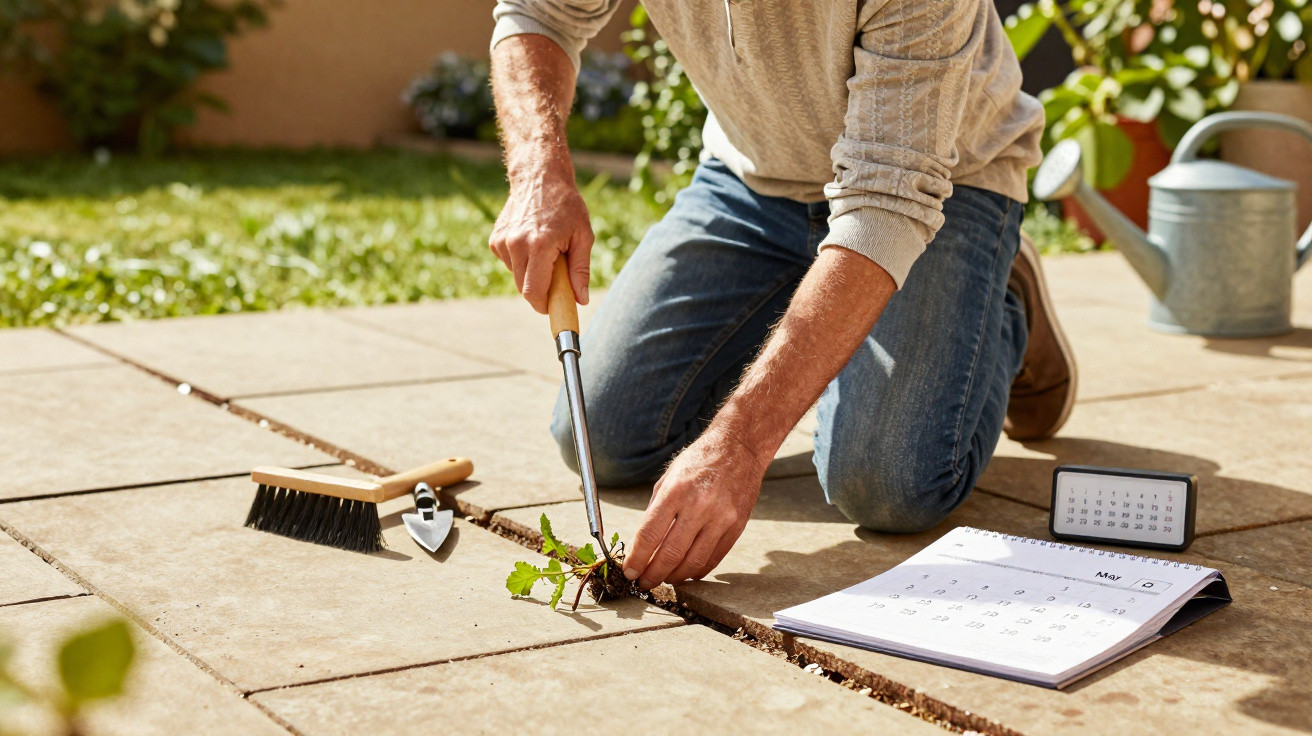
Anyone who painstakingly clears weed from paving joints and patio slabs early in the year often gets very little reward for the effort. The plants simply push back through the gaps again. The problem is rarely the “wrong product” and almost always the wrong moment. If you ignore the calendar, you are effectively scheduling the next annoying clean-up at the same time.
Why timing makes all the difference with weed in paving joints
Between paving stones, it is usually tough species such as dandelions or thistles that take hold. They do not survive because of what you can see above ground, but because of a strong taproot. That root can reach about 15 centimetres down into the ground - and that is exactly where the plant stores its energy.
If you only tear off the greenery at the top, or snap the stem just above the surface, roughly 90 per cent of the biomass remains under the stones. The result is predictable: the root responds with vigorous regrowth. Gardeners sometimes describe this as a kind of “reverse tip stimulation”: once the growing point is removed, dormant buds deeper down in the root are activated, and several new shoots appear.
"If you only pull off the top, every tug helps you grow tougher weeds."
Even with the right tool in your hand, the whole job can be wasted if the timing is off. Plant physiology and the weather decide when your effort really lands - and when it essentially disappears without effect.
Spring: before mid-May, weeding is hardly worth it
March and April in Central Europe often bring changeable conditions and plenty of showers. Biological remedies such as vinegar solutions, plant brews, or other contact treatments only work when they stay on the leaves long enough to “scorch” them. They are highly water-soluble. If rain arrives within 48 hours, the downpour simply rinses the active film away.
What you see then is misleading: the leaves may look briefly damaged, but they recover quickly. Within a few days the joints look just as they did before - or worse. On top of that, early weeding that removes only what is visible encourages the root to fight back.
The best spring window: after the Ice Saints
You will get a far more reliable result if you target the second half of May. After the Ice Saints (the traditional mid-May cold spell), the weather pattern usually settles, which makes a run of dry days much more likely.
- Wait until roughly mid-May.
- Choose a window of at least 72 hours with no rain.
- Check the joints using a tissue test - if it stays dry, you are good to start.
- Treat in the morning, so sunshine and warmth can intensify the effect.
This is how you work with the weather rather than against it. A classic mistake is grabbing the sprayer on Easter Sunday, getting a shower that evening, and finding the area green again two weeks later. In practical terms, the effort achieved almost nothing.
Autumn window: between September and October you hit the root
The second major opportunity arrives in autumn. From early September to the end of October, many perennial plants move their stored reserves from the leaves back into the root to survive winter. During that period the storage organs are full - and that is precisely when removing the plant weakens it most.
When you do a thorough job at this time, the difference is noticeable quickly: the joints stay clean for much longer, and the gap between sessions increases. Instead of battling three or four times a year, you may get away with one substantial pass in autumn, plus a targeted follow-up in late spring the next year.
How to make the autumn root attack work
For this appointment, the essentials are the right tools and a sensible sequence:
- Use a joint scraper, a sharp knife with a hook blade, or an asparagus/weeding fork.
- Work after rainfall or after heavy watering, when the ground has loosened.
- Drive the blade vertically into the soil close to the base of the plant.
- Lever the plant out carefully, ideally bringing soil and the entire root with it.
- Brush out remaining fragments and moss from the joints using a wire brush.
- Refill the gaps with clean, preferably dry sand and press it in firmly.
Why the sand matters so much: full joints let less light reach seedlings, provide little loose organic material, and make it harder for new seed-borne weeds to establish quickly. That significantly reduces regrowth.
Keep away from salt and quick-fix actions
Home-remedy tips often circulate, especially salt. At first glance the effect can look dramatic: leaves shrivel and the greenery collapses quickly. But the damage does not stop at the surface.
"Salt doesn’t just kill weeds; it also destroys soil life - and can ruin paved areas in the long term."
Salt seeps into the sub-base, draws water out of the ground, compacts the soil and harms micro-organisms. Joints can crack and paving can settle unevenly. There is also the risk of salty water washing into neighbouring beds or into groundwater. The short-lived visual “success” is not remotely worth the potential long-term consequences.
Just as unhelpful is ripping things out “quickly” in spring simply because it suits your diary. If you tug at the visible growth in a rush, without considering the root and the season, you are only creating more work a few weeks later.
Typical mistakes - and how to avoid them deliberately
| Mistake | Consequence | Better solution |
|---|---|---|
| Weeding in March or April | Little effect, rapid regrowth | Wait for the second half of May |
| Applying contact treatments before rain | Active ingredient is washed off | Plan for at least 72 hours of dry weather |
| Pulling off only the above-ground parts | The root regrows more strongly | In autumn, remove the whole root using a lever tool |
| Sprinkling salt into joints | Damage to soil, joints and the environment | Mechanical removal and refilling joints with sand |
How to reduce maintenance effort in the long term
If you look after your joints strategically, you save a lot of labour over time. Two well-chosen dates each year have proved effective: one focused pass in autumn to tackle the roots, and one controlled session in late spring to weaken fresh surface regrowth.
It is also worth improving the construction of the area itself: a stable sub-base, adequate fall for drainage, a well-compacted bedding layer and properly filled joints take away the habitat many problem plants rely on. The jointing material can help too - polymer-bound sands, for example, set slightly and allow far fewer seedlings through.
What hobby gardeners often misunderstand
Many people treat weed between slabs as purely a “cleanliness issue” that can be solved by working harder. In reality, it is an interaction between biology, the build-up beneath the paving and the weather. If you understand that the plant’s strategy sits in its root - and that the calendar determines whether an intervention takes effect - you have a clear advantage.
That is why a look at the weather app and a little extra planning is worth more than any new “miracle solution”. If you tie your efforts to two precise phases of the year, avoid salt, and refill the joints consistently after removing growth, the patio shifts from a never-ending project to a manageable routine task.

Comments
No comments yet. Be the first to comment!
Leave a Comment