
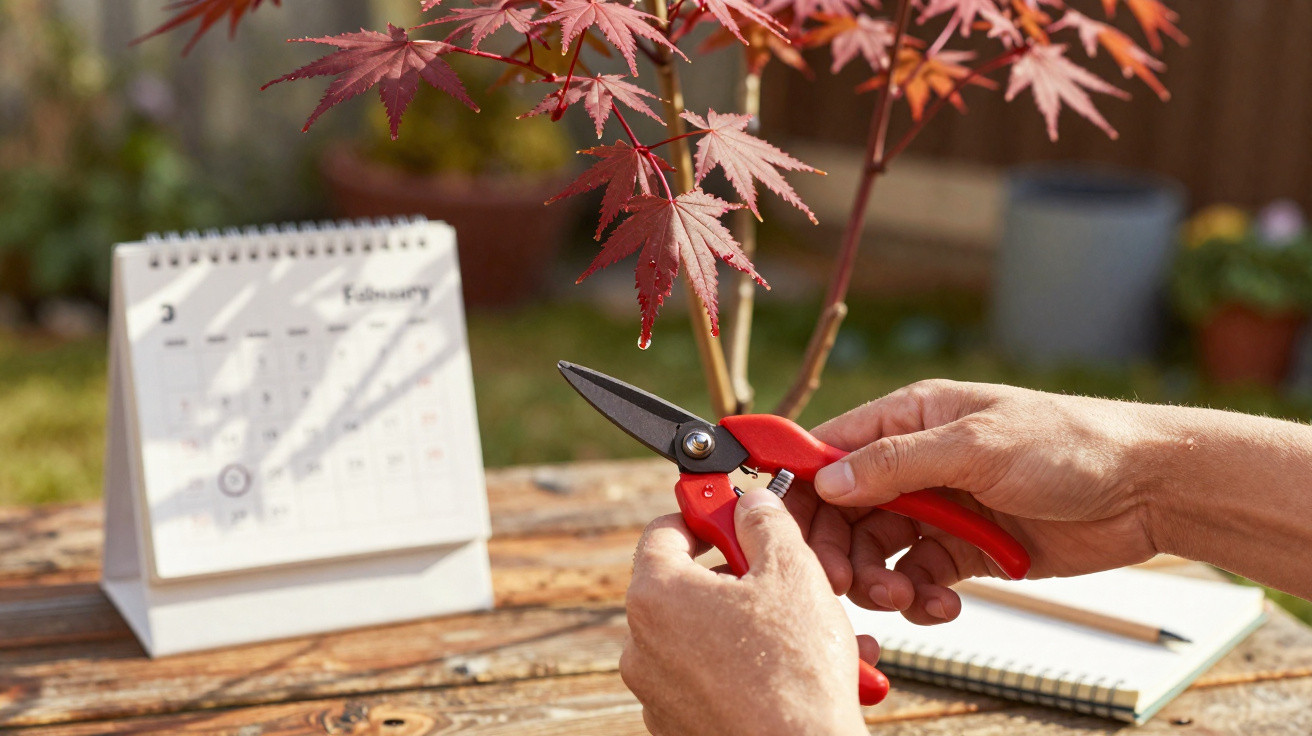
Japanese fan maples are among the most elegant ornamental trees you can grow in a garden. They are expensive to buy, slow to put on growth, and can be fussy to look after. That’s precisely why it hurts when one ill-judged moment with the secateurs leaves the tree vulnerable for months to disease, frost, and drought stress. The particularly tricky moment is the well-known “spring tidy-up” in February.
Why the Japanese fan maple can literally bleed after the wrong cut
The Japanese maple, botanically Acer palmatum, has very delicate bark and closes larger wounds only slowly. As soon as the so-called sap flow begins, the tree becomes extremely sensitive to any pruning.
Towards the end of winter, the root system starts pushing water and nutrients upward. If you remove a thicker branch at this point, strong sap flow can follow. The pruning wound then “bleeds” for an extended period.
“Heavy sap flow drains the Japanese fan maple’s reserves, slows wound closure, and quite literally opens the door to fungi and bacteria.”
If you care about your Japanese fan maple, it helps to accept one key point: a single poorly timed or poorly planned cut can noticeably set back the vitality you’ve built up over years. The crown may break into growth more weakly, leaves can stay smaller, and branches may begin to die back-often with a delay, so the connection to the pruning is no longer obvious.
When the right time to prune has arrived
The Royal Horticultural Society and many arborists advise pruning Japanese fan maples only when they are in their deepest dormant period: late autumn or mid-winter, when the tree is fully “switched off”. At that time, sap pressure is low and wounds remain comparatively calm.
A crucial rule of thumb is simple: the closer the tree gets to bud break, the more risky any non-essential cut becomes. In particular, thicker cuts are far more likely to trigger heavy sap bleeding.
February as the last reasonably safe opportunity
In many areas, February is seen as the final relatively safe window-but only while the tree is clearly still dormant and there is no frost. Specialists caution that anyone who starts pruning into the crown after that is likely to face much stronger sap flow and knock-on damage.
Once the buds are visibly swelling, you’ve reached the critical line. From then on, gardeners should put the secateurs away unless there are branches that pose an immediate safety risk.
- Plan pruning only in dry, frost-free weather.
- Check the buds: plump and green means it’s better not to prune any longer.
- It’s better to wait a year than force a “shape” with heavy-handed cuts.
The biggest mistakes when pruning Japanese fan maples
A lot of harm isn’t caused by one single cut, but by several poor choices combined. These are the traps that crop up most often in everyday gardening:
- Hedge trimmers instead of hand pruners: Machines “shave” off tips and leave countless small wounds that the tree struggles to seal neatly.
- Far too much thinning: If more than about a quarter of the living crown is removed in one season, the maple often responds with stress, pests, and sunscald on branches that were previously shaded.
- Removing large branches in late winter: Thick cuts just before or during sap movement almost inevitably lead to heavy bleeding.
- Pruning in frost: Cold nights make freshly cut, weakened wood more likely to split. Wounds become larger and heal more poorly.
“A Japanese fan maple would rather have a little fine work every year than one radical ‘cosmetic operation’.”
How to carry out a gentle winter prune, step by step
Anyone who genuinely wants to care for their maple works slowly and with a plan. Winter pruning is closer to a careful correction than a classic “shaping trim”.
- Study the tree calmly: Look from every side to spot problem areas and dead sections.
- Use only clean, sharp tools: A disinfected hand pruner or small pruning saw. Blunt tools crush rather than cut.
- Remove dead wood first: Grey, brittle twigs that snap easily and show no green.
- Deal with rubbing and crossing branches: Remove one of the two branches completely to prevent future wounds caused by abrasion.
- Always respect the branch collar: Cut close to the base, but do not slice into the trunk.
Pro tip: before each cut, pause and picture what the crown should look like in three or four years’ time. Japanese fan maples grow slowly-mistakes remain visible for a long time.
What is still allowed in February-and what is not
| Allowed | Problematic |
|---|---|
| Remove thin, clearly dead shoots | Shorten living, vigorous branches |
| Light thinning within the inner crown | Shaping with hedge trimmers |
| Prune on frost-free days | Working in sub-zero temperatures or on wet wood |
| Remove a maximum of one quarter of the living crown | Radical hard pruning “back to stubs” |
What to do if the ideal time has already passed
Many gardeners only realise in March or April that the maple ought to be corrected. By then, the tree is already pushing into growth and sap is moving strongly. Making large cuts at that point would be a major risk.
In that situation, one straightforward rule applies: do only what’s necessary. In practice, that means:
- Remove only dangerous branches that are clearly at risk of breaking.
- No reshaping and no cosmetic “tidying”.
- Keep the base of the trunk free of weeds, monitor the tree, and apply mulch.
- Postpone bigger interventions firmly until the following winter.
“If you’ve missed the moment, the safest way to protect the tree is to wait patiently-not to reach for the secateurs ‘just quickly’.”
Care around pruning: keeping the Japanese fan maple stable over the long term
A well-judged cut is only one part of good care. Just as important are the planting position and how you support the tree through the year. Japanese fan maples like bright conditions but not relentless midday sun, and they prefer soil that stays evenly, slightly moist.
Useful steps that help the tree regain strength after winter include:
- A thin mulch layer of leaf mould or composted bark around the root area.
- Avoid waterlogging, but water regularly during dry spells.
- No heavy soil cultivation right at the base of the trunk.
- At most, a light organic feed in spring-never overdo it.
When these basics are right, the maple copes better even if you make small pruning errors. A weakened tree, by contrast, can react badly even to minor wounds.
Why beginners often prune too much
Many new gardeners want a Japanese fan maple to look “neat”. In magazines and on social media, crowns appear perfectly shaped-almost like a painting. It doesn’t take much for that to turn into the idea of cutting boldly with secateurs.
In reality, the typical airy, cloud-like structure develops over years through gentle, careful decisions. Experienced gardeners remove only a handful of shoots each season, chosen with care. If you’re new to this, it’s wise to hold back and seek advice before any larger branches come off.
One more point that’s often underestimated: every cut shifts the balance between roots and crown. If you remove too much from the crown, you slow the whole tree down. Add a dry summer or a harsh winter afterwards, and the equation can easily tip into the negative.
Anyone who wants to keep a Japanese fan maple healthy in the long run can follow a simple motto: as little as possible, as carefully as necessary-and if in doubt, wait for another winter rather than making the consequential cut in the risky tail end of February.
Comments
No comments yet. Be the first to comment!
Leave a Comment