
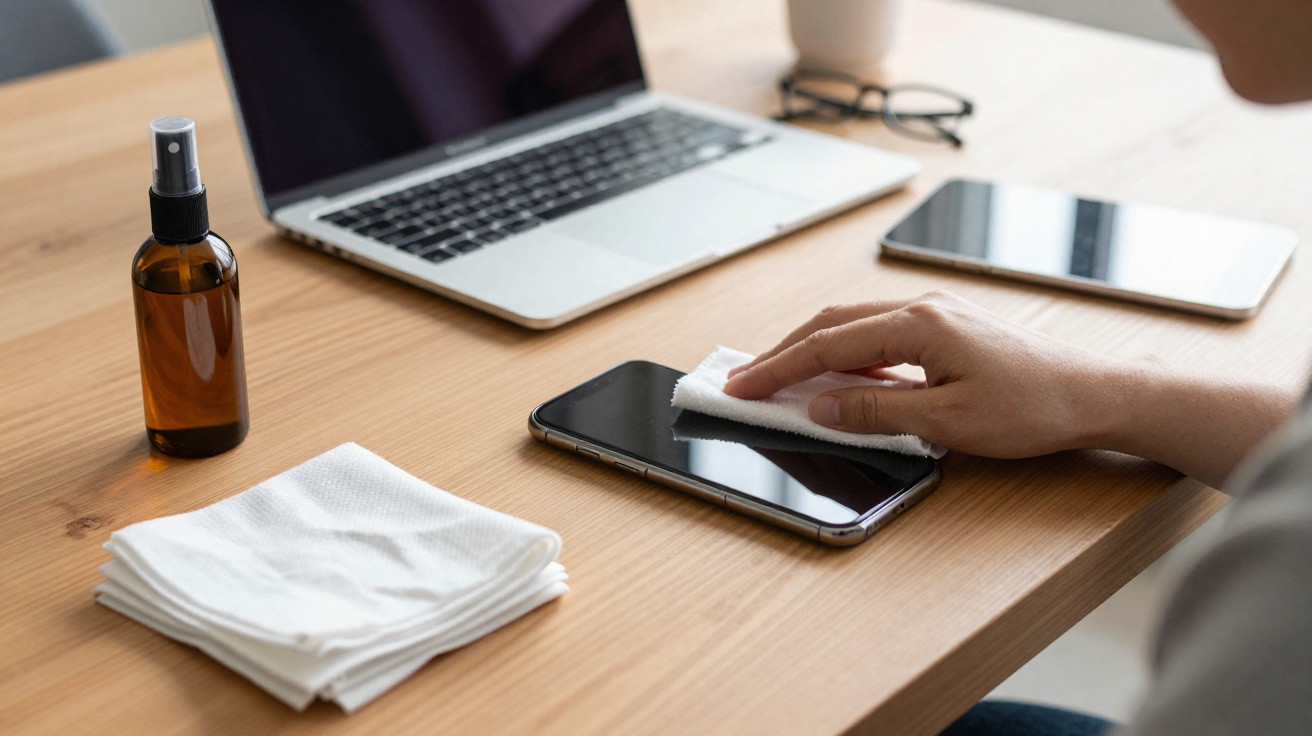
She took a tissue from her bag, breathed heavily on her phone screen and rubbed it in panicked circles as she waited for her latte. When the drink arrived, the glass appeared “clean” – shiny and free from fingerprints. What she could not see was the gradual harm she had caused to the invisible coating that makes the screen smooth, easy to wipe and somewhat protected.
At a table nearby, a student cleaned a £1,200 laptop using the edge of his hoodie. A father reached for kitchen roll to wipe his child’s tablet. A suited man polished his smeared smartwatch against his trouser leg. Screens lit up the room – along with countless tiny scratches nobody could see.
We believe we are looking after our gadgets. In reality, we may be damaging them bit by bit.
Why your screen is more fragile than it looks
Today’s screens may seem to be made from a single solid sheet of glass, but they are more like a layered cake. Above the glass is an ultra-thin protective finish, commonly known as an oleophobic coating. It is what allows fingerprints to slide away with a light wipe. It is also the layer most vulnerable to poor cleaning routines.
Rather than flaking or peeling away like paint, this coating wears away unevenly. At first, everyday smudges appear to stick slightly more than before. Later, particular areas always seem greasy. Before long, you have to rub harder. That is when many people turn to rougher cloths or more powerful products, accelerating the wear yet again. Slowly. Constantly.
Your screen has not simply “got worse with age”. In many cases, it has been scrubbed into an early retirement.
A repair technician in London told me he can identify a “tissue cleaner” almost instantly. Scratches are not the only giveaway – the glass reflects light in an unusual way. On some phones, one half of the display still retains its coating while the other looks flat and sticky. The boundary often follows the area most frequently swiped by thumbs, made worse by unsuitable cleaning.
One student brought in an almost new tablet, convinced there was a fault with its display. The colours were normal. The brightness was normal. What had disappeared was its soft, silky finish. She had cleaned it twice daily with kitchen roll and a generic glass cleaner. The coating never stood a chance.
Manufacturers seldom make a big deal of this. An oleophobic layer sounds delicate, and delicacy is not a selling point for smartphones. Still, it is present on nearly every premium device. Screens have become more resistant to major impacts than ever, yet these microscopic layers remain highly vulnerable to chemicals, paper fibres and coarse materials.
Treat your screen as you would non-stick cookware. A pan remains usable once its coating is gone, but it becomes more difficult to clean, food sticks to it and the lost layer cannot be restored. You cannot wipe a non-stick surface back into existence. Nor can you wipe an oleophobic coating back on.
The right way to clean a screen without damaging it
The safest approach is almost absurdly straightforward, which may explain why it is so often overlooked. Begin with a clean, dry microfibre cloth – the kind used for spectacles. Avoid kitchen roll, tissues and old T-shirts. Use gentle pressure and wipe in straight strokes or light circles. For recent smudges, this will normally be sufficient.
For marks that will not shift, moisten one corner of the cloth very slightly with plain water. It should not be wet enough to drip, only barely damp. Wipe softly, then use the dry section to finish. Nothing else is required. Skip glass cleaner, alcohol wipes and the window spray beneath the sink. Your screen may not sparkle like one on a shop display, but it should last longer.
With a laptop, switch it off before cleaning. This is not only safer: a dark display makes streaks easier to spot. Leave the edges until last, as dust often collects there, and do not force moisture towards ports or speaker grilles. Keep every movement light, patient and almost lazy.
For phones, the most frequent “crime” is frantic cleaning after food, make-up or sticky fingers. People use whatever is nearest – napkins, wipes or even baby wipes containing lotions. These are the moments when protective coatings break down most rapidly. Keeping an unremarkable microfibre cloth in a bag or desk drawer is the best defence against this kind of chaos.
We have all watched somebody attack a phone as though they were removing burnt cheese from a pan. The impulse is understandable: they want everything spotless. Glass is the source of the problem, because it inspires too much confidence. It feels sturdy. It appears impossible to damage. One brisk, forceful rub seems inconsequential.
Cleaning products are another issue. There are multi-surface sprays that promise a “streak-free shine”, alcohol wipes from the office cupboard and disinfectant sprays used after a cold. Applied very occasionally, in minimal amounts and with an appropriate cloth, they may not destroy a screen overnight. Used every week with tissues or paper towels, however, they certainly can.
Months later, people seldom make the connection when a screen begins to feel tacky or develops marks that never quite wipe away. They blame the manufacturer, or “cheap glass”. The sad reality is that a £2 cloth might have preserved that silky, new-screen sensation for years. Let’s be honest: nobody really does that every day.
There is also a subtle emotional element. Screens serve as our mirrors, maps, wallets and photo albums. When they begin to look worn, we can feel strangely guilty, as though we have “used them wrong”. That guilt leads some people to clean more frequently, rub with greater force and experiment with stronger products. It becomes a quiet cycle of good intentions and mounting damage.
“Most people don’t destroy their phone screens by dropping them,” says Mark, who runs a small repair shop in Birmingham. “They destroy them with love and kitchen roll.”
Here is a quick reference guide to keep in mind whenever you face one of the glowing rectangles in your life:
- Use: a soft microfibre cloth, light pressure and plain water where necessary.
- Avoid: tissues, kitchen roll, glass cleaner, disinfectant sprays and rough fabrics.
- Frequency: gentle daily wiping is fine; intensive scrubbing should be almost unheard of.
The aim is not a showroom shine; it is a screen that still feels new in two years’ time.
Living with imperfect screens and making them last longer
A wider issue sits behind all this discussion of cleaning. Screens cost a great deal, both financially and environmentally. Every phone or tablet replaced prematurely because its display feels “ruined” becomes another device left in a drawer, another item moving closer to electronic waste.
We live among technology designed to look immaculate straight out of the box. Removing the factory film for the first time has become a small modern ritual. From then on, the decline begins. Smudges accumulate, micro-scratches emerge and the coating gradually fades. Perhaps the answer is to accept screens that are “good enough”, while learning not to hasten their deterioration.
Discussing cleaning habits can sound painfully insignificant. Yet these habits affect how long our devices remain enjoyable to use. A slightly streaky screen that has been properly maintained is better than one scrubbed “perfectly” until its protective surface has worn away. We do not need more cleaning products. We need softer hands and fewer harsh shortcuts.
The next time you notice someone aggressively polishing their phone with a napkin, you may wince a little. Perhaps you will offer them a microfibre cloth, partly joking and partly serious. Or perhaps you will simply put one in your own pocket – a small gesture towards a future you with a screen that is still smooth.
How we handle these glowing panes reveals much about our relationship with the objects we depend on each day. A little more care and a little less force can make a difference. Your thumbs, your eyes – and your bank account – will notice.
| Key point | Detail | Why it matters to the reader |
|---|---|---|
| Coating vulnerability | Oleophobic layers are thin and sensitive to chemicals and abrasive materials | Understand why familiar “good habits” can damage a screen |
| Gentle cleaning method | Microfibre, plain water, light movements and no aggressive products | Follow a simple routine that keeps a screen smooth for longer |
| Long-term impact | Fewer “tired screen” sensations and fewer early replacements | Save money, improve everyday use and reduce electronic waste |
FAQ:
- Can a damaged oleophobic coating be repaired at home? Not really. Certain products claim to “restore” it, but they can only provide a temporary layer that does not perform like the original coating and quickly wears away.
- Are alcohol wipes always harmful to screens? When used rarely, very lightly and with a soft cloth, they are not disastrous, but frequent use can accelerate the deterioration of protective coatings.
- Is a screen protector better than the built-in coating? A high-quality screen protector provides a sacrificial layer that can be replaced, although it may alter the feel slightly compared with uncovered glass.
- Can paper towels genuinely scratch glass? Paper fibres, dust and tiny mineral particles caught in them can cause micro-scratches and gradually wear down coatings.
- How often should I properly clean my phone screen? For most people, a gentle microfibre wipe every day or two is enough; thorough cleaning is only necessary when something obviously sticky or greasy gets onto it.




Comments
No comments yet. Be the first to comment!
Leave a Comment