
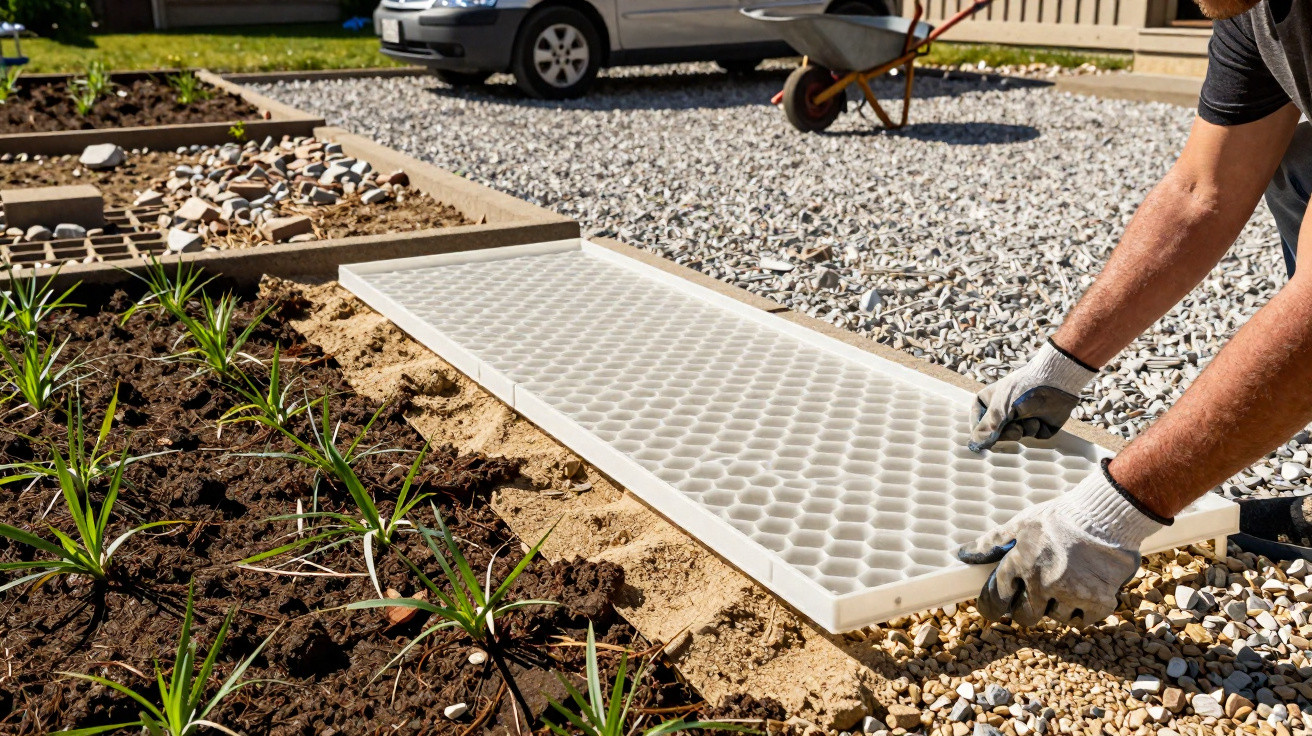
Paths, patios and garage approaches: a discreet surfacing option is appealing to homeowners who want to stabilise outdoor areas without making them completely impermeable.
When a garden route turns into a muddy mess every time it rains, a concrete slab or paving is not the only answer. Honeycomb grids can be laid and filled with natural materials to form a usable surface while allowing water to drain back into the ground. The finished area may resemble a gravel path, a grassed track or a space covered with wood chips.
A straightforward way to stabilise unstable ground
These panels are rigid grids, commonly made from recycled plastic. They interlock to create one continuous surface. The cells are then filled with the selected material: gravel, topsoil and grass, or wood chips.
This structure performs two functions. It stops the infill from spreading under foot traffic, wheelbarrow wheels or car tyres, while also distributing pressure across a wider area. Gravel laid directly on soil often sinks, shifts outwards and leaves dips behind. A grid keeps the stones more securely in position.
“The surface does not trap water above ground: its gaps and free-draining materials encourage water to soak into the soil.”
This option is particularly relevant for homeowners with a regularly used part of the garden. It can be used for a house entrance, a route to the vegetable garden, an area for wheelie bins, access to a garden shed or occasional parking.
Gravel, wood chips or grass: three distinct finishes
The choice of infill is about more than appearance. Each material suits a particular purpose and comes with different maintenance needs.
- Gravel is suitable for paths, entrances and areas used by vehicles. It creates a firm, free-draining finish.
- Wood chips provide a more natural-looking setting. They work well in gardens, around a vegetable plot or on a lightly used path.
- Grass retains a planted appearance. It is suited to reinforced lawn areas, especially for occasional parking.
For a gravel path, a consistent aggregate size is generally selected, avoiding stones that are either too fine or too large. Very small stones can escape from the cells, whereas oversized gravel makes walking less comfortable. A size between 6 and 16 millimetres is commonly used to maintain a stable surface.
Grass needs time to establish
A grass grid will not turn green overnight. Once the panels have been installed, the cells are filled with topsoil and then seeded or fitted with turf. Regular watering is needed during the first few weeks, and heavy use should be avoided until the roots have become established.
This solution remains useful where the aim is to reduce the visual impact of hard surfacing. It may suit a parking space used only a few days each week. In a heavily shaded or permanently damp area, however, grass may struggle even with the support of the honeycomb cells.
Ground preparation makes all the difference
The grids cannot, by themselves, remedy poorly prepared ground. Before installation, loose soil, roots and large stones need to be removed. The excavation depth depends on the project: a simple pedestrian route requires less preparation than an area intended to carry a car.
For a gravel driveway or path, a compacted foundation layer is often required. This may consist of crushed aggregate. The base prevents ground movement and helps reduce rutting. A geotextile membrane installed between the soil and foundation layer slows weed growth while still allowing water through.
- Clearly mark out the area to be surfaced.
- Excavate the ground to a depth suited to its intended use.
- Level and compact the base.
- Fit a geotextile membrane and a drainage layer where needed.
- Interlock the panels, checking the level regularly.
- Fill the cells without overfilling them.
A slight fall can help direct water towards a permeable part of the garden. The aim is not to create a completely sealed surface, but to prevent standing water in front of a door or at the base of a gate.
An answer to muddy ground and scattered gravel
In many gardens, repeated traffic compacts the soil. Water then infiltrates less readily and collects in footprints or wheel marks. Over time, the route becomes slippery and mud is carried into the house. Honeycomb grids help reduce this issue by holding the finish material within a stable framework.
The system can also reduce gravel scatter. Without edging or support, stones are carried onto the lawn, patio or street. The grid does not eliminate the risk entirely, particularly near a frequently used gate, but it significantly slows the spread.
Consider the intended load
Not every grid is designed to withstand the same weight. Some are made for pedestrians, bicycles and wheelbarrows, while others are rated for cars. Before buying, the manufacturer’s stated intended use should be checked, along with the quality of the foundation beneath the panels.
A product designed for a garden path should not be fitted beneath a motorhome or heavy vehicle. Even a strong grid may fail when it sits on waterlogged, uncompacted soil. Stability relies as much on the prepared ground as on the product itself.
Low-maintenance, but not maintenance-free
A stabilised path requires little day-to-day work. Leaves, soil and debris can collect among the gravel. A leaf blower, light rake or broom is often enough to tidy the surface. After several seasons, some additional gravel may be needed, especially in turning and manoeuvring areas.
Wood-chip surfaces need topping up more often. The material naturally breaks down and loses volume. Although this process feeds the soil, the cells must be refilled to keep the surface comfortable to walk on.
With a grassed surface, mowing should be kept reasonably high to protect young shoots within the cells. Grass cut too short may turn yellow more quickly during a dry summer. In a parking area, varying where vehicles are parked also helps avoid repeated marks.
“The honeycomb grid works like an unobtrusive framework: it stabilises the route while allowing the garden to retain some of its natural appearance.”
This method can also be combined with edging, stepping stones or low-level lighting along the path. Together, these features organise the garden without imposing the heavy look of a continuous slab. For plots where rain quickly turns every journey into a slippery route, this solution provides a practical balance between usability, drainage and landscape integration.






Comments
No comments yet. Be the first to comment!
Leave a Comment