
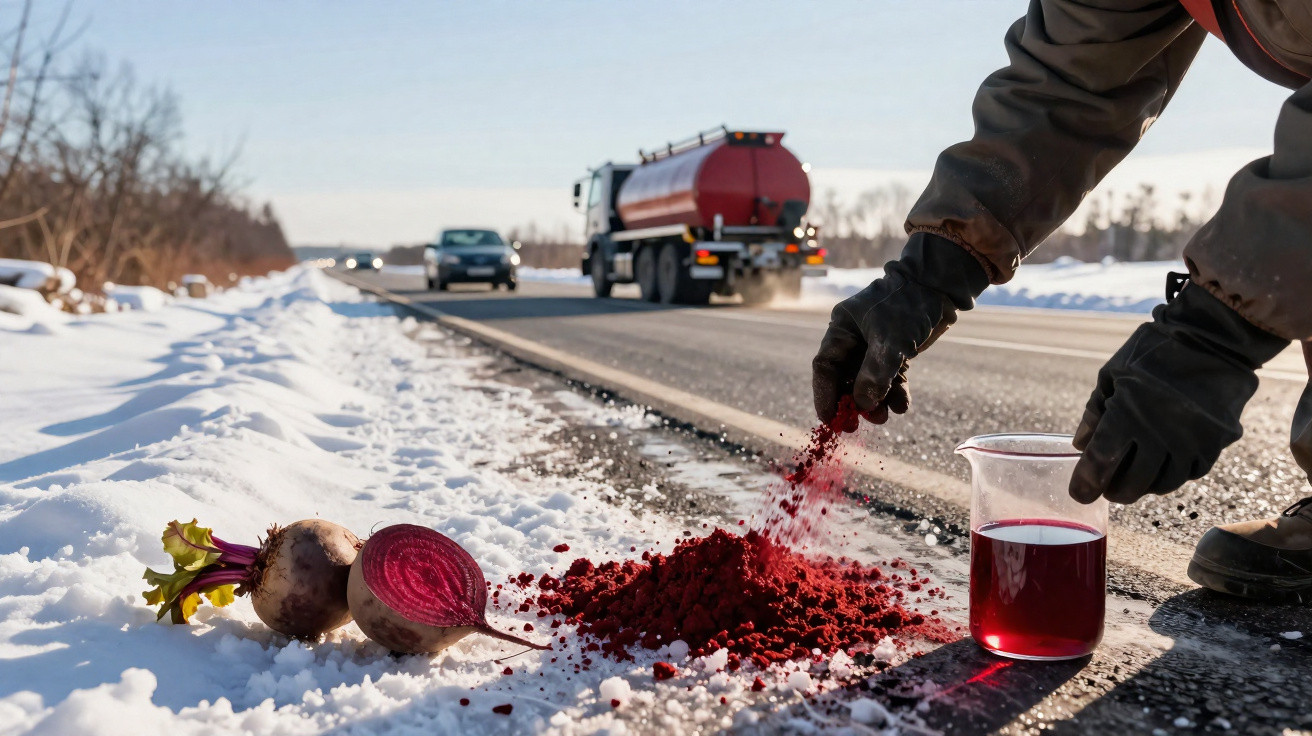
There is no accident behind it – but a rather clever idea.
At first glance, it looks like a bad joke: local authorities pour beetroot juice onto roads and call it winter maintenance. Yet in some parts of the US and Canada, the method has become a standard part of highway maintenance teams’ toolkit. What is behind the red liquid on the tarmac – and could it work in Germany too?
Beetroot instead of road salt: what actually goes onto the road
Nobody, of course, is heading to the supermarket, buying jars of pickled beetroot and emptying them onto the carriageway. What is used is a by-product of sugar beet or beetroot processing: a thick, reddish-brown liquid residue left after sugar or juice has been extracted.
A company in the Canadian province of Ontario discovered its potential more or less by chance. Its employees noticed that this residual juice did not freeze even at extremely low sub-zero temperatures. That observation led to the idea of using it as the basis for a new de-icing agent.
Industrial waste became a skid-resistant “road cocktail” that is now standard in several North American cities.
In Washington, parts of the US East Coast and cities including Winnipeg in Canada, road-clearing services deliberately spray the mixture onto roads and bridges before winter weather arrives.
How the anti-skid beetroot juice mixture works
The road treatment is generally based on a straightforward formula:
- around 60% beetroot or sugar beet juice
- about 30% water
- roughly 10% salt, usually in solution rather than as granules
It is applied preventively from spray vehicles, often several hours before snow or ice is forecast. The liquid forms a thin layer across the surface and adheres well to the tarmac.
Why snow and ice do not stick as easily
The key is that the sugar in beetroot juice lowers the solution’s freezing point. Combined with salt, it produces a kind of “super-brine” that tolerates far lower temperatures than an ordinary salt solution.
As a result, snow and ice bind less firmly to the road surface, can be removed more easily by ploughs and are less likely to create a compact, glassy layer.
The beetroot mixture acts like a separating film between tarmac and ice – the road does not become completely dry, but it remains much easier to manage.
Benefits compared with conventional road salt
The technique offers several practical advantages, particularly for transport planners and local authority finance officers.
Much more effective in severe sub-zero temperatures
Conventional road salt rapidly becomes less effective at very low temperatures. Below around –10 to –12 °C, mechanical clearance is often the only option left. The beetroot mixture works across a much wider temperature range:
- conventional salt brine: usually effective down to around –10 to –12 °C
- beetroot mixture: usable down to approximately –28 °C
This is especially beneficial in areas with a continental climate, such as much of Canada and the northern US Midwest.
Lower cost per tonne
As the juice is already produced as an industrial by-product, its raw-material costs are low. Reports suggest that North American local authorities pay around one tenth of the cost of conventional road salt per tonne for the beetroot mixture.
What was once regarded as waste now saves genuine winter-maintenance budget – a classic case of “waste becomes a raw material”.
Less damage to vehicles and infrastructure
Road salt eats into vehicle bodywork, damages bridges, attacks concrete and makes fences and crash barriers rust faster. The beetroot mixture is considerably less corrosive, helping to protect:
- vehicles used by commuters, delivery services and police
- bridges, tunnels and railings
- road markings and tarmac surfaces
Over time, this can reduce maintenance and repair costs for local authorities – an argument that carries weight in budget discussions.
Environmental benefit: less salt, better for soils and watercourses
The liquid mixture still contains salt, but uses substantially less per square metre of road. The juice’s organic components are biodegradable. This reduces the burden on:
- soils beside roads
- groundwater and streams
- trees, shrubs and urban green spaces
Road salt often leaves conifers brown in spring and creates bare strips alongside roads. The beetroot cocktail measurably reduces this damage.
Are there any drawbacks? Key concerns to consider
The method is not entirely without downsides. Its reddish colour alone has prompted debate: residents in some cities were puzzled by what looked like “bloody roads”. Authorities first had to explain what had been sprayed.
Local authorities must also address several other issues:
- Smell: The juice may have a mildly sweet or earthy odour, particularly during thawing conditions.
- Staining: Residue can leave vehicles and clothing slightly brownish, although it can usually be washed off.
- Logistics: Storing and spraying liquid requires different equipment from traditional salt stores and gritters.
Switching to the beetroot mixture is not a minor update for authorities, but a complete change to winter maintenance.
Why beetroot juice is still rarely used on European roads
While the approach has become established in several North American regions, it remains unusual in Europe. In Germany, towns and local authorities still mainly rely on the following measures:
- traditional de-icing salt with grit
- brine-spraying methods on heavily used routes
- grit or sand alone in especially sensitive areas
There are some trials in Germany involving alternative de-icing agents, including sugar or molasses solutions from beet processing. However, widespread use of beetroot or sugar beet juice has not yet materialised.
The irony: Germany has plenty of raw material
Ironically, the method remains on the shelf in one of the world’s largest sugar beet-growing countries. Germany produces huge quantities of sugar beet, as does France. This means there would be ample by-products available that could be suitable for de-icing.
The responsibility lies with local authorities, regional agencies and winter-maintenance contractors. They would need to launch pilot schemes, adapt their equipment and build experience of how the mixture performs in European weather conditions.
What beetroot-treated roads feel like for drivers
People driving on a road treated with the beetroot mixture will generally notice no difference, apart from a slightly darker, sometimes reddish sheen on the tarmac. Its impact becomes most apparent by comparison:
- fewer sudden sheets of ice
- snow can be cleared more quickly
- the carriageway remains easier to manage in very low temperatures
Even so, winter remains winter: speed limits, greater following distances and driving to the conditions still apply with this mixture. The liquid improves safety; it is not an invitation to drive fast.
The chemistry behind the effect
For anyone wanting a closer explanation, salt and sugar alter water’s properties. When both are dissolved in it, they lower its freezing point. Water therefore needs much lower temperatures before it turns to ice.
Sugar molecules and salt ions “disrupt” the formation of ice crystals. The beetroot solution consequently prevents meltwater from quickly becoming a continuous, hard layer of ice. Instead, it is more likely to form a slushy covering that clearing vehicles can remove more easily.
Where the method could matter in future
Cities facing frequent cold snaps but limited budgets are already taking a closer look. Potential applications include:
- bridges and slip roads that freeze especially quickly
- steep roads on hillsides
- critical motorway sections with a known risk of sudden black ice
- regions with a continental climate and long periods of frost
At the same time, political pressure is growing to reduce salt use and limit environmental impacts. The beetroot mixture fits well into strategies for climate-adapted, sustainable winter maintenance.
So if you see photographs of reddish roads during snowfall while on holiday or on social media in future, you are not looking at a quirky art project, but at a highly practical experiment: vegetable waste used as a weapon against black ice. Whether this idea makes the leap from North America to German roads will depend above all on local authorities having the confidence to take new approaches to winter maintenance.





Comments
No comments yet. Be the first to comment!
Leave a Comment