
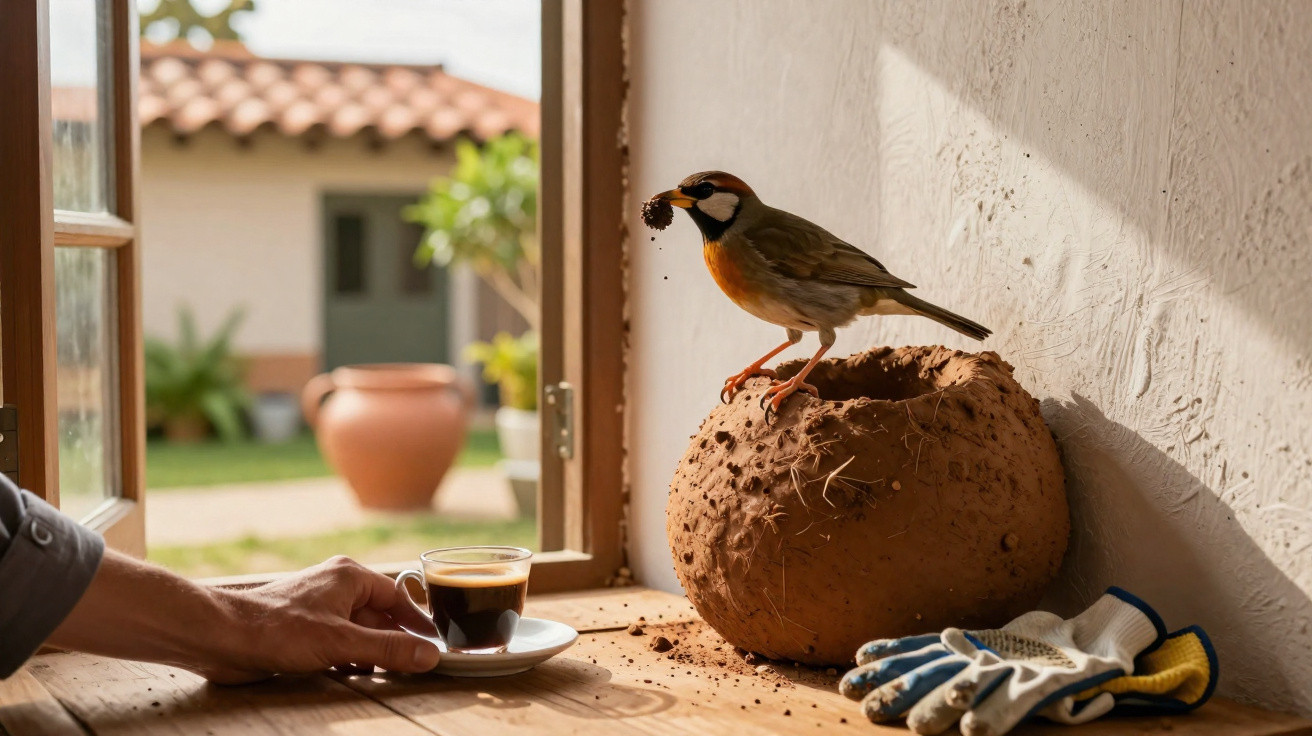
Rufous horneros nesting close to a home nearly always draw attention, both for the care evident in their handiwork and for the symbolic weight attached to the nest. In back gardens, gardens and on verandas, this kind of mud-built structure generally shows that the site provides shelter, a solid support, nearby food and little disturbance - all valuable signs for people who watch nature closely.
What does a newly built mud nest reveal about the surroundings?
A mud nest does not appear by chance. Rufous horneros select sites according to their structure, safety and access to mud, grass, insects and perches. When a bird chooses to build on a wall, post, tree or eaves, it is responding to specific features of that microhabitat.
In practical terms, this is usually good news. The presence of a rufous hornero indicates that small invertebrates are active in the soil, that the space has a degree of stability and that the pair can keep watch over the area. Rather than being a bad omen, it points to a lively garden with resources for breeding, foraging and resting.
Are there superstitions associated with this bird?
Superstitions surrounding the rufous hornero are longstanding and differ from one region to another. Some people regard its nest as a sign of good luck, domestic prosperity and protection for the home. There is also a popular belief that the direction of the entrance can predict wind, rain or a change in the weather, although this is not a reliable rule.
These beliefs grew out of everyday contact with a bird that is highly visible in both rural and urban landscapes. Because the rufous hornero builds a durable shelter and often returns to favourable places, its image of constant work, pair bonding and permanence has fostered positive superstition far more than any notion of danger.
What should you do if a rufous hornero builds in the garden or on the roof?
The best approach is not to interfere. A recently completed nest may still need alterations, time for the mud to dry and frequent visits from the pair, so sudden activity and building work nearby can be very disruptive.
- Do not touch the structure, even if its outside seems dry.
- Avoid pruning, high-pressure washing and loud noise within a few metres.
- Keep dogs and cats away from the base of the wall, tree or veranda.
- Watch from a distance, ideally without flash photography or daily close approaches.
If the nest is in a sensitive position, such as a frequently used gate or on equipment, it may be worth cordoning off the route for a few days. Rufous horneros often leave sites that experience too much disturbance. Protecting the area at this stage improves the chances of egg-laying, incubation and raising the chicks.
Why is the presence of a rufous hornero usually considered positive?
When nature chooses a residential space for nesting, it is responding to signs of ecological suitability. The rufous hornero requires material to collect, edges on which to perch, a reasonably clear view and prey available on the ground. A garden with these features is generally more functional for birds, insects and the small ecological processes of everyday life.
There are straightforward benefits for the people living there:
- more opportunities to watch birds in the garden and a daily routine more connected to the local breeding cycle;
- greater appreciation of trees, flower beds, hedges and areas of damp, exposed soil;
- increased awareness of rain, wind, the breeding season and wildlife activity;
- the presence of a native species that is highly adapted to living alongside people.
How can you live alongside this visitor without disrupting the natural cycle?
Living alongside a rufous hornero is simple: keep your distance, maintain relative quiet and look after the garden carefully. Avoiding excessive insecticide use, retaining patches of damp soil and keeping useful vegetation nearby will help more than any artificial attempt to attract the bird.
When a mud nest appears at a home or in a garden, the clearest message comes not from superstition but from an ecological reading of the site. It has enough shelter, resources and stability to support a sensitive stage of reproduction. For anyone attentive to nature’s rhythms, this is usually one of the most positive signs a domestic space can offer.



Comments
No comments yet. Be the first to comment!
Leave a Comment