
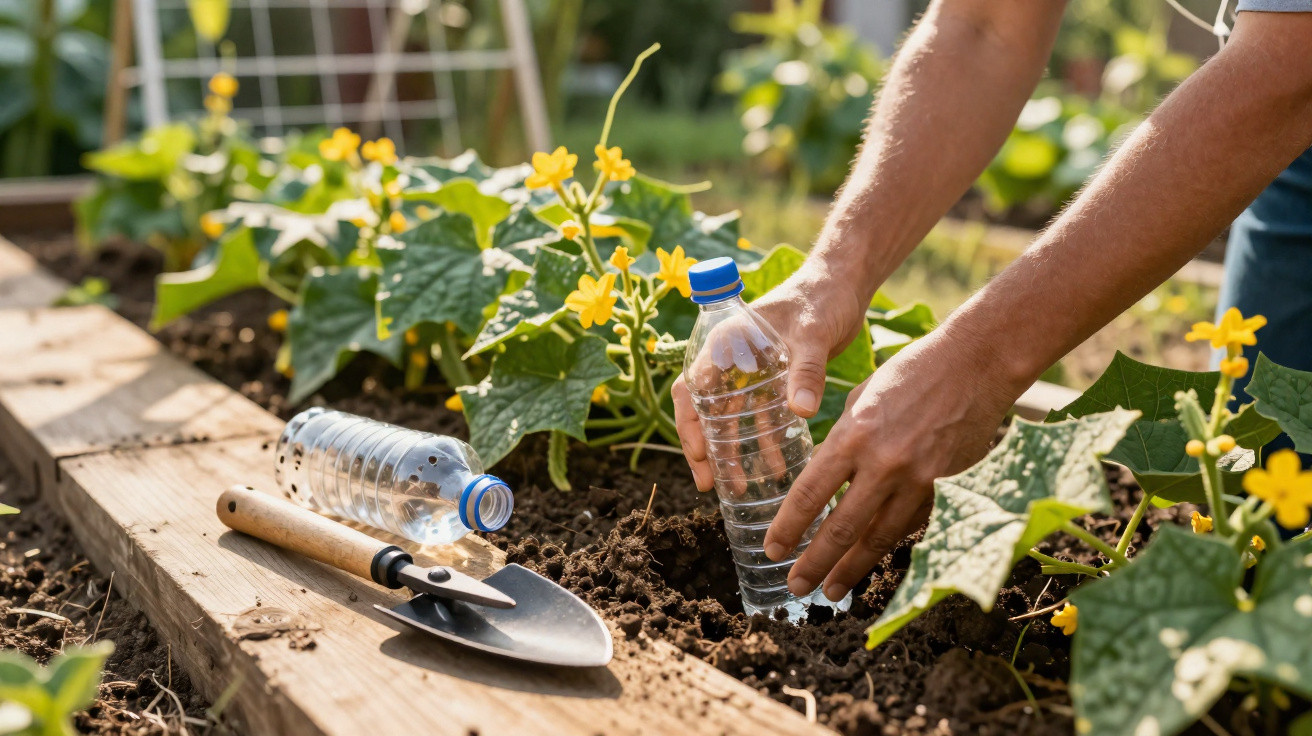
The day had barely begun, yet the heat was already pressing down like a sticky blanket over a small terraced-house back garden. The cucumber leaves drooped, slightly curled, as if they’d had too little sleep. Their owner-mid-fifties, barefoot on grass that was still cool-stared at the beds, unsure what else to do. Water, water, water… and still, on hot days, the plants kept tipping back towards the edge of drying out. The water ran past the little ridges, or vanished into the air.
With a quiet sigh, her gaze drifted over the fence. Next door, the cucumbers stood lush and green, as though a private well sat beneath them. No fancy kit, no drip system-just a few old plastic bottles, neck-down in the soil. Almost comically basic. Yet that moment-one small jab of envy mixed with curiosity-often changes how we think about gardening. The cucumbers won’t say it out loud, but on scorching days this bottle trick is close to a life insurance policy for them.
Why cucumbers flag in summer faster than we’d like
Anyone growing cucumbers knows the quiet drama of a heatwave. They look firm in the morning, go limp by lunchtime, and by evening you’ve rescued them only halfway with frantic watering. Cucumbers root shallowly and crave moisture more than most vegetables. Once the top layer of soil dries, they slip into stress very quickly. You’ll spot it in sagging leaves and small fruits that simply refuse to bulk up. The very summer that draws us outside can become a real test for cucumbers. And, honestly, nobody can patrol the beds with a watering can every two hours.
In plenty of gardens the pattern is the same: the hose goes on full blast, the surface floods, water streams over the edge of the bed, some sinks away somewhere, and the roots get only a brief taste. On sunny, sandy soils it’s worse still-the water practically races straight through. The result is a plant that often looks watered, yet swings internally between drought stress and oversupply. It’s a bit like living on coffee all day and then wondering why you still feel dried out. We know it isn’t great for us-and it isn’t great for cucumbers either.
From the plant’s point of view, that reaction is logical. The fine roots just below the surface are delicate, and heat quickly bakes the top layer hard. When water arrives too quickly and in large amounts, it doesn’t spread evenly into deeper layers. Cucumbers answer with stress signals: fruit turns more bitter, flowers drop, leaves become more vulnerable. If you’ve ever watched closely, you’ll notice how strongly the plant reacts to tiny changes. So the fix needs to be quieter, steadier, and closer to the roots. Nothing flashy-more like a good neighbour who waters while you’re at work. That’s exactly where the old plastic bottle comes in.
The bottle trick: turning waste into a quiet irrigation system
The principle sounds almost too basic to take seriously: an empty plastic bottle becomes a mini drip irrigator. Take a standard water or juice bottle-1.5 or 2 litres is ideal. Using a hot needle or a thin nail, make several tiny holes in the cap. Keep them small, around pinhead size.
Next, cut off the bottom of the bottle completely, or slice it enough that you can refill it later like a little funnel. Then push the bottle into the soil next to the cucumber plant with the neck pointing downwards, about 10–15 cm deep. Fill it with water-and after that, it largely looks after itself.
Most people seeing it for the first time are doubtful. Water from a bottle-can that possibly be enough on a 35 °C day? The key isn’t sheer volume, but the pace. Through those tiny holes, the water seeps slowly into the soil right where cucumber roots can take it up best. Unlike hurried watering from above, the root zone stays evenly moist, without the surface repeatedly drying out and cracking. Another advantage often becomes obvious during the first spell of real heat: while the sun beats down relentlessly, the bottle keeps releasing water calmly in the background. The plant barely registers that it’s “burning” outside.
There’s a surprisingly practical logic behind this simple bit of DIY. Water released gradually can move through the soil instead of evaporating pointlessly. The moist zone spreads, and the plant adapts by following it-almost like a training programme for cucumber roots. Rather than lingering in the dry crust near the top, they’re encouraged to explore deeper. And let’s be realistic: most home gardeners aren’t installing expensive irrigation systems for every row of cucumbers. An old bottle, a few holes in a cap, and a little patience fits real life-where the garden is loved, but can’t be the centre of attention all day.
How to set up bottle watering without stressing your cucumbers
This method works best if you introduce it early in the season. When you plant your cucumbers, dig a second hole beside each planting hole, about a hand’s width away. Insert the bottle vertically with the neck pointing down. The cap with the holes should sit within the root area, and the cut-off base should remain above the soil so you can refill it.
Then fill the bottle slowly until it’s full. At the start, watch how quickly the water level drops. If it disappears within minutes, the holes are too large. If it takes hours, you’re in the sweet spot. Done this way, you create a quiet reserve that noticeably eases the strain on cucumbers during hot spells.
Of course, it doesn’t always go perfectly. A common mistake is placing the bottle too close to the stem and accidentally damaging young roots as you push it in. It’s better to keep a small gap-around 10 cm from the plant. Another trap is getting the hole size wrong. If the holes are too tiny, the cap can clog, especially in areas with hard, limescale-heavy water. If they’re too big, you’re back to the same problem as hose watering: a brief flush with no lasting effect.
Many gardeners add a splash of nettle feed or a diluted liquid fertiliser when refilling. Cucumbers respond well to that extra “food in water”, so the trick can work double-duty.
Over time, this simple setup gives you a real feel for how much a cucumber actually needs. An experienced allotment gardener from Brandenburg put it like this:
“Since the bottles have been in the soil, I water less often, but with more intention. The cucumbers stay plump even after three sweltering hot days. Before, it was always a gamble.”
To help this bottle trick carry your cucumbers through summer, it’s worth keeping a short mental checklist:
- Set the bottles up by planting time at the latest, so roots grow towards them.
- Every few weeks, check that the holes in the cap are still clear.
- During heatwaves, check the fill level morning and evening-out of routine, not guilt.
- Mulch around the plant so moisture from the bottle doesn’t escape straight back up.
- Watch the plant itself: firm leaves and steady growth show the system is working.
Why this small hack changes more than just the cucumber harvest
Once you’ve seen how calmly cucumbers can get through a week of intense heat with a hidden water source, you often notice another shift too. Your relationship with the garden moves from “constant emergency” towards something more dependable. Instead of spending every warm summer evening compensating with a watering can after work, you do a quicker, calmer round-checking, feeling the soil, learning.
Cucumbers become a quiet indicator: if they’re richly green, growing evenly and tasting less bitter, the soil conditions are generally right. And an old plastic bottle turns into something symbolic-a small promise that you don’t have to be perfect to get your plants safely through summer.
| Key point | Detail | Benefit for the reader |
|---|---|---|
| Slow water release directly at the roots | A plastic bottle with a pierced cap is placed upside down in the soil beside the cucumber | Cucumbers receive steady moisture and suffer less stress in hot weather |
| Less time spent watering | The bottle acts as a reservoir, releasing water over several hours | Daily life feels easier, even for people working full-time or away briefly |
| Upcycling instead of buying new | Old drinks bottles are used instead of costly irrigation systems | Saves money, reduces waste, and makes it easy for beginners to start growing veg |
FAQ:
- Question 1 How many bottles do I need per cucumber plant? In most gardens, one bottle per plant is enough. On very sandy soils, a larger bottle placed between two plants can make sense.
- Question 2 How deep should I bury the bottle? The bottle neck should sit about 10–15 cm deep so the water reaches the root zone.
- Question 3 Which bottles work best? Sturdier PET water or juice bottles last longer. Thin single-use bottles can crease sooner, but still work in the short term.
- Question 4 Can I add fertiliser to the bottle? Yes-well-diluted liquid fertilisers or plant feeds work well. Nutrients go straight to the roots and are released evenly.
- Question 5 Does the trick work for other vegetables? Yes. Tomatoes, courgettes and peppers benefit in a similar way. Cucumbers simply show the effect most clearly, so you notice it fastest there.

Comments
No comments yet. Be the first to comment!
Leave a Comment