
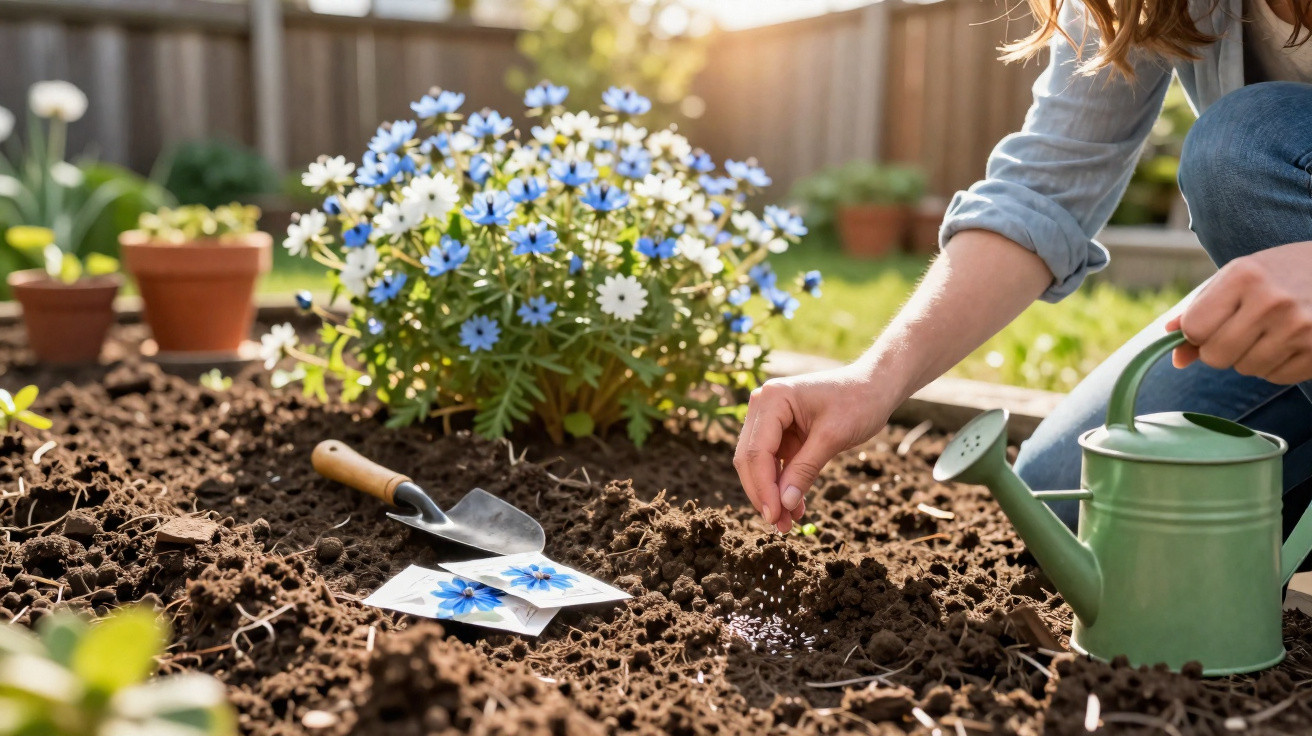
Many amateur gardeners look out in March at beds that still feel flat and lifeless, then wonder how to turn the space into something bright and full of movement-quickly. One particular summer annual can do exactly that: sow it once and, for weeks on end, it produces light, colourful clouds of flowers with very little effort.
The March secret weapon for your borders: what makes love-in-a-mist so special
The plant in question is love-in-a-mist (Nigella damascena), sometimes also referred to as Damascus nigella. If you have grown it once, it tends to stick in your memory. Its fine, star-like blooms hover above thread-like foliage, as though someone has swept a watercolour brush across the bed.
On average, plants reach 40–60 cm in height. Flower colours range from soft sky-blue through white to faintly rosy shades. Because the leaves are so delicate, it never looks heavy; instead it reads as airy and natural-almost like a wildflower you might find in an old orchard meadow.
If you sow in March or very early April, flowering usually begins from mid-June and often continues until the end of August-and in mild years, even into September. That is precisely why it is so useful for bridging the otherwise dull gap between spring and high summer.
"If you sow love-in-a-mist directly into the bed in March, you’ll get an almost continuously flowering, low-maintenance ribbon of delicate blooms from June well into late summer."
Many gardeners say they only had to sow it intentionally once. In the years that follow, it often appears again "on its own" in suitable spots-here one year, there the next-like a pleasant surprise.
Why March is the ideal time
Love-in-a-mist is one of those tough, annual summer flowers that copes well with cooler conditions, which makes it especially appealing for an early sowing. As soon as the harsh frosts have passed and the soil begins to warm, it gets moving.
Sowing in March also plays to a natural advantage: seeds germinate reliably in moderate temperatures, young plants stay compact and sturdy, and by the time the first real summer heat arrives they have already built a solid root system. That, in turn, noticeably reduces how often you need to water.
- Happy to germinate in cooler weather: the seedlings handle typical chilly March nights well.
- Extended flowering period: an earlier start usually means an earlier first flush-and a longer season overall.
- Great for beginners: if you are new to gardening, this is an easy way to see quick results.
Experienced growers often describe it as "easy-care and uncomplicated". It does not demand a specialist soil: ordinary garden ground is usually enough, and it will forgive the odd minor mistake.
How to sow in March, step by step
The best part: you do not need a greenhouse or an expensive set-up to grow love-in-a-mist. A sunny spot and a few spare minutes are enough.
Choose the right position
A sunny location is ideal. Partial shade can work, but flowering is often a little less generous. The main requirement is loose, free-draining soil. The plant really does not tolerate waterlogging.
Prepare the soil-done in minutes
Before sowing, a brief bit of prep helps set everything up for success:
- Remove weeds and any leftover roots thoroughly
- Loosen the surface with a rake or hand trowel and break up clods
- If the soil is very poor, work a little well-rotted compost into the top layer
Aim for a surface that is as fine and level as possible, so the seed makes good contact with the soil.
Sow properly and keep spacing in mind
Sow directly outdoors. Starting on a windowsill is unnecessary and can be awkward because the seedlings quickly become leggy.
- Scatter the seed lightly over the prepared area-either in rows or broadcast.
- Cover only very thinly with soil or fine compost; a few millimetres is plenty.
- Press down gently with your hand so the seed sits firmly against the soil.
- Water with a fine rose so nothing washes away.
A common mistake is sowing far too thickly. Once seedlings have formed a few true leaves, thin them out. A spacing of 20–25 cm suits sturdy, airy clumps. If you want more substantial standalone plants, leave up to 30 cm.
"Thinning early saves disappointment later: only well-spaced plants can reach their full flowering potential."
Stretch flowering into late summer with minimal care
Once love-in-a-mist has settled in, it largely looks after itself. In an average UK summer, rainfall is often enough. Only during longer dry spells is occasional watering worthwhile, so buds do not abort.
If you want flowers for months, the key habit is simple: remove spent blooms regularly. By cutting off faded heads, you push the plant to put energy into fresh buds rather than seed production.
Many gardeners keep it practical: a quick walk around the bed every few days, pinching or snipping off the clearly dried flower heads by hand or with small scissors-often that alone is enough to extend the display for weeks.
Ideal for natural bouquets from your own garden
Those slender, delicate stems do not just shine in the border. In a vase, they also look superb and, when cut well, often last up to ten days.
They pair particularly nicely with:
- Cosmos
- Annual daisies
- Ornamental grasses such as feather grass or fountain grass
- Classic roses for a playful contrast
If you allow a few flowerheads to mature, you also get decorative seed pods. By late summer they turn brownish and become balloon-like. Dried, they are perfect for autumnal everlasting arrangements.
Self-seeding: when the garden plants itself
One of the standout benefits often only becomes obvious in the second year: if you leave a few ripe pods on the stems towards the end of the season, the plant will open naturally and drop seed close to the parent.
Next spring, small, delicate seedlings frequently appear in multiple spots. If you like, you can lift them carefully and replant them elsewhere in the garden. Over time, this creates a relaxed, cohesive look-almost like a naturalistic planting scheme.
"Sow it once, and in many gardens love-in-a-mist returns for years-without needing to buy new packets."
For anyone who does not want to draw up detailed planting plans every year, this trait is invaluable. The garden develops on its own, with minimal input.
Ideas for companions, potential issues, and smart ways to use it
Love-in-a-mist suits beds that are meant to feel light, romantic, and informal. It blends well with perennials, and it also sits happily among other annual flowers.
| Area of use | Recommendation |
|---|---|
| Perennial border | Plant between late-summer perennials to fill gaps in June/July. |
| Vegetable garden | Use as a loose flowering row between beds-good for insects and visually attractive. |
| Front garden | Sow along paths or fences for a light, country-style feel. |
One small caution: in very nutrient-rich soils, plants can become softer and may flop after heavy rain. In windy locations, sow in groups so the stems support each other. Avoid heavy nitrogen feeding-it encourages leafy growth rather than more flowers.
For families with children, there is an extra bit of fun: the striking seed pods are tempting to collect, and in late summer children can make their own "seed bombs" by shaking seeds out of the dry pods and scattering them in other parts of the garden.
Love-in-a-mist also matters for insects. Various wild bees and other pollinators readily visit the flowers. So, sowing in March not only creates a beautiful display, it also supports wildlife in your own garden.
Comments
No comments yet. Be the first to comment!
Leave a Comment