
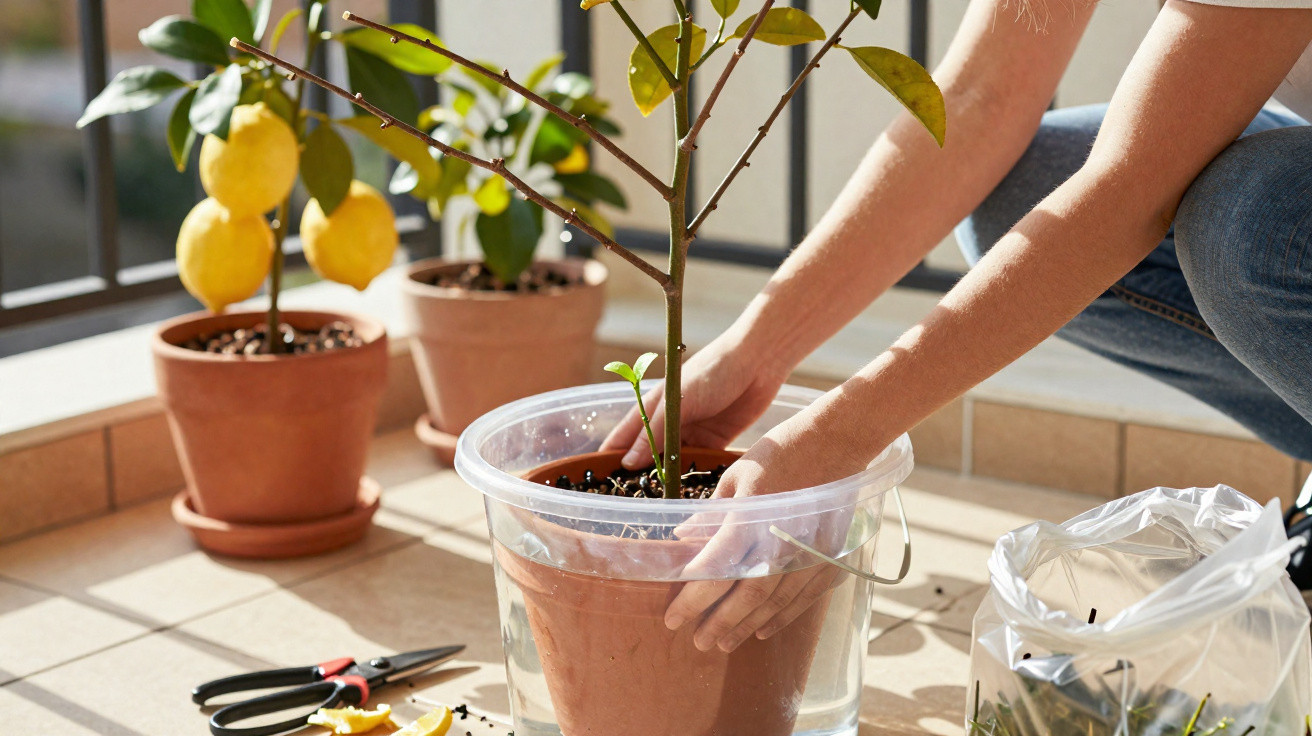
A simple technique can often turn things around.
Plenty of hobby gardeners recognise the moment: the pot feels feather-light, the branches are stiff, and there is not a single leaf left on the tree. Your first thought is usually to bin it. Yet a lemon tree that looks completely dried out is often far tougher than it appears. With a straightforward, free rescue routine drawn from traditional gardening practice, it can bounce back surprisingly well in around a fortnight - provided you act correctly now.
Is the dry lemon tree actually dead?
Before you panic, take a clear look at what state the tree is really in. Citrus plants are extremely sensitive to a lack of water. When the compost in a pot dries out entirely, it shrinks away from the sides, leaving gaps around the edge, and any water you pour in simply runs down the sides. The fine root tips end up getting none of it.
The result is often dramatic: the tree drops all its leaves almost overnight as a protective measure. From the outside it can look dead, but in many cases it is simply running on emergency mode.
10-second life check
You can find out quickly whether there is still life in the plant:
- Using a fingernail, gently scrape away a tiny patch of bark from a twig.
- If the tissue underneath is green and moist, that branch is alive.
- If it is brown, brittle and dry, that section has died back.
As long as you can still see green anywhere under the bark, it is worth trying to save it - the tree is considered alive.
The pot itself is also a clue: if it feels extremely light, the plant has effectively been without water. That is exactly where the rescue plan begins.
Day 1: Prune and soak - not a rush of fertiliser
In this situation, many people instinctively reach for fertiliser. That is the wrong move. Stressed roots are sensitive, and in the worst case they can be scorched. First, you need to get water uptake working again; everything else comes afterwards.
Pruning to encourage fresh growth
On day one, make decisive cuts so the plant can focus its energy on a smaller number of strong shoots.
- Remove dead, completely dry branches generously.
- Shorten healthy branches back to the point where clearly green wood is visible.
- Aim to reduce the crown by about one third.
- Cut out very thin, weak little twigs entirely.
Using clean, sharp secateurs lowers the risk of damage. Wound sealant on thicker branches can be helpful, but it is not essential.
A water bath to save the roots
The key element of the method is a so-called immersion soak. It re-wets compost that has become bone dry.
- Fill a bucket or tub with lukewarm water (around 20 °C).
- Stand the entire pot in the water so the rim remains just above the waterline.
- Wait 15 to 20 minutes and check whether air bubbles rise.
- If the compost is extremely dry, extend the soak to up to two hours, until no more bubbles appear.
- Lift the pot out and let it drain fully in a shaded spot - do not use a plant saucer.
The immersion soak ensures the entire root ball absorbs water like a sponge - only then will the roots reliably reach moisture again.
Afterwards, place the lemon tree somewhere bright but out of direct sun. Ideally, keep it at 15 to 18 °C - for example in an unheated conservatory, a bright hallway, or a cool room with a window.
Why this method works
The explanation is straightforward: compost that has dried out completely will barely accept water at the surface. Ordinary watering then just sends water down the sides into the saucer. The roots remain thirsty.
With an immersion soak, water penetrates from below and from the sides via capillary action, travelling deep into the root ball. The fine root hairs regain contact with moisture and can start working again.
Mini greenhouse made from a plastic bag
The trick does not end with soaking. To take pressure off a weakened tree, one small step can make a big difference: a transparent plastic bag over the crown.
- Slip a clear, sufficiently large bag (or a thin cover) over the branches.
- Loosely secure the bottom edge around the pot, for instance with an elastic band.
- Do not pull it tight; leave some air space inside.
This creates a highly humid microclimate. The tree loses far less water through the bark while the roots recover. To prevent mould, this “protective suit” needs regular airing.
Every two days, open the bag for about ten minutes - that is enough to limit mould and let fresh air in.
The first 15 days: patience and as little interference as possible
Days 2 to 7: A rest period for the tree
In the first week after you start the rescue, the rule is: doing less achieves more.
- Keep the bag on the tree, opening it only briefly for ventilation.
- Check the compost with your finger: only water when it feels dry about 3 centimetres down.
- Do not water every day.
- Keep the location consistent; avoid moving it around.
- Avoid draughts and keep it away from direct heat from radiators.
A simple finger test is sufficient: if you can press the surface down a little and it feels cool and damp, the tree does not need water. Only when it feels clearly dry should you water again - then thoroughly, but without leaving standing water in a saucer.
Days 8 to 15: Gradually back to normal
From the second week, many plants begin to show early signs of recovery: buds start to swell and tiny new shoots appear. By now, the tree should also get more air.
- At first, open the plastic bag slightly.
- Increase the opening a little more each day.
- After a few days, remove the bag completely.
At the same time, the temperature can rise slightly, to around 18 to 22 °C. You can also increase the light level gradually, but still avoid harsh midday sun at this stage. Only once the tree has rebuilt a proper, dense canopy of leaves should it move to a sunnier spot outdoors.
Care after the rescue: fertiliser, repotting, location
As soon as stable new leaves have formed, the plant’s need for nutrients increases markedly again. This is the moment to start feeding - not before.
When and how much should you feed?
A specialist liquid fertiliser for citrus is well suited, as it matches their requirements. Many gardeners follow this practical rule of thumb:
- Add a dose of liquid feed to the watering can every three weeks.
- Start with half the recommended dose to ease the roots back into feeding.
- If growth becomes strong and steady, you can later use the full dose.
If your tap water is very hard, keep an eye on pH. Citrus plants prefer slightly acidic conditions. In many areas, rainwater is an easy, effective alternative for watering.
Does the lemon tree need repotting?
Repotting is not automatically part of the first-days rescue plan. In fact, changing the pot immediately can add extra stress. It only makes sense when:
- the compost seems heavily compacted and hardly lets water through,
- lots of roots are visible at the surface,
- roots are growing out of the drainage hole underneath.
Choose a new pot that is only slightly larger than the old one. A well-draining citrus compost helps prevent waterlogging. A layer of gravel or expanded clay at the base further improves drainage.
Common mistakes that weaken the tree again
After saving a lemon tree once, you will understandably want to avoid a repeat. Three points matter most:
| Problem | Consequence | What helps |
|---|---|---|
| Watering too often | Roots rot, leaves turn yellow | Only water when the top layer is dry |
| Water left standing in the saucer | Lack of oxygen around the roots | Tip away excess water after a few minutes |
| Sudden changes of position | Stress, leaf drop, growth stops | Keep the location as consistent as possible |
Why citrus trees react so strongly to care mistakes
Citrus plants originate from places with plenty of light, relatively stable temperatures, and free-draining soils. In pots on a balcony or terrace, they rely entirely on their owner’s care. Once you understand their signals, you can spot many problems early:
- Suddenly yellow leaves often point to waterlogging.
- Limp, rolled leaves are more likely a sign of drought stress.
- Leaf drop after moving the plant suggests too abrupt a change in light or temperature.
So, if you keep an eye on your lemon tree regularly, you can often avoid the dramatic rescue altogether. And if it does happen: with the zero-cost trick described above and a bit of patience, even a seemingly dried-out tree has a realistic second chance.


Comments
No comments yet. Be the first to comment!
Leave a Comment