
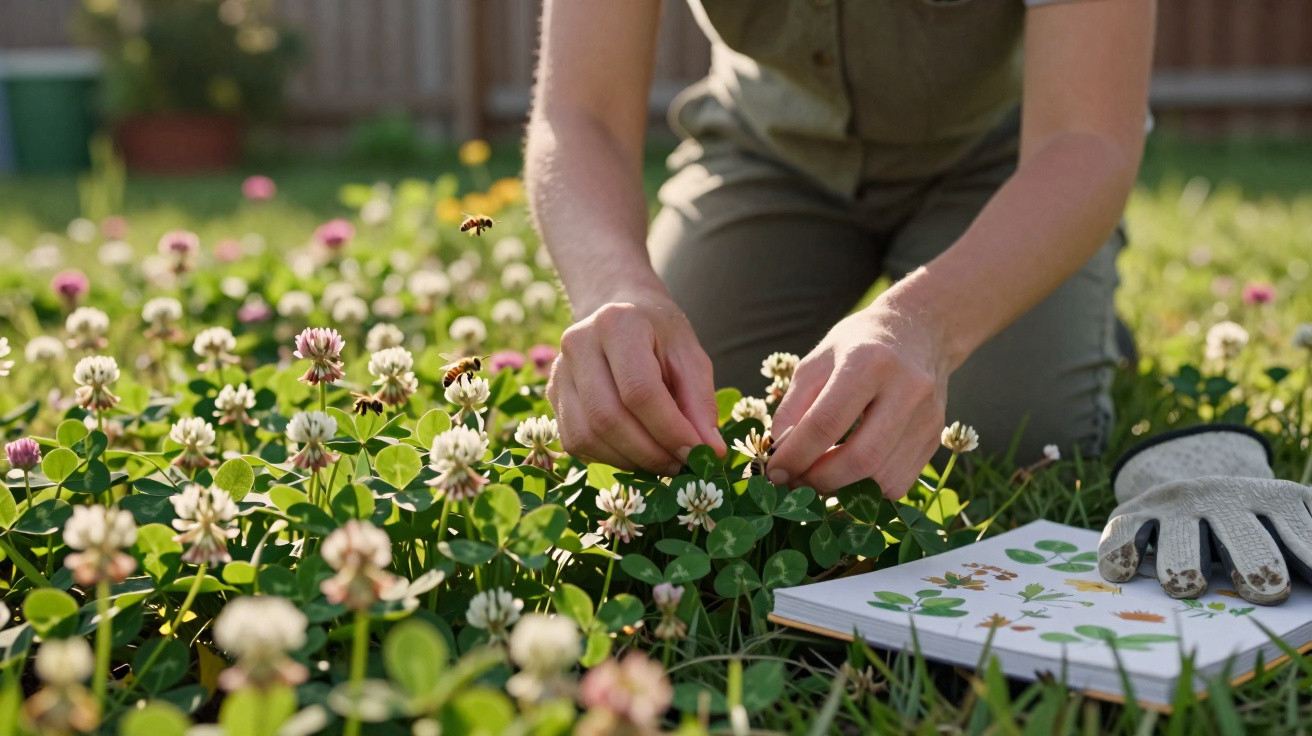
No loud droning - more a delicate vibration in the air, like a quiet engine somewhere in the distance. I was standing at the edge of an overgrown strip of car park verge, wedged between a supermarket and a dual carriageway, looking out over a carpet of tiny purple dots. In among them: bees. Dozens. Perhaps hundreds. People walked past with their eyes on their phones; nobody looked twice. Only an older woman paused for a moment, leaned towards the flowers and smiled. “The bees like that,” she muttered, more to herself than to me.
Only then did it hit me how often we walk past this plant without really noticing it - and how much work it does, quietly, in the background.
The unassuming queen: why clover is everywhere - and why bees love it
On playgrounds, between paving stones, in front gardens, on meadows, even right in the middle of town: clover grows almost anywhere. White clover, red clover, sometimes pinkish in-betweens - it’s hard to get smaller or more easily overlooked. Most of us associate it with bare feet and those little white summer blooms. Bees, though, treat it like a proper filling station.
When clover is in flower, few bees stay away for long. Each rounded flower head is made up of lots of tiny individual florets, and each one holds its own drop of nectar. For a worker bee, stopping there is hugely efficient: minimal travel, plenty of blooms to work, and high-energy food. For bees, clover is like a well-stocked buffet right by the main road.
Even so, many gardens still label it “a weed”. Yet that so-called “weed carpet” is often what makes a garden feel alive in the first place. And sometimes it starts with nothing more dramatic than letting one small patch do its own thing.
Take one example: a young family in a terraced housing estate in North Rhine-Westphalia decided to stop keeping their lawn perfectly clipped. Not the whole lawn - just one corner. A few weeks later, that patch was speckled with white clover. At first, there was doubt. A neighbour commented that it looked “unkempt”. Then the bees arrived. Within a single summer, the number of insects you could count with the naked eye had doubled.
The children began doing little “bee rounds”, sitting on the patio and watching the insects move from bloom to bloom. What had been the supposedly “unkempt corner” became everyone’s favourite spot. There was even less bare soil and dust, because the clover formed dense, cushioning mats.
Stories like this are becoming common. Towns that no longer mow their green verges to millimetre perfection. Nursery playgrounds where clover is deliberately left standing. And each time, the pattern is the same: when clover blooms, the buzzing grows thicker.
That isn’t coincidence. Clover is one of Central Europe’s classic bee plants. Its blossoms provide sugar and protein - often at times when other flowers have finished or have yet to start. For bees, clover means one thing above all: reliability.
And there’s more: clover is undemanding. It copes with poor soil, tolerates being walked on, handles heat, and even manages short dry spells. Through its roots it fixes nitrogen from the air and, almost as a side effect, improves the soil. While we think “it’s just something low growing”, below ground it is actively building better earth.
On farmland, that role has mattered for a long time. Farmers use clover as a forage crop and to improve soils. Private gardens are slowly catching up - not only out of romantic love for nature, but also because it’s practical: if you allow clover, you water less, fertilise less, and mow less. Let’s be honest: hardly anyone does all that every day.
How to bring clover into your routine - without rebuilding the whole garden
You don’t have to turn your entire lawn into a wildflower meadow. Often, a small, deliberately chosen area is enough to draw in bees: a sunny strip along the fence, the corner by the carport, or the edge of the veg bed. Those are the places where you can let clover move in on purpose.
Garden centres sell seed mixes with white clover or red clover, sometimes marketed as “bee-friendly” cover or as a “lawn alternative”. Loosen the soil a little, scatter the seed, press it in gently, and wait for the next rain. No fancy kit, no specialist tools. Clover will even grow in a window box or a shallow container if it gets enough light.
If you already have a lawn, you can simply mow less tightly in certain areas. Clover often establishes itself without any help. Raising the cutting height slightly gives it the chance to flower. In these more “relaxed” zones, small oases appear for bees, bumblebees and butterflies.
What many people underestimate is that the biggest clover mistake happens in the mind, not in the flowerbed. We’re so used to the image of a flawless, uniform green lawn that anything with texture can feel like “carelessness”. Suddenly clover becomes a nuisance rather than a benefit - and the fear of neighbours’ comments plays a part.
In practice, the usual missteps are fairly mundane: mowing too soon, straight after flowering; using “lawn weedkiller” products designed to remove clover; or watering constantly so the grass outcompetes everything else. Thinking differently takes the pressure off: a few “patches” where clover dominates aren’t failure - they’re a contribution.
Many gardeners only realise later how freeing it is to stop fighting every little plant. A garden doesn’t need to look like an exhibition stand at a home-improvement show. It can breathe, shift, and change.
“I used to dig out every clover plant straight away,” says a hobby gardener from Franconia. “Now I’m pleased by every flower head, because I know: the bees will be along in a moment.”
If you want to start with clover, a few simple guidelines help:
- Don’t overhaul everything at once - begin with a small corner
- Let clover grow where people aren’t constantly walking or playing
- Mow at least part of the area only once the clover has finished flowering
- Avoid chemical “lawn weedkiller” products, which can also harm bees
- Talk to neighbours before they’re surprised by the “wilder” lawn
What clover teaches us - and why a small flower can ripple outward
Once you take a moment and crouch beside a patch of clover, your perspective shifts. You don’t just notice flowers and greenery; you start to see processes: approach, landing, collecting, take-off. A single square metre can feed dozens of bees in half an hour. A residential area with a hundred gardens? That’s an entire neighbourhood full of tiny filling stations.
Clover points to something we easily forget in day-to-day life: just how finely tuned the relationship between soil, plant, insect and person really is. A plant we long dismissed as a “cheap gap-filler” in the lawn turns out to be a quiet professional behind the scenes. It supports bees, holds soil together, saves us work, water and fertiliser - and it grows almost anywhere, with no fuss.
Perhaps that’s why clover can feel surprisingly moving once you pay attention. Because it shows, quietly, that change doesn’t have to be loud. That a few square metres can be enough to make something happen. And that nature protection isn’t only about big campaigns, but also about the moment you lift your hand from the mower and say: “This corner can stay.”
At a time when we talk so much about bee decline, biodiversity loss and heat, clover feels almost embarrassingly simple. It’s a plant we’ve known since childhood. It grows without specialist knowledge, without an app, without a trend. And yet it can be a quiet lever - if enough people give it space again. Sometimes a different way of looking at the world starts right here: with a hum above an unassuming little bloom.
| Key point | Detail | Benefit for the reader |
|---|---|---|
| Clover as a bee magnet | Provides plentiful nectar and pollen over many weeks | Readers understand why bees actively seek out clover |
| Easy to fit into daily life | Small areas in the garden, on the balcony or by the roadside | Low barrier to entry, an idea you can act on immediately |
| Ecological and practical value | Improves soil, reduces maintenance, strengthens insect life | Readers see that a “wilder” lawn brings tangible advantages |
FAQ:
- Which clover is especially attractive for bees? White clover and red clover are the classics. Red clover has slightly deeper flowers that bumblebees particularly love, while white clover is visited by many honeybees.
- Can I grow clover in a pot or on a balcony? Yes - it works well. A wide, shallow planter with free-draining soil is enough. The key is plenty of light and restrained watering so the plants don’t grow weak and leggy.
- Will clover damage my normal lawn? It will replace grass in some spots, but it makes the surface tougher and more hard-wearing. Many people later find a mixed “clover lawn” more pleasant.
- When should I mow a clover patch? Ideally only once a large proportion of the flowers have faded. That gives bees enough time to gather nectar and pollen.
- If clover brings in more bees, is that dangerous for children? There will be more bees around flowering areas, but they’re usually peaceful unless you step on them or squeeze them. Many families deal with this by keeping play zones and flowering zones slightly separate.



Comments
No comments yet. Be the first to comment!
Leave a Comment