
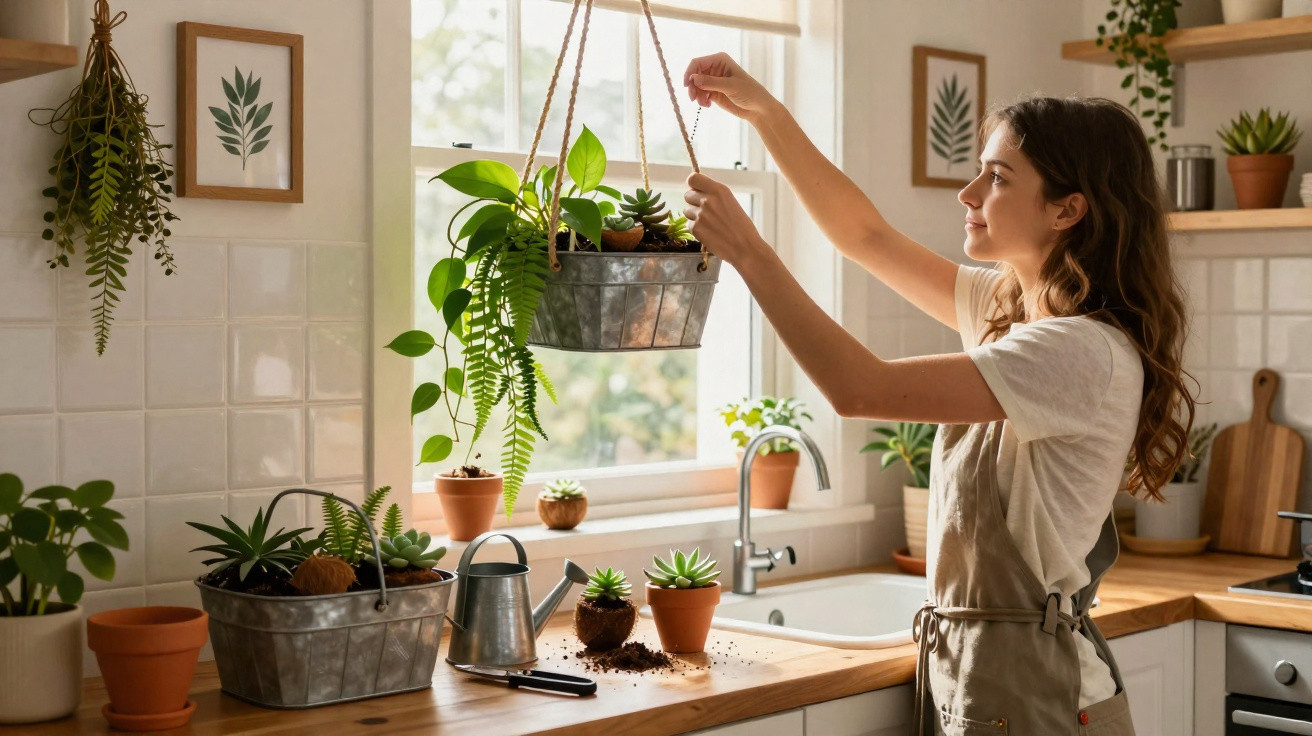
Plenty of people have one of these tucked away somewhere: a slightly dented wire basket from a car boot sale, a wooden basket from your gran’s kitchen, a metal basket rescued from the charity-shop corner. They look charming, but in day-to-day life they’ve usually stopped being useful. Those exact finds are perfect for turning into a mini hanging garden - great for small flats, gloomy corners, and anyone who likes to show off their houseplants rather than hide them away.
Why an old fruit basket is ideal for hanging plants
A traditional fruit basket already has a lot going for it from a houseplant point of view. It’s typically a decent size, often has openwork sides, and is built to be sturdy. That mix makes it a brilliant starting point for a hanging plant basket.
Open sides, a robust structure, minimal floor space - an old fruit basket meets almost every requirement for a hanging planter all by itself.
Common advantages of these baskets:
- Open edges: leaves and trailing stems can drape naturally.
- Plenty of room: there’s usually space for several small pots.
- Strength: fruit baskets are made for carrying weight, so soil and plants are rarely an issue.
- Better value: second-hand finds cost much less than new designer hanging planters.
- Upcycling appeal: a used item gets a second life instead of ending up in the bin.
Before you start converting it, take a proper look at what you’ve got: is the wood rotten? Are there deep cracks? Is the metal rusting to the point where holes are forming? If so, it’s better to leave it behind - or use it purely as decoration, without soil and without any heavy load.
Cleaning and prep: refresh first, hang later
Before any plants move in, the basket needs a quick freshen-up. Warm water, a bit of washing-up liquid and a scrubbing brush are usually enough. Any leftover fruit residue, dust or old decorative grime needs to come off completely to avoid mould later.
After cleaning:
- Let the basket dry out fully - ideally overnight.
- Straighten, remove or fix any loose pieces, sharp edges or bent wires.
- Optional: apply a thin coat of clear varnish or a moisture-resistant paint to wood or metal so it copes better with splashes from watering.
If you like a colour accent, painting the basket matt black, cream or a pastel shade can help the finished mini jungle feel more contemporary and blend more easily with your interior style.
Materials list: what you need for a hanging plant basket
This is a straightforward DIY project. A lot of the kit is likely already at home; anything missing is easy to pick up from a DIY shop or garden centre.
| Component | Purpose |
|---|---|
| Old fruit basket | Base that supports soil and plants |
| Strong cord or chain | Suspension; spreads the weight |
| Hooks or rings | Connects to a ceiling hook, rail, or shelf |
| Fleece, coir, or jute | Lining that keeps soil inside the basket |
| Lightweight compost + expanded clay | Growing medium and drainage |
| Houseplants | The green stars of the whole project |
If you’d rather avoid drilling, use hooks that can sit over a curtain rail, a beam or a sturdy shelf. In rented homes with delicate ceilings, that can be a low-stress alternative.
Planning the hanging setup: safe, stable and practical
Before you add any compost, sort out the hanging method. Three or four suspension points help the basket sit steady. Attach the cords or chains evenly around the rim so it doesn’t tip to one side.
A practical sequence:
- Line the inside with fleece, coir or jute.
- Add holes or eyelets if the basket doesn’t already have openings for the cords.
- Thread through the cords, measure the lengths carefully, and tighten the knots properly.
- Hang the empty basket on its final hook for a test run, and simulate the load by applying pressure with your hand.
If the basket will hang close to a wall, sticking a small piece of felt or cork on the back helps prevent scratches and ugly scuff marks.
The right houseplants for a hanging basket
The overall look depends heavily on plant choice. Trailing and climbing varieties work especially well because they can “spill” over the edge and soften the basket visually.
Popular options include:
- Pothos (devil’s ivy) with heart-shaped leaves
- Classic ivy for full, green cascades
- Tradescantia (“wandering Jew”) with colourful foliage
- Philodendron with long, soft shoots
- Hanging strawberries for anyone who likes a snack by the window
It can look particularly striking if you mix leaf colours and shapes: a variegated plant next to a dark green one; rounded leaves alongside fine, trailing strands. The result feels lively - more like a small jungle than a neatly ordered bed.
Watering and care: keeping the mini jungle healthy
Hanging baskets often dry out faster than pots on the floor because they’re exposed to more air movement. Early on, it’s worth checking the compost closely. If the top feels dry but it’s still slightly damp underneath, a small amount of water is often enough.
Better to water small amounts more often than to pour in a big load rarely - that’s how roots stay vigorous in a hanging basket.
A few care pointers:
- Put expanded clay or small stones in the bottom section as drainage.
- Choose light, airy compost so the basket doesn’t become too heavy.
- Don’t let leftover water sit in the lining or in any saucers.
- Check cords, chains and hooks regularly for wear.
- Rotate the plants now and then so they receive light evenly.
Where a hanging plant basket looks best
Your new focal point doesn’t take up much space, but it’s worth thinking about placement. It works well in corners that would otherwise be just empty wall, or above sideboards where floor plants would get in the way.
Popular spots:
- Above a reading nook with an armchair and a floor lamp
- By a kitchen window with herbs or strawberries
- In the hallway to bring a bare wall to life
- In the bedroom as a green contrast near the bed and bedside table
Light still matters: most houseplants prefer bright, indirect light. Avoid hanging them directly over a radiator or in a draughty walkway.
Upcycling, sustainability and atmosphere: why it’s worth doing
Using an old fruit basket as a hanging planter isn’t only a money-saver - it also changes how a room feels. You keep the floor clear, the corner looks airier, and you gain a bold visual feature. Unlike many shop-bought hanging planters, a basket like this often comes with a bit of personal history: a car boot bargain, a family hand-me-down, a loft discovery.
That’s exactly what “upcycling” means: instead of throwing out an item that’s done its original job, you enhance it and give it a new purpose. At a time when many people are trying to consume more consciously, a project like this fits perfectly at home.
Once you’ve started with one basket, it’s easy to want to try variations: two smaller baskets stacked as a vertical plant ladder; an old metal shelving section turned into a wall hanger; or a wide wire basket above the dining table filled only with dried grasses.
Comments
No comments yet. Be the first to comment!
Leave a Comment