
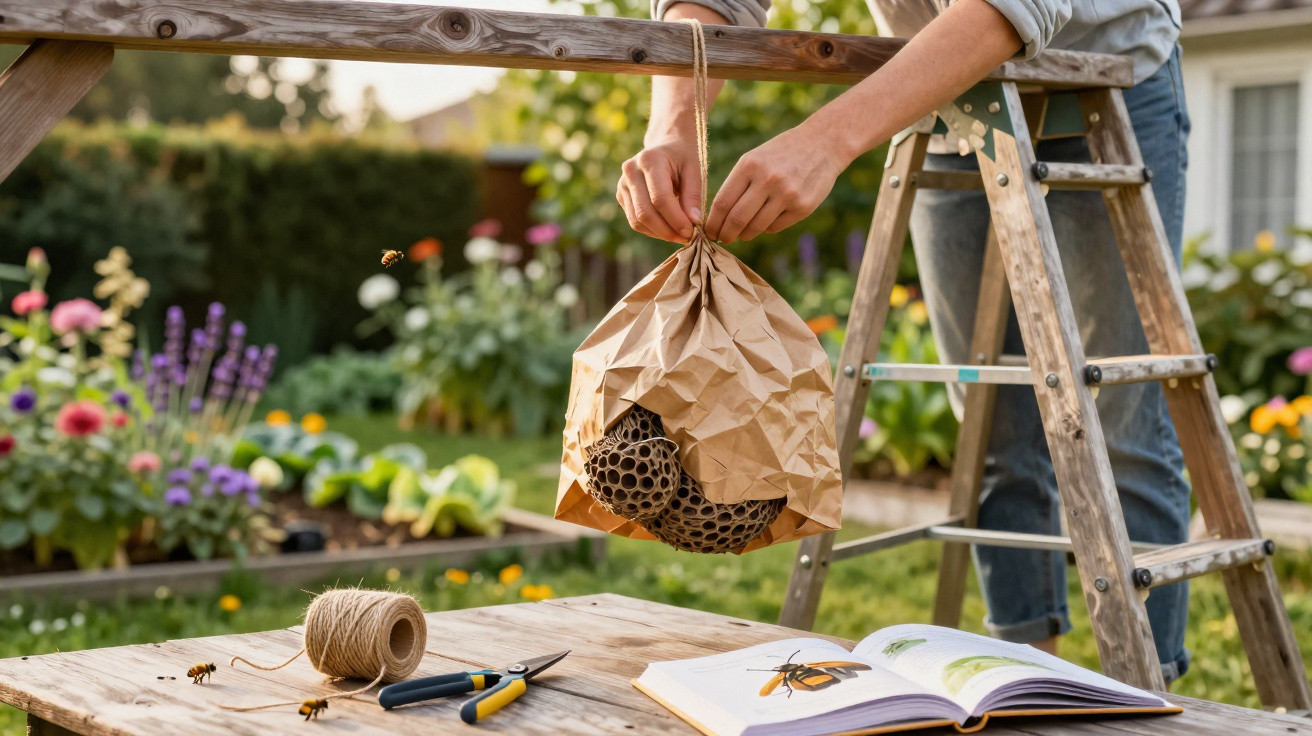
If you want to sit comfortably in the garden in summer, there is a new worry on many people’s minds: the invasive Asian hornet. It doesn’t just prey on bees - it can become a nuisance for people too. One surprisingly straightforward idea is currently doing the rounds: an inflated paper bag, made to look like a nest, is said to keep the insects at a distance.
How a paper bag imitates a nest
The concept is strikingly simple and has nothing to do with mysticism - it’s based on animal behaviour. Asian hornets are highly territorial and tend to avoid setting up a new colony close to an existing nest. Specialists assume they will not tolerate another nest within a radius of about 50 metres.
That is exactly what this trick aims to exploit. A crumpled, inflated paper bag mimics the rounded silhouette of a hornet nest. To a queen searching for a site in spring, the bag can look like the home of a rival colony.
An inflated paper bag simulates a foreign hornet nest - and signals to the queen: “This territory is already taken.”
Important: no reputable source claims this works every time, in every garden. However, it is so cheap, harmless and easy to try that many hobby gardeners give it a go anyway - simply because the effort-to-possible-benefit ratio is very appealing.
The right timing: why spring matters
Timing is crucial. Asian hornets overwinter as lone queens. In spring, usually from April onwards, they become active again and look for places for their first, still-small nest - often in sheds, garages, under eaves, or in trees close to houses.
If you already have “decoy nests” hanging in the garden at that point, you are influencing this key stage of site selection. Later in the year, once nests are large and fully populated, a paper bag does very little. By then the colony is established and the decision was made long ago.
- March/early April: first queens become active; prepare the first protective steps
- April/May: hang paper bags clearly in view - peak period for site searching
- From June: prevention becomes much less effective; nests are usually already established
So if you want to act, it’s better not to wait for the first hot summer day. Start in spring - before a nest grows in the roof space or in the tree next to the patio.
How to use the paper bag trick properly
Materials and shape: what you actually need
You don’t need anything more than a plain brown paper bag. Sturdier paper is best - like the type used for bread or fruit bags. It should be easy to shape and not tear as soon as it gets damp.
- Crumple the paper bag firmly, then open it out again - this creates an uneven surface.
- Inflate the bag with air or pack it with dry paper/plastic until it is roughly the size of a handball.
- Seal the opening securely, for example with cord or tape.
- Hang it with string from a hook or branch at a height of about 1.5 to 2 metres.
From a distance, the irregular, rounded shape resembles a real nest. For hornets, the key factor is the visual cue rather than scent.
The best places in the garden
The paper bag should hang somewhere clearly visible - ideally where the insects are likely to build or where you spend time yourself. Commonly effective spots include:
- under the eaves or a carport roof
- on a summerhouse or tool shed
- in a low fork of a tree near the patio or seating area
- on a pergola, balcony railing or gazebo
On larger plots, one bag is often not enough. If you have several sensitive areas - such as a vegetable patch, patio and an apiary - it makes sense to put up multiple decoy nests.
The larger the plot, the more sensible it is to place several “decoy nests” in different corners.
After heavy rain, it is worth looking up to check the condition. If the bag becomes too soft, tears, or looks very ragged, simply replace it. The cost stays low, and the effect can be noticeable.
Why Asian hornets are such a problem
The Asian hornet, scientifically Vespa velutina, originally comes from East Asia and was accidentally introduced to Europe around two decades ago. Since then, it has spread rapidly. In some regions, hundreds of thousands of nests are now reported every year.
Its reputation as a bee hunter is well earned. Studies in affected countries show that a single nest can consume around 11 kilograms of insects over a season. A large proportion are pollinators - especially honey bees, but also wild bees and other beneficial species.
Beekeepers often see the impact immediately: if a hornet nest is near an apiary, foragers may barely dare to leave the hive. Honey yields drop, and plants in the area are pollinated less effectively. At that point it is no longer just a “summer nuisance” - it affects farming and nature directly.
What the paper bag cannot do
As clever as the trick sounds, it is not a substitute for professional control when a large nest already exists. An established colony with thousands of insects will not simply move out because a paper bag is hanging nearby.
If you find a real nest on the house, in a chimney, inside a roller shutter box, or high in a tree crown, keep your distance and do not poke around. Multiple stings can be dangerous for people who are sensitive.
The paper bag is a preventive measure - not a solution once the nest is already there.
This is where professionals are needed: depending on the area, that may mean local pest control services, specialist companies, or contractors appointed by the council. In some regions, towns and councils contribute to the cost because slowing the spread of this invasive species is now treated as a public responsibility.
More simple ways to discourage hornets in the garden
The paper bag approach works best as part of a wider set of straightforward garden habits. Lots of small steps can add up to a noticeable difference.
Reduce attractants around the garden
- Pick up fallen fruit quickly: ripe, rotting fruit is highly attractive to stinging insects. Ideally dispose of it in a sealed food-waste bin.
- Limit decaying wood and leaf piles: hornets use these sources to create the paper-like material for their nests. Keep large piles a bit further from the house.
- Cover leftover drinks: open lemonade, juice and beer glasses on the patio are classic lures.
Plants hornets tend to dislike
Certain aromatic plants appear to smell unpleasant to hornets while still attracting bees and bumblebees. A thoughtful planting plan can therefore deter pests and support pollinators at the same time.
| Plant | Effect in the garden |
|---|---|
| Lavender | attracts bees, bothers hornets |
| Wormwood | strong scent, creates a natural fragrance barrier |
| Lemon thyme | aromatic ground cover, useful in cooking |
| Mint | distinctive smell, good for teas and cocktails |
| Tomato plants | pungent leaves, generally avoided |
A herb bed along the patio or beside the entrance to your seating area can be doubly useful: for the kitchen and for discouraging hornets.
How to protect bees without harming other wildlife
Many traditional “insect traps” cause more harm than good: sweet liquids attract all sorts of species and kill indiscriminately. Bees, hoverflies and other beneficial insects are often the ones that suffer.
The paper bag method takes a different route. It only pretends there is a nest and does not kill anything. Bees, butterflies and other insects can continue to move freely - a major advantage for anyone aiming for a wildlife-friendly garden.
Anyone who wants to preserve biodiversity in the garden needs solutions that deter selectively rather than killing blindly.
If you do discover a genuine hornet nest, report it to the relevant services as accurately as possible: location, height, size and activity. The more detail provided, the safer the work can be. If you keep bees, it is also best to inform your local beekeeping association.
What else you should know about Asian hornets
Despite the intimidating name, a single Asian hornet sting is usually no more dangerous for healthy people than the sting of an ordinary wasp. The real risk is disturbing a nest and being attacked by many insects at once.
Typical signs of a nest include noticeably frequent hornets repeatedly following the same flight line - for example along a hedge or towards the loft. In that case it is worth taking a closer look, but only from a safe distance, using binoculars or a camera zoom.
For garden owners, the takeaway is clear: with an inflated paper bag, a few deliberately chosen herbs, a tidy orchard, and a watchful eye, you can significantly reduce the chance of a nest becoming established right by the house. None of these measures works like an invisible wall, but together they shift the odds clearly in your favour - and in favour of the bees that pollinate your fruit trees and beds in summer.


Comments
No comments yet. Be the first to comment!
Leave a Comment