
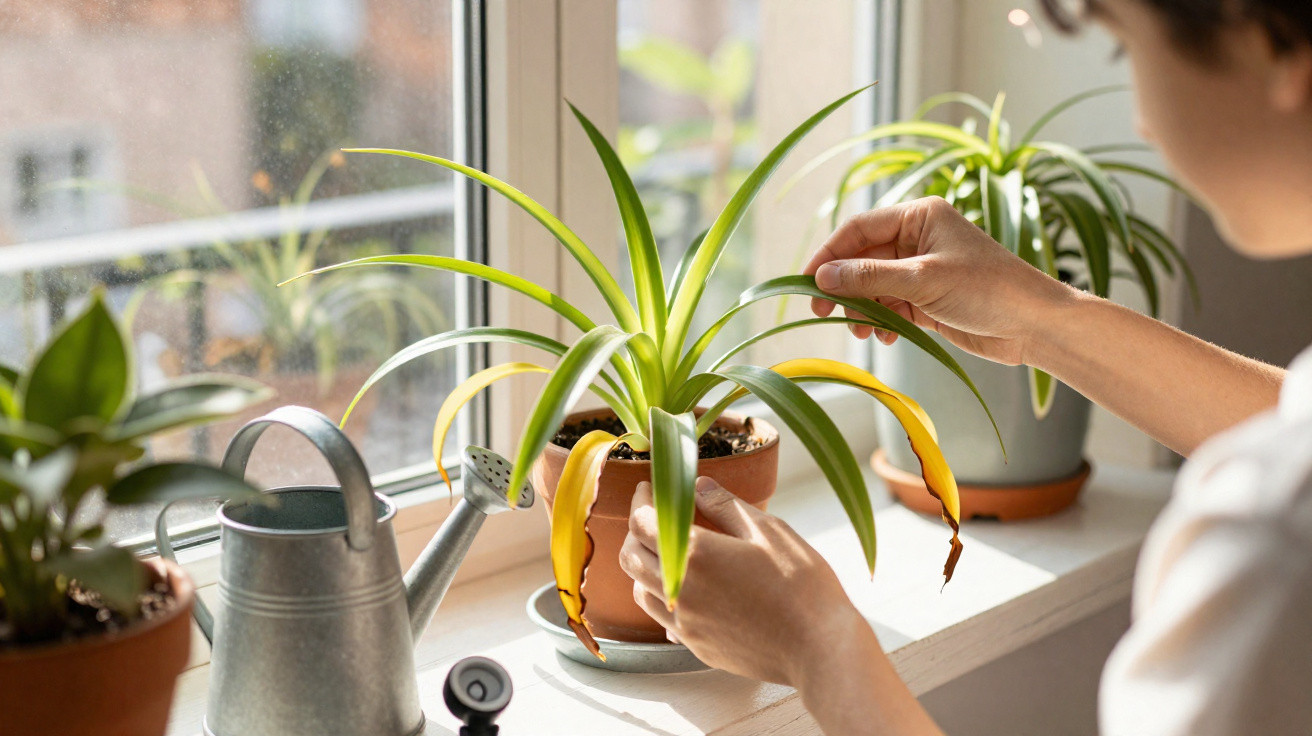
Many owners are puzzled: the spot seems right, watering is regular - and yet the spider plant suddenly looks tired, with leaves that crease, kink or even snap. Those exact leaf injuries are useful clues, because they point to what’s going wrong in the pot and in your watering routine.
What a truly healthy spider plant looks like
The spider plant (Chlorophytum) is one of the toughest houseplants you can grow. When it’s happy, it has a very recognisable look: long, narrow, deep green leaves - sometimes green-and-white striped - that feel supple and slightly springy. They emerge from a dense central crown and arch downwards, almost like a small indoor fountain.
On a healthy leaf, the central rib and the blade flow smoothly through that curve. If you run a finger along it, you won’t find sharp creases or brittle spots. Even larger plants with leaves up to 80–90 centimetres long stay flexible.
A genuinely problematic leaf looks different. It has a sharp angle, as if it has been firmly bent once. You can feel a ridge; sometimes the area seems soft and yellowish, or the opposite - dry and stiff. That’s a sign the internal channels are damaged, so water and nutrients barely make it past that point.
"Healthy spider plants have long, soft, evenly arched leaves - with no hard creases and no soft or paper-thin sections."
Kinked leaves: when it’s simply an accident
Before you assume you’ve made a care mistake, check the obvious. Many spider plants live on windowsills, shelves or sideboards - exactly where it’s easy to knock them.
Typical “accident” causes include:
- The pot was moved and a leaf was trapped in the window
- A cat or dog jumps at the plant
- Children tug on the long leaves
- The pot has tipped over once
If only one or two older leaves are affected, while the rest of the plant is producing fresh, upright, vigorous growth, it’s usually just mechanical damage. It’s annoying, but it isn’t a disaster for the plant overall.
If several leaves are kinking: a warning sign from the root ball
If newer leaves repeatedly emerge soft, creased or oddly misshapen, the cause is almost always care-related. Spider plants react particularly strongly to three things: water, humidity and light.
Too much water: limp, yellowing kinked leaves
A classic scenario: the pot stays wet for too long. Everything may still look acceptable at the surface, while root trouble is already starting lower down. Common signs are:
- Leaves turn soft, droop and kink more easily
- Colour shifts from deep green to pale green or yellow
- The compost feels heavy and damp most of the time
- The pot smells musty, sometimes slightly rotten
Check: push your finger about 5 centimetres into the compost. If that deeper layer still feels damp, don’t add more water yet. If you want extra certainty, a simple soil moisture meter helps - and quickly pays off if you have a larger plant collection.
"Overwatering weakens the roots first - kinked, mushy leaves are often only the visible tip of the problem."
Too little water: dry, brittle tips
The opposite issue is a pot that has dried out. Some people try to water “carefully” and end up leaving the spider plant almost dry for weeks. The root ball shrinks and pulls away from the pot edge, so water then runs down the sides rather than soaking in.
Typical signs include:
- Leaves feel dry, sometimes almost like parchment
- Tips and edges turn brown and snap easily
- Leaves may kink at weakened points and then break cleanly
- The compost visibly recedes from the sides of the pot
Here, thorough rehydration helps: stand the pot in a bucket of lukewarm water until no more air bubbles rise. Then let it drain well, and shorten your future watering intervals slightly.
Root damage and poor compost
If the leaves are soft, crease easily, and there’s no improvement even after adjusting watering, it’s worth checking the roots. Carefully lift the plant out of its pot:
- Healthy roots: light-coloured, firm, slightly moist, no smell
- Unhealthy roots: brown to black, mushy, unpleasant odour
If there’s rot, you need to act: cut away any soft, dark roots, repot into fresh, airy compost, choose a pot with a drainage hole, and avoid waterlogging consistently from then on.
Light, air and placement: the factors many people underestimate
Too little light: long, weak leaves
When a spider plant sits in a dim corner, it tends to produce longer, thinner, softer leaves. These crease more readily, especially around the middle. The whole plant may also start leaning towards the window.
A better option is a bright position out of harsh midday sun - for example near an east- or west-facing window. There, the leaves usually stay sturdier and more stable.
Dry central heating: brittle tips and fine creases
In winter, many plants suffer on a windowsill above a radiator. The air becomes dry, and watering rhythm and evaporation get out of balance.
A few straightforward countermeasures:
- Fill a saucer with pebbles and a little water, and stand the pot on top
- Place a bowl of water nearby
- Mist lightly with room-temperature water regularly (without overdoing it)
What to do with leaves that are already kinked or broken
A leaf that has been sharply creased will not fully straighten again. The internal channels remain damaged, so the bent point stays a weak spot. It looks particularly untidy if the kink is in a prominent place, or if the leaf later snaps at that point.
The best approach:
- Use a clean, sharp knife or scissors
- Cut the affected leaf as low as possible at the base
- Keep the cut dry, and don’t soak the plant immediately afterwards
"Kinked leaves won’t become like new again. Removing them neatly makes space for healthy, strong new growth."
A generally vigorous spider plant replaces lost leaves quickly. If you plan gentle, regular feeding during the growing season, you’ll support that regrowth as well.
How to prevent new leaf breaks
So the same issue doesn’t return in a few weeks, a simple “care log” can help. It’s especially worthwhile with plants you keep for years.
Useful routines include:
- Roughly note watering dates and approximate amounts
- Record any location changes (window side, distance from the glass, proximity to a radiator)
- Once a month, check leaves and roots briefly
- Keep an eye on pot size - pots that are too tight let the root ball dry out faster
It can also be practical to hang the plant rather than leaving it on the edge of a frequently used table. That reduces the risk of someone bumping into it or getting caught in the leaves.
Why the spider plant’s signals are so valuable
Spider plants respond relatively quickly to care mistakes - but not with a sudden total collapse. Instead, they give readable hints: creases, colour shifts, and soft or brittle patches. If you take these signals seriously, you’ll also learn a lot about watering balance, indoor climate and compost.
Many of the relationships described here also apply to other popular houseplants, such as spider plant relatives, some palms, or broad-leaved species. Kinked leaves often point to stress around the roots or at the plant’s location. If you check systematically - how damp is the compost, how bright is it really, what does a healthy leaf feel like - you can usually pinpoint the cause surprisingly quickly and correct it before a few creases turn into a real plant emergency.

Comments
No comments yet. Be the first to comment!
Leave a Comment