
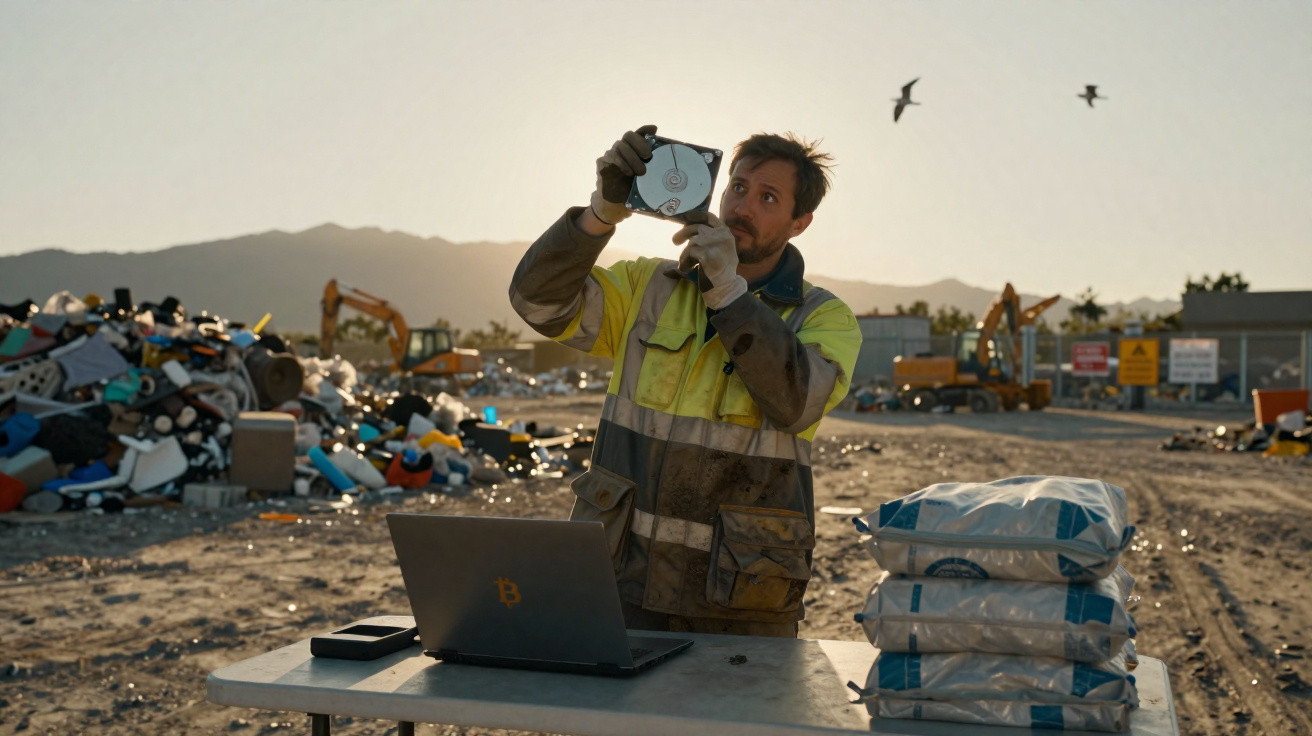
An IT technician throws away an old hard drive during a clear-out, initially thinking nothing of it – only to realise later that it held the credentials for thousands of Bitcoin. Today, that digital wallet would be worth hundreds of millions of dollars. The missing drive is buried in landfill, authorities refuse to permit a search, and courts put the chances of success at zero. Yet the story has not disappeared: it is now heading to a film studio.
From an office clear-out to a 649-million-dollar drama
The story starts in Newport, Wales, in 2013. IT technician James Howells is tidying his workspace. Among cables, old computer components and stacks of paper, a hard drive ends up in the bin – an ordinary occurrence, seemingly unremarkable. The problem is that this particular drive contains the private keys to around 8,000 Bitcoin.
At the time, the coins are already worth several million dollars. That is a substantial sum, certainly, but not yet the material of legend. Only when Bitcoin’s price surges in the following years, at times reaching well above $60,000 per Bitcoin, does a moment of carelessness become perhaps the costliest mistake of the cryptocurrency age.
Based on the current market value, Howells’ lost wallet is now worth roughly $649 million – and is probably compressed deep within rubbish.
The hard drive is somewhere in Newport’s municipal landfill site, where compacted waste has accumulated for decades. Chemical reactions, damp, toxic substances and metal fragments make it a particularly hostile environment for ageing sensitive electronics. Nevertheless, James Howells refuses to give up.
High-tech landfill search at his own expense
Over the years, Howells has developed increasingly complex recovery proposals. He is not seeking permission for an uncontrolled treasure hunt, but for a tightly managed, technically sophisticated retrieval operation. His plan resembles the specification for a space project more than the idea of a frustrated IT enthusiast.
- AI-controlled drones would map the surface and structures beneath it.
- Robotic excavators would dig at carefully selected locations.
- Monitoring systems would track toxic gases and leaks.
- Dedicated safety procedures would secure contaminated material and return it to the landfill correctly.
The crucial point is that Howells has offered to fund the entire operation privately. Newport City Council would not need to pay a penny and would even receive a share of the cryptocurrency proceeds if the search succeeded. To many people, that may sound like an obvious decision; to the local authorities, it does not.
Why Newport City Council is applying the brakes
The council has repeatedly rejected his applications. Its reasons include substantial environmental risks, the danger posed by toxic gases, potential damage to the landfill’s protective lining, and risks to groundwater and nearby residents. The site is considered an environmentally sensitive area where excavation cannot simply take place because a storage device of potentially enormous financial value may be buried there.
There is also a legal complication. In the United Kingdom, discarded items generally become the property of landfill operators. Anyone who throws something away usually gives up their rights to it. Formally, the hard drive has therefore long ceased to belong to James Howells. Even with the council’s full co-operation, the legal position would be difficult; without it, the prospect is effectively hopeless.
Court: virtually zero chance of success
Howells takes the matter to court, seeking to establish his right to search for the hard drive at his own expense. In 2024, the ruling arrives, and many see it as the final blow to the recovery plan.
A British judge effectively puts the chance of finding the hard drive at zero per cent, concluding that there is no realistic prospect either technically or legally.
During the case, experts explain what happens to magnetic storage media in landfill. Over years, moisture reaches every gap, chemical processes degrade materials, and the weight above distorts the components. Even if the hard drive were located, the internal platters would be extremely likely to have suffered irreversible damage.
For Howells, the judgment means he must officially accept that his Bitcoin will probably remain lost forever. There is no new legal route, no further application to the council and no back door. The digital treasure chest remains sealed shut.
From court defeat to television project: James Howells’ story is being filmed
Rather than withdrawing from public view, James Howells has taken an unexpected path. A US production company has acquired the exclusive rights to his story. A multi-part documentary series is planned under the working title “The Buried Bitcoin: The Real-Life Treasure Hunt of James Howells”.
The project will focus not only on the infamous figure of 8,000 Bitcoin, but on the entire journey: the first recovery ideas, the technical proposals, difficult discussions with politicians and officials, the legal defeats, and the personal reality of a man who has lived with his own mistake for more than a decade.
Howells sees the series as his first genuine opportunity to show the public in detail what he actually intended to do at the landfill site.
Elaborate visualisations of the landfill are planned, alongside 3D models, simulations of the search robots, access to the legal files and extensive time with Howells himself. The production is clearly aimed at an international audience fascinated by extraordinary cryptocurrency stories, while also being accessible to people with little experience of digital money.
What the story reveals about Bitcoin security
The tragic twist is that the lost hard drive is probably beyond recovery both legally and physically, but its lesson remains immense. Howells’ case demonstrates how fragile digital wealth can be when access details are kept in one place – and that one place disappears.
Private keys: the single point on which everything depends
People who own Bitcoin do not store coins in the conventional sense; they safeguard private keys. These long strings of characters make it possible to sign transactions and therefore move the coins. If the key is lost, the coins technically remain on the blockchain but can no longer be used.
Howells did not lose his wealth through a hacking attack. He lost it simply because, while clearing out, he no longer remembered a storage device. It is a lapse that probably affects thousands of people with smaller sums, although their stories never make the headlines.
Anyone dealing with cryptoassets today should therefore take secure storage seriously, for example by:
- using hardware wallets and backing up the seed phrase on paper or metal;
- keeping those backups in several physical locations;
- providing clear documentation for heirs without exposing the keys without protection;
- regularly checking that all data and devices remain accessible and functional.
Money versus the environment: the sensitive landfill question
The case also raises another highly relevant question: how far should the pursuit of money be allowed to go when the environment and public health are at risk? Newport’s landfill is subject to strict requirements. Protecting groundwater, monitoring methane and other gases, and maintaining the long-term stability of the landfill cap are all difficult to reconcile with a major project that reopens the site layer by layer.
The council has made its position clear: environmental protection takes precedence over profit motives. For Howells, that is difficult to accept. For residents and officials, however, the principle appears logical: if an exception is made for $649 million, where should the line be drawn?
Why the story captivates so many people
Its appeal lies in the combination of elements: a modern treasure vanishing underground as if in a pirate novel, except in a landfill rather than on an island. There is a protagonist spending years trying to undo his mistake. Future-facing technologies such as Bitcoin, AI drones and robotics collide with dry environmental rules and bureaucratic logic.
For many cryptocurrency enthusiasts, Howells has become a kind of cautionary icon: the man who shows what is at stake when minor carelessness is combined with highly volatile digital assets. For sceptics, meanwhile, the story reinforces an instinctive concern: money that exists only as code can disappear just as completely.
Anyone who invests in Bitcoin or other cryptocurrencies, or is considering doing so, has a tangible example here that the greatest risk is often not the market but the person sitting in front of the computer. One wrongly discarded storage device, one lost note containing a seed phrase, one carelessly formatted hard drive – and wealth becomes a legend that, at best, survives as a streaming series.





Comments
No comments yet. Be the first to comment!
Leave a Comment