
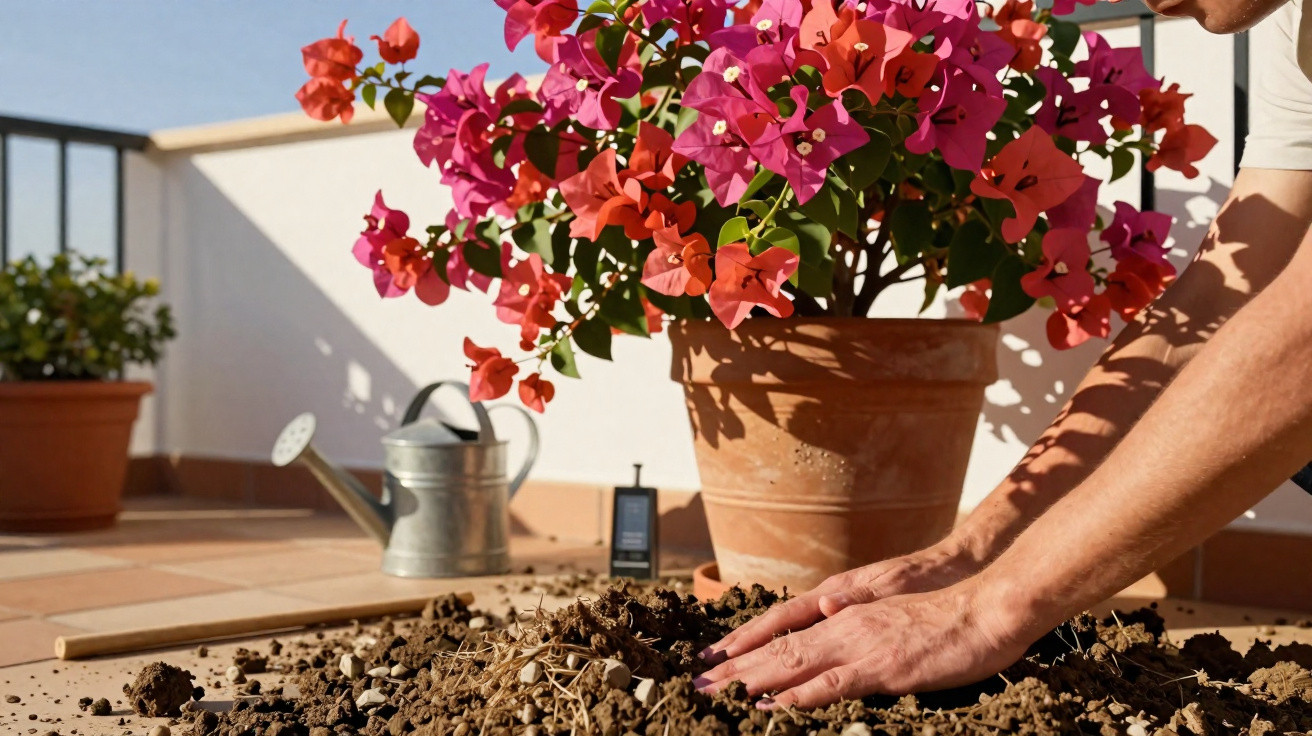
Many Bougainvillea owners keep making the same easy-to-miss mistake.
Bougainvillea is often seen as the queen of Mediterranean-style patios - yet in plenty of gardens it produces lush green growth rather than a riot of colour. The reason is usually not the variety at all, but a particular care habit that effectively switches off flowering. Change that one routine and, in many cases, the plant will start blooming within a single season.
Why your Bougainvillea produces leaves instead of flowers
A Bougainvillea that looks healthy but refuses to flower is a familiar sight on balconies and terraces. It grows strongly, throws out long shoots, and the foliage looks picture-perfect - and still you end up with nothing more than a green shrub. The key point is that this climbing plant responds very strongly to light, temperature and, above all, water.
At heart, Bougainvillea thrives on three things:
- at least six hours of direct sun per day
- warm temperatures between about 20 and 30 °C
- loose, well-draining soil with short dry spells
If temperatures sit consistently around 5 °C, it needs moving to a sheltered spot. Many varieties suffer damage around freezing. A warm, protected position is best - for example in front of a south- or south-west-facing wall that also stores heat.
The root zone matters just as much. Bougainvillea does not come from damp ravines, but from relatively dry regions where rain arrives in short, heavy bursts. Treat it like a thirsty houseplant and you will get lots of green growth - but very little in the way of flowers.
"Full sun, short dry spells and a free-draining pot are the foundation without which Bougainvillea is hardly ever in the mood to flower."
Too much water, too much feed: the typical “green bush effect”
Here is a scenario that plays out in countless gardens: in July, a Bougainvillea stands in a container on a hot patio. Worried about the heat, it gets watered every two days and, on top of that, receives a dose of general-purpose fertiliser each week. It sounds caring - but it often delivers the opposite of what you want.
The outcome is long, soft shoots and dense foliage, but not a single colourful bract. From a botanical point of view, when there is plenty of water and lots of nitrogen, the plant commits fully to growth. It is not “thinking” about reproduction - and that means no flowers.
If, however, it goes without water briefly, the plant experiences mild stress. That is precisely the trigger that can flip the switch: Bougainvillea diverts more energy into forming flowers, aiming to reproduce and attract pollinators.
"If you pamper your Bougainvillea constantly with water and nitrogen, you train it into a leaf monster - not a flowering machine."
The controlled-dryness method
The crucial trick used by many professional gardeners is controlled “thirst periods”. This is not about punishing the plant, but about a clearly managed rhythm of drying out followed by a thorough watering.
Check the basics before changing your routine
Before you adjust how you water, a few fundamentals need to be right:
- Position: full sun, sheltered from wind, ideally in front of a warm wall
- Compost/soil: loose, free-draining mix, ideally blended with sand or lava grit
- Pot: always with drainage holes, never without a way for water to escape, and no saucer left holding standing water
- Feeding: light during the season, with an emphasis on potassium rather than too much nitrogen
From spring through late summer, a potassium-rich feed every two to three weeks is entirely sufficient. From mid-September, feeding should be gradually reduced and then stopped, so the plant can prepare for its rest period and allow the wood to mature.
How the summer watering rhythm works
In warmer months, a simple rule of thumb helps: only water once the top 3–4 cm of compost has dried out. When you do water, avoid giving little “sips” - instead, water properly in one go.
- Use a finger to check whether the top layer is dry.
- If it is dry, water thoroughly until water runs out of the drainage holes.
- After about 20–30 minutes, empty the saucer so no waterlogging remains.
This alternation between slight dryness and a subsequent “downpour” mirrors the plant’s natural conditions.
Winter watering: almost dry is acceptable
From November to March, Bougainvillea benefits from a kind of artificial winter. A bright, cool spot at around 10–15 °C suits it well. During this period, growth is almost at a standstill, so water needs drop sharply.
If you continue watering as though it were mid-summer, root rot and fungal problems become likely. A better approach is to moisten the compost only occasionally and keep the root ball almost dry. The plant often looks a little tired at this stage, and that is normal.
"If you keep Bougainvillea cool, bright and on the dry side in winter, you often reward yourself the following year with a noticeably stronger set of flower buds."
The right moment to water - without putting flowers at risk
To avoid missing the key timing, your finger is usually enough. Push it into the compost to about the first knuckle: if it feels dry there, it is time to water. If the compost still feels cool and damp, it is better to wait.
Slightly drooping leaves are a sign that a shortage of water is beginning. At that point, water should follow - without waiting until leaves curl or turn brown. If it reaches that stage, the stress has been too intense and the plant will need time to recover.
The principle is a kind of “summer thunderstorm simulation”. Several times during the season, lightly dry phases alternate with deep, soaking waterings. Many gardeners notice the first colourful bracts appearing at exactly that point.
Common mistakes that hold back flowering
Some care steps seem sensible at first glance, but they undermine Bougainvillea’s willingness to bloom. Typical pitfalls include:
- Automatic watering systems: they keep the compost constantly slightly moist, so the essential dry trigger never happens.
- Saucers permanently full of water: waterlogging causes roots to rot and prevents proper nutrient uptake.
- A pot that is too large: the plant focuses on root growth first, and flowering is pushed back.
- Pruning at the wrong time: a hard cutback shortly before the main season removes many potential flowering shoots.
- Overwintering too warm: keeping it in a heated living room encourages soft, weak growth without flower formation.
If you want to prune, it is better to aim for two points in the year: a light tidy-up immediately after a flowering phase, and a somewhat stronger prune at the end of winter, just before the plant starts growing strongly again.
How stress, nutrients and light affect one another
Flowering in Bougainvillea depends on several factors that can either reinforce or block each other. Bright, sunny positions provide the energy the plant needs. Potassium supports flowers and woody growth, while too much nitrogen mainly pushes leaf production. Controlled dry stress, finally, provides the signal to reproduce.
When you keep all three in mind, it becomes clear how powerful small changes can be. Moving the plant to an even sunnier spot, switching to a more free-draining mix, and being more disciplined about breaks between waterings can turn a previously “stubborn” plant into an impressive bloomer.
Practical examples and risks of the dry-spell approach
In practice, a period of two to three weeks with slightly reduced watering is often enough to encourage new flowers on well-established plants. The crucial point is not to overdo it. Long-term stress leads to leaf drop and weakens the woody framework.
More sensitive plants in their first year in place tend to take offence sooner. In that case, a cautious approach is best: extend the gaps between waterings a little, but still respond in time before leaves start to droop. Older, well-rooted plants cope far better with clearer dry cycles.
Because of this principle, Bougainvillea suits life in containers particularly well for experienced gardeners who enjoy watching closely and fine-tuning. Once you understand its rhythm, you can create an impressive, almost Mediterranean backdrop on a balcony or terrace with relatively little water and fertiliser.
Comments
No comments yet. Be the first to comment!
Leave a Comment