
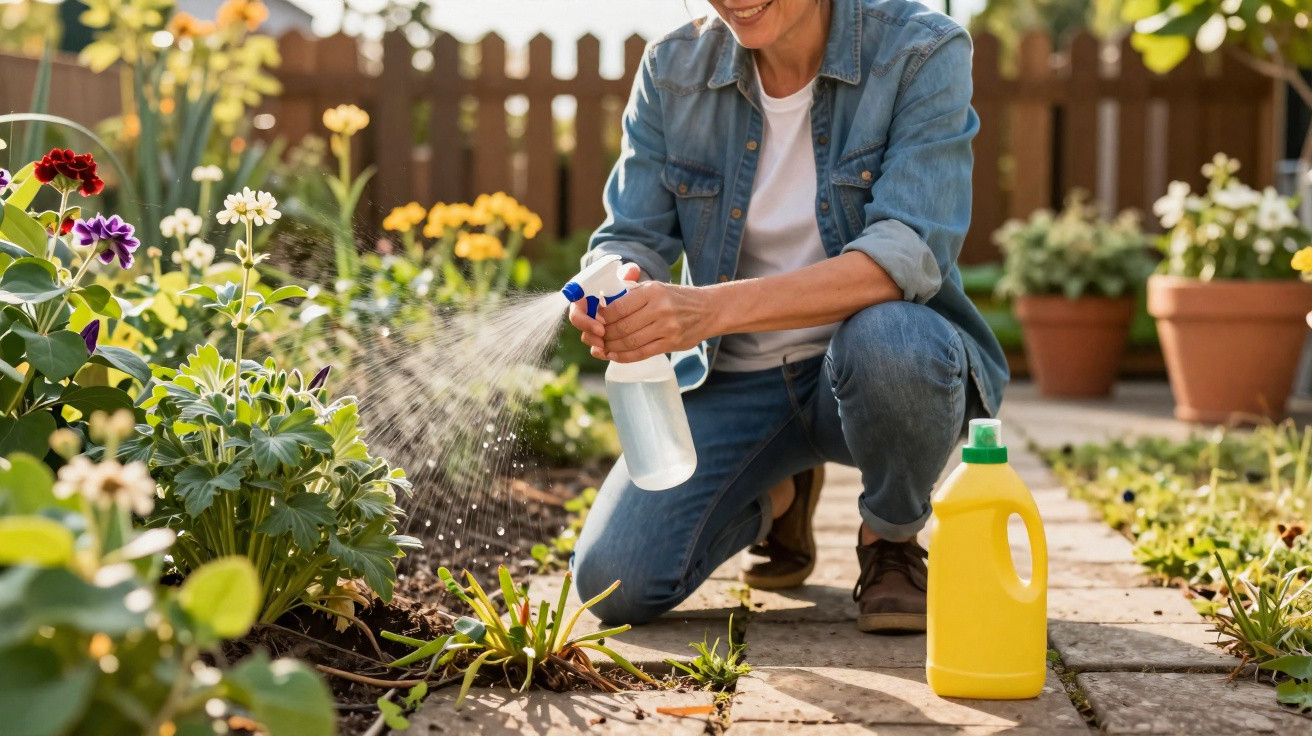
For a while now, forums, gardening groups and social media have been sharing a straightforward homemade spray made from washing-up liquid, water and sometimes vinegar, said to clear weeds from paving joints and gravel paths. What sounds like a brilliant low-cost fix tends to raise more eyebrows than applause among professionals. It’s worth looking closely at what it does, what can go wrong, and what works better.
Why reaching for the vinegar bottle often disappoints
The trend starts with a long-standing home remedy: vinegar. Many gardeners mist heavily diluted household vinegar over small plants that pop up between paving stones or in gravel. The acid attacks the above-ground growth: leaves discolour, stems dehydrate - and at first glance it can look like a win.
That’s exactly where the misconception sits. In most cases the roots remain largely untouched in the soil. After a few days or weeks, many plants simply grow back. Spraying again just means repeating the same cycle.
“Vinegar browns leaves, but often leaves the root largely alone - the plant gets going again later.”
In paving joints and tightly packed gravel, roots can be surprisingly deep and firmly anchored. A superficial “acid shock” is rarely enough to remove the plant properly. Frustrated by the quick return, many people then look for something to boost their homemade mixture - and end up adding washing-up liquid.
Washing-up liquid in the garden: what the mix can actually do
Washing-up liquid is not, in itself, a weedkiller. It’s a cleaning product that contains surfactants. These reduce water’s surface tension so the liquid spreads more evenly and clings better. That sticking-and-spreading effect is precisely what some gardeners are aiming for.
When washing-up liquid is added to a water-and-vinegar solution, the spray tends to coat leaves more thoroughly, run off less quickly, and seep more readily into fine leaf structures. As a result, the above-ground parts of some weeds can dry out noticeably faster.
“In the garden, washing-up liquid works more like a booster: it helps the mixture stay on the leaf longer and act more intensely.”
It’s important to put that into context. Washing-up liquid does not replace a proper weed control product. It acts as an adjuvant - essentially a helper that increases the contact effect of whatever else is in the mix. It does little to fix vinegar’s basic weakness: the lack of meaningful impact on roots.
Typical recipe: how many hobby gardeners mix the “weed cocktail”
In gardening communities, one simple set of proportions appears again and again. It’s often shared as a rough guide, but it is not an official or recommended standard:
- 1 litre of water
- 1 tablespoon of washing-up liquid
- optional: 1 cup of household vinegar
The mixture is usually poured into a spray bottle or small pressure sprayer and applied directly to the green growth in paving joints, on paths or across gravel areas. Many users advise spraying in dry, sunny conditions so the leaves dry out more quickly.
Anyone who still chooses to try this approach should be aware of a few ground rules - not least to avoid unnecessary damage in the garden.
Where the washing-up liquid trick can make sense - and where it doesn’t
In certain outdoor spots, the washing-up liquid mix can look reasonably effective in the short term. In those areas, many people are primarily chasing a tidy appearance rather than protecting soil quality.
Possible areas of use
- Paving joints between patio slabs or paving stones
- Gravel paths and chippings areas that are not meant to be planted
- Kerb edges and margins where neither vegetables nor ornamental plants are growing
In these locations, it matters less if leaves are superficially damaged and some of the liquid seeps away or runs off. Even so, it’s worth remembering that the effect rarely lasts long, and new weeds often reappear quickly if the site remains generally favourable for them.
Where the mix causes problems
Beds, lawns and the area around shrubs and trees are a different story. There, the surfactants and acidity can harm plants you actually want to keep:
- delicate perennials and young plants can suffer scorched leaves
- soil organisms can be thrown off balance if cleaning products are introduced repeatedly
- salty additives (sometimes recommended in other versions of the recipe) can damage soil structure over time
“Household cleaners are designed for sinks - not for living soils with earthworms, microorganisms and roots.”
So if you care about your veg patch, flower borders or fruit trees, it’s best to avoid sprays containing washing-up liquid in those areas.
Legal and ecological grey area
One point that many online tips miss entirely: household vinegar and washing-up liquid are not legally approved weedkillers. Using them for weed control is effectively using them for a purpose they weren’t intended for. On larger areas - for example driveways or yard surfaces - this can even conflict with local rules, because the mixture may enter drains or leach towards groundwater.
There are environmental concerns as well. Surfactants can be harmful to aquatic life, acetic acid can disturb soil life and shift the local pH. A single application once a year may seem insignificant, but frequent use across many households adds up.
Mechanical alternatives: more effort, but more sustainable
If you’d rather avoid chemical weedkillers, there are several approaches that demand a bit more elbow grease but tend to be far more sustainable.
Tools for weeds in joints and gravel
- Joint scraper with a narrow blade for patios and paths
- Wire brushes with long handles, sometimes with a roller guide
- Weed burner (gas) to damage weeds using heat
Heat-based methods don’t necessarily burn the plant away completely, but they do damage the cells decisively. After repeated treatments, weeds usually die back in most cases or at least become much weaker. They won’t disappear forever, but regrowth is typically slower.
Prevention works better than constant rework
If you’re laying new areas, you can avoid a lot of future hassle. A well-prepared base layer, tightly laid slabs and - where appropriate - a firm joint filling using sand or specialist jointing material make it much harder for weeds to get established. In gravel areas, a dense layer and regular raking helps stop young plants rooting deeply in the first place.
Why “weeds” aren’t only the enemy
Strictly speaking, “weeds” are usually just wild plants growing in the wrong place. Many provide food for insects, loosen soil with their roots, and indicate something about nutrient levels in the garden. A completely sterile garden may look neat, but it can be a problem for nature.
A practical middle ground is often best: keep paths and patios tidy, maintain beds deliberately - and allow a bit of growth in less-used corners. That way the garden stays functional without losing its ecological value.
Practical tips for anyone who still wants to test the trick
Plenty of gardeners are curious and want to try the washing-up liquid recipe at least in a small, targeted way. With a few boundaries, it can be done more responsibly:
- treat only small, clearly defined patches
- do not apply in the rain or just before strong winds
- keep run-off into the soil to an absolute minimum
- avoid using it near beds, ponds or water butts
- never add salt to supposedly give it “more power”
If you find the results don’t last, it’s worth being willing to switch back - for example to a joint scraper or a weed burner. These options may be less dramatic than an “internet hack”, but over time they often lead to a calmer, more stable balance in the garden.


Comments
No comments yet. Be the first to comment!
Leave a Comment