
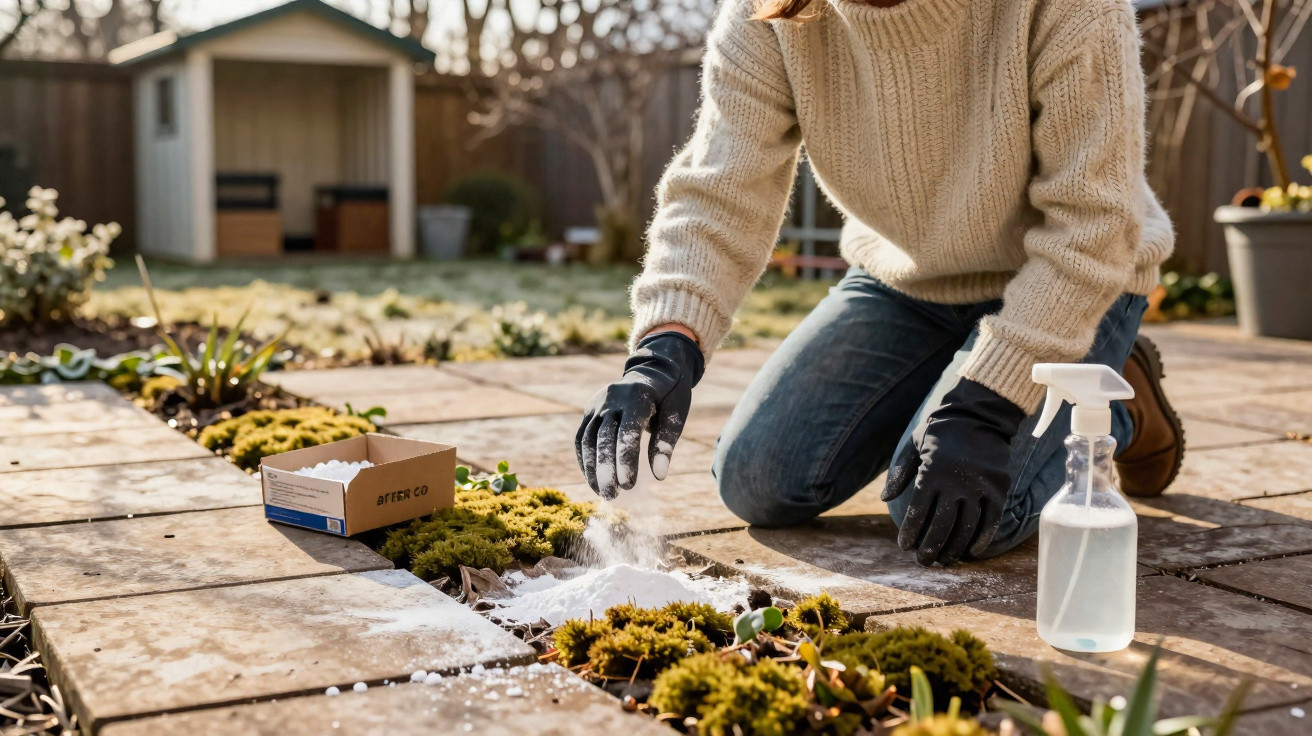
Anyone who spends hours every spring on their knees scraping out paving joints is often making the job harder than it needs to be. Landscaping professionals have long relied on a simple household staple that, when used from mid-winter onwards, starts drying out moss and joint weeds ahead of time. No harsh chemicals, no pressure washer - and by spring, a broom is often all you need.
Why the fight against moss starts in winter
At first glance, a patio in December can look completely dormant. But life continues in the joints: leftover roots, spores and seeds sit ready to take off again as soon as temperatures lift. If you only react in April, you’ve already missed the key window.
That’s why garden professionals begin in the middle of winter. They take advantage of plants’ weak period: sap flow is reduced, growth is close to a standstill, and the plants are more vulnerable. In that moment, one targeted step can prevent regrowth from getting established.
"The key advantage: if you act in January or February, you literally take away moss and joint weeds’ restart in spring."
Where boiling water can damage paving and home remedies such as vinegar often leave roots untouched, one mineral powder works more deeply - and with very little physical effort.
The professionals’ secret household remedy: bicarbonate of soda from the kitchen
The “magic” ingredient isn’t exotic at all: it’s ordinary bicarbonate of soda, familiar to many from cooking or cleaning. Chemically, it’s a mineral salt that draws water out of plants.
When it touches leaves and shoots, bicarbonate of soda creates osmotic stress. Water moves out of plant cells, causing the plant to dry out. At the same time, the powder’s mildly alkaline nature slightly raises the pH in the joints. That makes it harder for spores and seeds to sprout again.
"Bicarbonate of soda doesn’t work like a classic poison; it removes moss and joint growth’s basis for survival - right down into the root zone."
A particularly useful winter bonus is the natural moisture from fog, dew and drizzle: it helps the powder dissolve gradually and travel deep into the joints. So there’s no need to scrub or rinse.
How garden professionals apply bicarbonate of soda correctly in winter
Dry application for a preventative effect
For areas that aren’t completely overgrown yet, the dry method is ideal. It can be done in a single afternoon:
- Sweep the patio or driveway roughly with a broom
- Sprinkle about 20 grams of bicarbonate of soda per linear metre of joint (a small handful)
- Use a stiff broom or brush to work the powder down into the gaps
- Do not rinse - moisture from rain and dew will do the rest
This gets the granules straight to the soil and root material. The effect builds over several weeks without you having to do anything else. By spring, the joints are noticeably lighter and almost free of growth.
Liquid solution for heavily mossed areas
If the surface is already heavily greened over, dusting alone often won’t be enough. In that case, a bicarbonate of soda solution helps because it can be directed right onto moss cushions and clumps of weeds.
Many professionals mix it like this:
- Pour around 950 millilitres of water into a bowl or watering can
- Stir in two to three tablespoons of bicarbonate of soda until fully dissolved
- Transfer the solution into a watering can with a rose head or a pump sprayer
- Apply directly onto moss and weeds in the joints in dry, still weather
After just one to two days, the green typically shifts to yellowish tones and then brown. The plants become brittle and can be removed easily with a broom or joint scraper. Persistent patches are treated a second time, precisely where needed.
Where bicarbonate of soda makes sense - and where it doesn’t
As handy as this household remedy is, it isn’t suitable everywhere. Because it’s a mineral salt, too strong a concentration can also affect soil life and plants you actually want.
"Bicarbonate of soda belongs on patios, paved paths, driveways and steps - not in borders, not in the vegetable garden."
If you want to play it safe, stick to a few basics:
- Use only on mineral surfaces (concrete, paving, slabs, stone)
- Keep an eye on drains and channels so concentrated run-off doesn’t flow into beds
- Apply no more than once or twice a year
- Treat edges next to lawns and perennials with care
On sloping sites in particular, any run-off solution can otherwise end up in parts of the garden where healthy soil life matters. If you’re working close to beds, keep the dose light and work accurately within the joints.
How effective bicarbonate of soda is against moss - and where its limits are
In many gardens, the first winter season brings a clearly visible difference: less moss, less slip risk, cleaner-looking joints. The dreaded spring clean shrinks to a quick sweep.
At the same time, bicarbonate of soda isn’t a replacement for ongoing upkeep. If a patio has been left completely untouched for years, even a salt solution won’t clear every joint in the first year. In that situation, a combination approach pays off:
- In the first year: do a rough clean in spring, then use a bicarbonate of soda solution for remaining growth
- From the following winter: scatter dry bicarbonate of soda as a preventative measure
- If needed: spot-treat individual joints
Construction also plays a part. Deep, very sandy joints give moss more purchase than narrow, well-compacted gaps. If you’re re-pointing anyway, choosing a slightly firmer jointing compound can help slow regrowth over the long term.
Risks, misunderstandings and sensible alternatives
A common misconception is that bicarbonate of soda must be completely harmless because it’s a “household remedy”. In high doses it still puts stress on soil and can harm beneficial organisms. That’s why it should be used responsibly - not poured over everything out of frustration with moss.
If you have delicate natural stone, test the method in an inconspicuous spot first. Some softer stones are more sensitive to salt solutions, even at moderate concentration.
There are also a few additional methods that can be combined with bicarbonate of soda:
- Mechanical joint care: In spring, remove loose plant remains with a joint scraper or scraping tool.
- Brush attachments for garden equipment: Rotating brushes loosen surface growth without needing water.
- Let in more sun: Cut back overhanging branches to reduce damp, shaded corners.
Many gardeners find that by the second year, a routine develops: work in bicarbonate of soda once in winter, sweep occasionally - done. The back-breaking, knee-down joint scraping becomes the exception.
Anyone wanting to avoid harsh chemical weedkillers on paths will find bicarbonate of soda an affordable, controllable option. A few quick steps in winter can decide whether your patio is a spring building site - or ready to enjoy.

Comments
No comments yet. Be the first to comment!
Leave a Comment