
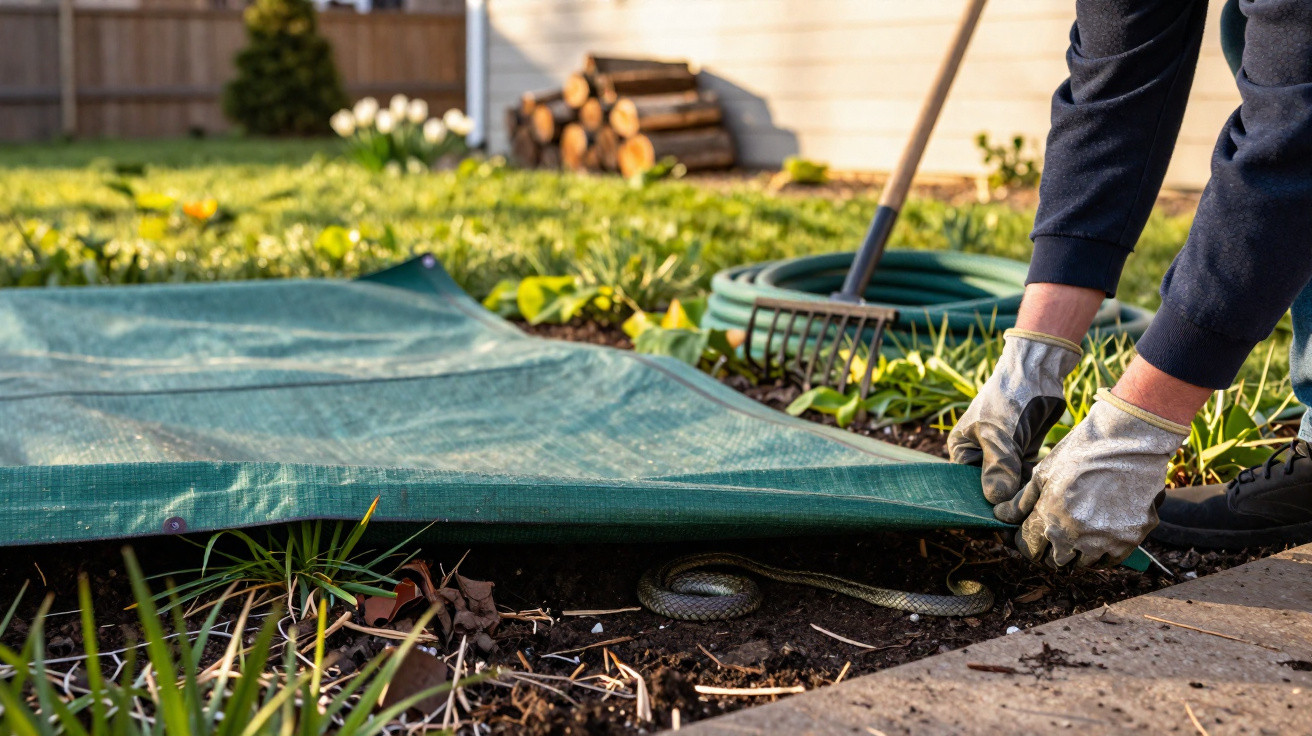
The lawn has just been cut, the garden furniture is out - and somewhere there is still a tarp or an old sheet lying flat on the grass. That exact spot can quietly turn into a comfortable hiding place for reptiles. If you are unlucky, you can end up attracting snakes right by the patio, a children’s play area, or the front door without even realising.
Why a simple tarp becomes a snake magnet in spring
Snakes are cold-blooded, which means they rely on their surroundings to manage their body temperature. As soon as spring brings milder weather, they deliberately look for warm, sheltered places where they can heat up without being easily spotted.
A dark garden tarp spread flat on the ground provides exactly that. The plastic absorbs heat from the sun during the day. The soil underneath holds warmth and moisture. The result is a small, protected microclimate - ideal for reptiles emerging after winter dormancy.
"From above it just looks like a boring tarp - underneath, a snake can warm itself comfortably, hide, and hunt."
What looks from the patio like a "leftover from a garden project" becomes a kind of natural radiator for snakes. Harmless species are particularly fond of these spots. In rare cases, however, venomous species may also favour similar hiding places - depending on the region.
These items in the garden make perfect hiding places for snakes
Tarps are not the only issue. Around the house, several accidental “snake hotels” can build up in day-to-day life - with no ill intent at all:
- Garden tarps and sheeting left flat on lawn or soil
- Old metal sheets, boards, slate pieces, or fibre-cement offcuts resting on the ground
- Wood piles stacked directly on soil, without a pallet or base
- Compost heaps covered with plastic, old carpet pieces, or boards
- Forgotten building materials such as roof tiles, stones, or slabs dumped in a corner
All of these have the same qualities: they sit close to the ground, they warm up, they create shade, and you cannot see underneath easily. That makes them attractive not only to snakes, but also to animals such as mice, lizards, or toads.
Spring check around the house: how to remove what attracts snakes
A deliberate walk around your garden and yard in spring can improve safety with very little effort. Think of it as a kind of “outdoor spring clean”:
- Remove tarps, sheeting, and covers from the ground.
- Put wood stacks on pallets or racks (at least 20 cm of ground clearance).
- Do not store old metal sheets, slabs, or boards directly on soil - prop them up or dispose of them.
- Keep the lawn and any long grass short, especially close to the house, along paths, and near play areas.
"If you lift tarps, wood, and boards off the ground, you remove snakes’ favourite hiding places and automatically push the ‘snake belt’ further away from the house."
It is particularly worth keeping things tidy around patios, children’s play areas, pools, ponds, and front doors. Short grass, minimal clutter at ground level, and a clear view reduce the chance of getting unpleasantly close to a snake by surprise.
How to store garden tarps properly without attracting snakes
Tarps are useful and do not need to go in the bin. What matters is how you store them. A few simple steps are enough:
- Lift the tarp off the ground and shake off loose dirt.
- In dry weather, spread it out and let it dry completely.
- Roll or fold it neatly.
- Hang it up in a garage, shed, or cellar, or place it on a shelf - and never lay it flat on soil again.
The same principle applies to large metal sheets, wooden boards, or leftover materials from building projects: move them into a vertical position, lean them against a wall, or store them under cover. The main thing is that they are no longer lying directly on the ground.
What to do if you suddenly find a snake under a tarp
Even if you are careful, it can still happen: you lift an old cover and a snake is there underneath. In that moment, keeping calm and keeping your distance matters most.
- Keep at least 2 to 3 metres away.
- Only lift the tarp or board from the side, using a long handle, broom, or rake.
- Do not lean over it; stay to one side.
- Step back slowly and leave the animal a clear escape route.
"With distance, calm, and a long handle, you defuse the situation - most snakes will flee as soon as they have space."
Taking matters into your own hands and trying to “deal with” the snake is a bad idea. Many snake species are strictly protected. Anyone who deliberately kills them risks heavy fines - and in extreme cases, even imprisonment.
Snakes in the garden: assess the risk instead of panicking
In Central Europe, most snakes are not generally dangerous to people. Non-venomous species usually only bite if you grab them or corner them, and even then it is typically more of a fright than a serious incident.
Even so, many people feel strong dislike or fear. It helps to understand your local area: some regions have venomous species, while others have practically none. Local conservation organisations or councils can provide information.
If you are unsure after a sighting, you can take photos from a safe distance and contact a local conservation organisation or the relevant authority to ask for help identifying the species.
How to balance your garden and nature
Interestingly, you can improve human safety while still respecting wildlife. A highly styled, completely “sterile” garden is neither necessary nor especially good for biodiversity. A clearer approach is to divide the space:
- Keep the area close to the house tidy, easy to see, and well mown.
- Leave a wilder corner at the back of the plot: long grass, deadwood, a small pile of stones.
- Create hiding places and refuges deliberately well away from the patio and play area.
This way, habitats for lizards, insects, hedgehogs, and also snakes can remain - just in places where encounters with people are less likely.
Why warmth, moisture, and prey matter
Snakes do not choose resting places at random. Three factors are key:
| Factor | What encourages it in the garden |
|---|---|
| Warmth | dark tarps, stones, slabs lying in the sun |
| Moisture | compost heaps, dense grass, water points, shady corners |
| Prey | mice, frogs, insects in wood piles and clutter |
If you reduce at least one of these - for example, by removing heat-trapping items right next to the house or by limiting hiding places for mice - the area immediately around the building becomes much less appealing.
Practical examples of a “snake-safe” garden area
A few straightforward changes are often enough:
- Use a wooden rack or metal frame for firewood beside the shed, rather than stacking logs on the ground.
- Choose solid, light-coloured paving slabs right next to the patio instead of loose boards or leftover offcuts.
- Position children’s play areas with a sandpit, slide, and swing well away from compost and wood storage.
- Keep a rainwater butt securely covered and the surrounding area free of clutter.
Keeping these points in mind reduces the risk of unwanted encounters with snakes and also makes the garden feel tidier and easier to oversee - without having to give up nature entirely.
Comments
No comments yet. Be the first to comment!
Leave a Comment