
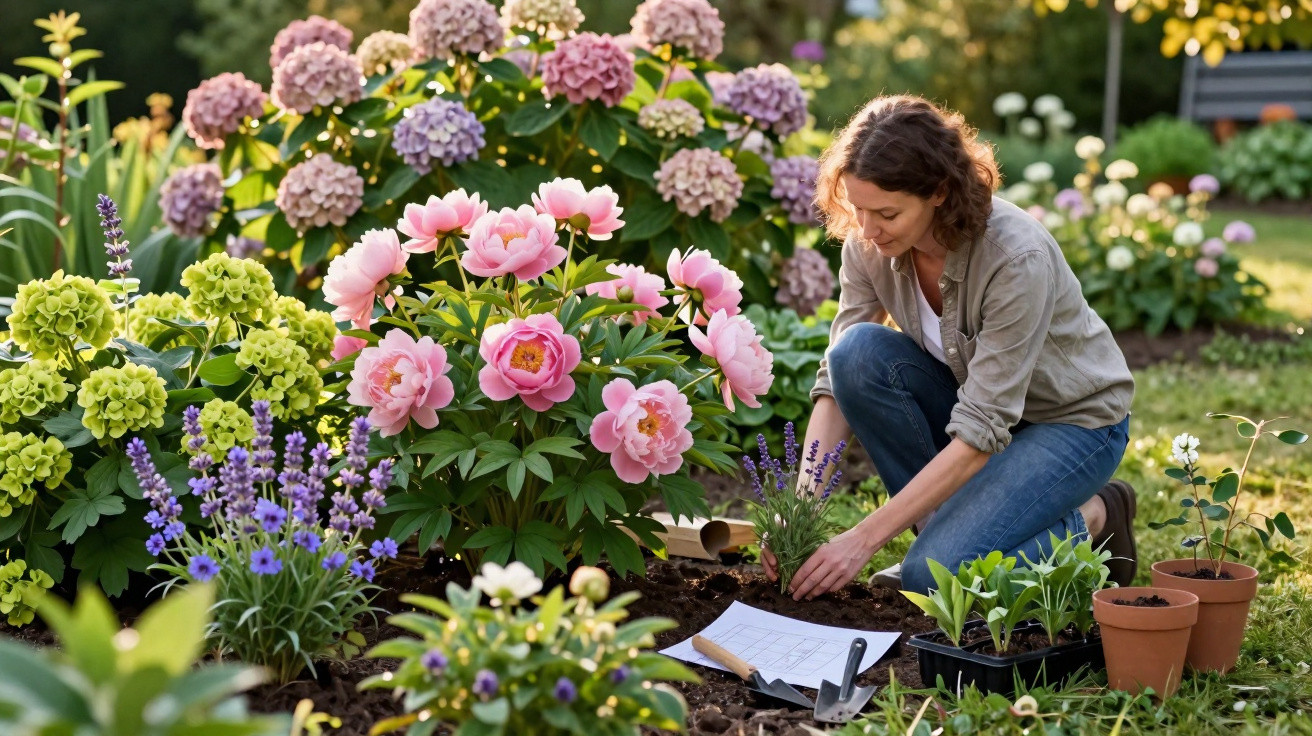
Plenty of gardeners plant a peony, enjoy a handful of blooms, and then wonder why it never turns into a proper showstopper. The secret is rarely the cultivar itself; it is almost always the setting around it. Position, soil, and the plants growing right next to it determine whether a few stems become a standout flowering performance.
What peonies genuinely need before neighbours are allowed into the border
If you want to pair peonies well, you first need to work with their basic needs. These perennials thrive in bright conditions. A sunny spot or light partial shade suits them, provided the midday sun is not relentlessly beating down and the soil is not drying out.
Soil is just as important: it should be deep, humus-rich, and still free-draining. Waterlogging in winter is disastrous. It weakens plants, causes buds to rot, and makes it far easier for fungal diseases such as grey mould to take hold.
"Peonies need light, space and drier feet – then they build up year after year rather than going backwards."
A common misstep is packing the bed too tightly. Peonies do not enjoy being crowded. When they are hemmed in by surrounding roots and foliage, moisture lingers in the planting. That creates a close, humid microclimate in which fungi thrive.
Three basic rules for choosing suitable companion plants
- Compare growing requirements: pick plants with similar sun and soil preferences to peonies.
- Avoid giants in front of or over peonies: tall, dense perennials planted directly ahead will steal their light.
- Give each perennial its own circle: leave at least a hand’s breadth of open, loose soil around every peony.
Keep to these essentials and you create the conditions for combinations that look cohesive and stay healthier, too.
Soft texture and colour: lady’s mantle and bellflowers as the ideal backdrop
Peonies look particularly balanced with Alchemilla, usually called lady’s mantle. This perennial forms a dense yet low carpet of soft, rounded leaves. In early summer, a haze of countless yellow-green flowers floats above it.
"The delicate yellow glow of lady’s mantle makes pink, white or red peony flowers shine – in the border and in a vase."
Lady’s mantle remains compact, does not push into the peony’s space, and its leafy cushion helps prevent the soil from drying out. At the same time, it is not an aggressive competitor for the peony’s roots. The result is a calm base layer that makes the large flower heads look almost painted in place.
Perennials with bell-shaped flowers can work just as well, including many varieties of bellflower (Campanula). They add a playful note and help fill gaps once peonies are nearing the end of their flowering. The key is to choose compact types so they do not shoot up too tall.
One small drawback: some bellflowers attract pests more readily. If you include them, start with healthy plants and position them nearer the edge of the bed, or weave them in lightly with fragrant, protective plants.
Hydrangeas for a structured background and a continuous flowering calendar
If you want the bed to look good beyond the peony season, you need reliable structure behind the main display. This is where hydrangeas earn their place. Their large flower heads echo the rounded shape of peony blooms, but they flower for far longer.
They are best planted with a little distance behind the peonies. That way, in high summer they can cast a touch of shade without overwhelming the main stars. Many hydrangeas cope well with sun as long as the soil does not dry out. Planting is typically done from autumn through to spring, once the ground is free of frost.
For an unbroken run of colour, these companions also fit well:
- Bearded iris: flowers shortly before peonies, adds strong vertical accents, and enjoys the same sunny position.
- Ornamental alliums (Allium): appear at the same time or a little later, and their spherical blooms create a graphic highlight.
- Daylilies (Hemerocallis): take over in midsummer when peonies are mostly foliage.
| Plant | Main flowering period | Role in a bed with peonies |
|---|---|---|
| Bearded iris | late spring | signals the start of the flowering season, emphasises height |
| Peonies | late spring to early summer | the star of the bed, large, eye-catching blooms |
| Ornamental alliums | early summer | graphic spheres among the perennials, protective function |
| Daylilies | summer | extend the colour season, fill emerging gaps |
| Hydrangeas | summer to autumn | calm, stable backdrop in the background |
Lavender as a bodyguard: scented protection for delicate blooms
Lavender pairs naturally with peonies, at least where the soil is fairly free-draining. Both prefer sun, both manage with moderate moisture, and both do best when left in the same spot long term.
"Lavender acts like a living protective fence: beautiful to look at and at the same time a natural deterrent for many garden pests."
Lavender’s strong scent can put off mosquitoes, flies, some sap-sucking insects, and even larger visitors such as deer. In many gardens, a loosely planted row of lavender along the bed edge is enough to help shield more sensitive perennials in the centre.
Ornamental alliums reinforce this effect. Their sulphurous note discourages certain pests, while their flower spheres visually echo the rounded peony heads. Using both creates planting that is bold in appearance and practical in function.
These companions do peonies no favours
Despite the many good combinations, some plants tend to cause trouble in the same bed. The most problematic neighbours are strong root competitors or species that prefer persistently damp soil.
- Large ornamental grasses: they grow vigorously, root densely through the surrounding area, and take a lot of water and nutrients.
- Perennials for boggy soils: where the ground stays wet, peonies struggle and rot becomes a risk.
- Overly dense ground cover: it reduces air movement at soil level and holds morning dew for longer.
Bellflowers and similar pest-prone perennials can also become an issue when they form big swathes. In smaller groups, supported by lavender, ornamental alliums, or other aromatic perennials, the partnership works far more reliably.
Practical tips: how to make the planting scheme work in your own garden
If you are reshaping an established bed, begin with a quick assessment. How much sun actually reaches the peony? Is it already too hemmed in? Does water sit after rainfall?
Useful steps:
- Plan a loose open space of around 40–60 centimetres around each peony.
- Place taller companions towards the back, with low, cushioning plants such as lady’s mantle at the front.
- Create a scented barrier with lavender or other aromatic perennials, particularly along sunny bed edges.
- Stagger flowering times so that colour runs from April into midsummer.
Especially in smaller gardens, a clear plan pays off so the site works for the long term. Peonies dislike being moved repeatedly. If you plant them correctly once and build the surrounding scheme intelligently, you will be rewarded with dependable flowering for years.
Why peonies react so strongly to their neighbours
Peonies are among the longest-lived perennials. Many specimens stay in the same place for decades. Their thick, storage roots bank energy that they can only accumulate with the right balance of sun, nutrients, and air circulation.
If they sit in too much shade, they set fewer buds. If they are too wet and too tightly planted, they spend more energy on defence and recovery than on flowering. Neighbouring plants influence all of these factors indirectly. That is why a well-composed bed can feel like a completely different garden climate, even if it is only a few metres away.
Once you understand this interplay, you can stage a favourite peony with intent: calm leaf veils in the foreground, clear structural plants in the background, fragrant guardians along the edges, and a succession of partners that keeps the “stage” from ever looking empty.



Comments
No comments yet. Be the first to comment!
Leave a Comment