
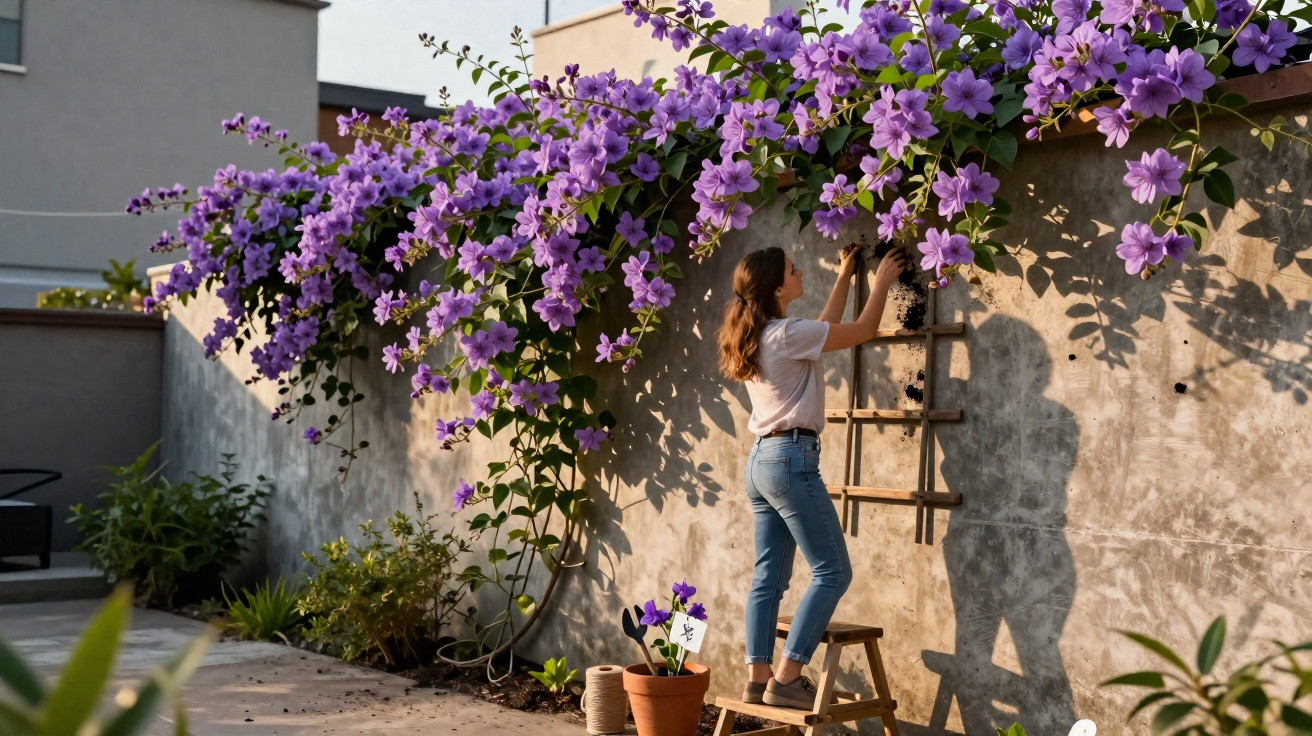
Many homeowners end up frustrated by a bare retaining wall in the garden: grey, cracked and structurally essential, yet a real mood-killer to look at. What’s often overlooked is that the right perennial can turn that problem into a striking feature in just a few weeks - especially in spring, when one particular plant makes the stonework disappear beneath a sea of violet flowers.
Why aubrietie is made for bare walls
The quiet hero for tricky walls is Aubrieta deltoidea, better known here simply as aubrietie. In garden centres it’s also commonly sold as rock cress (sometimes labelled as wall cress). It originates from rocky landscapes where many plants struggle to survive - which is precisely why it’s such a strong choice for dry, stony retaining walls.
Aubrietie forms low, cushion-like mats at around 10–15 cm tall. Rather than growing upwards, it spreads outwards, creeping over stones, joints and wall edges. From mid-April into early summer, it carries hundreds of small, violet flowers which, depending on the variety, can lean slightly towards pink or a deeper purple.
"Within a single spring, a gloomy wall can look as if someone has poured a violet waterfall over it."
Its preferred conditions read like the specification for a typical retaining wall: poor, gravelly soil, plenty of stone, perfect drainage and lots of sun. While many garden plants scorch and fail in such spots, alpine cushion perennials come into their own there. Aubrietie copes with dry spells, enjoys heat, and also handles frosty winters well.
The ideal spot on a retaining wall
If you want the wall to become a small piece of garden art, focus first on the top edge. From there, aubrietie can “flow” downwards and drape the stones like a curtain.
- Best position: the top of the wall, ideally facing south or west
- Light needs: several hours of direct sunshine per day
- Soil: on the lean side, sandy-gritty, and absolutely free-draining
- Climate: tough in areas with cold winters and hot summers
The key point is preventing water from sitting around the roots. If your garden has very heavy, clay-rich soil, it’s best to work in plenty of gravel or grit. That helps the planting pockets dry quickly after rain - exactly the condition this perennial thrives on.
How to plant aubrietie correctly in a retaining wall
The quickest route to a flowering cascade is using small, pot-grown young plants. Sowing from seed is possible, but it takes noticeably longer and is more fiddly to manage along a wall edge.
Step by step to a flowering cascade
- Choose the planting time: spring after the last night frosts is ideal, or a mild autumn.
- Create planting pockets: dig small niches between two stones or just behind the top course.
- Mix the substrate: one part ordinary garden soil, one part well-rotted compost, two parts gravel or grit.
- Set the plants in place: loosen the roots and place the plant in the pocket with a slight outward tilt.
- Water in: give one thorough watering so the mix settles around the roots - then keep watering to a minimum.
Don’t space the plants too closely. A gap of 25–30 cm is enough for them to knit into a continuous carpet over the coming years. During the first few weeks, it’s worth checking after heavy rain: if any substrate has washed out, simply top it up again with the soil–gravel mix.
Maintenance: minimal effort, maximum impact
Once established, aubrietie is widely considered ideal for beginners. It tolerates missed watering, copes with baking sun against a wall, and doesn’t need a complicated feeding regime. In fact, too many nutrients can encourage leafy growth at the expense of flowers.
The three most important care steps
- Water: only during prolonged dry periods, especially in the first year after planting.
- Cut back: after flowering (May/June), trim the plants back by roughly half.
- Rejuvenate: every few years, lift and divide small sections and replant them elsewhere along the wall.
Cutting back straight after flowering is the key technique. It keeps the cushions dense and compact rather than letting them go bare in the middle. At the same time, it encourages fresh shoots - which helps deliver even heavier flowering the following spring.
"If you give aubrietie a strong cut after it flowers, you’ll be rewarded the next year with an even denser carpet of blooms."
A welcome side benefit is that the flowers attract plenty of insects. Bees and butterflies make use of the early nectar, while deer and rabbits tend to leave the plant alone.
Turning the wall into a mini habitat
The retaining wall looks even more impressive when aubrietie isn’t the only plant. In the upper joints, drought-tolerant succulents pair beautifully with it, such as houseleek (joubarbe) or low-growing Sedum varieties. These keep their structure even in winter, when aubrietie isn’t in flower.
If you enjoy playing with colour, you can mix different aubrietie varieties - from soft lilac to deep purple, with single or double flowers. The result is layered cascades that shift in character as the light changes.
Suitable companion plants for dry walls
- Houseleek in a range of forms and colours
- Low Sedum varieties (stonecrop)
- Cushion phlox for later or complementary flowering periods
- Thyme mats that add fragrance and green up joints you can step on
By combining several species, you create a tiered effect: aubrietie delivers the big violet display in spring, Sedum and houseleek provide structure, and phlox and thyme add extra colour accents and scent.
Risks, common mistakes and practical tips
Using plants on a retaining wall isn’t entirely risk-free. If the conditions are wrong, plants can quickly decline. However, the most common issues are easy to avoid:
- Too much moisture: waterlogging quickly leads to root rot. It’s better to water slightly too little than too often.
- Unsuitable soil: pure potting compost holds too much water. Always mix in gravel or sand.
- Permanent shade: on a north-facing wall, aubrietie flowers sparsely. In that case, choose different wall plants.
- Weed pressure: at the start, keep joints free of grasses until the cushions have closed over.
For very steep, tall walls, it can help to plant from multiple levels: at the top, in mid-level joints, and at the base. This spreads the planting more evenly and transforms the wall as a whole.
One factor that’s often underestimated is heat. In full sun, retaining walls warm up like a storage heater. That suits heat-loving plants, but it can stress roots where the soil layer is shallow. A slightly thicker layer of gravel and a free-draining - but not ultra-thin - planting mix helps buffer this.
If you like experimenting, you can also raise new plants easily from cuttings. Push short shoots into a mix of sand and fine soil, keep it lightly moist, and protect it from harsh, direct sun - after a few weeks, roots will have formed. In this way, the violet carpet can be extended step by step across the entire wall, turning a purely functional structure into a living focal point.
Comments
No comments yet. Be the first to comment!
Leave a Comment