
Many home gardeners ask themselves every year why the neighbour’s peonies seem to hover above the borders as huge, round blooms, while their own plants flower rather modestly. The reason is rarely the variety. More often it comes down to a brief window in early spring - and one deliberate job carried out in the soil.
Why the end of March decides the size of the flowers
Peonies are among the perennials that need a clear winter dormancy. Several weeks of cold at around 4 °C trigger internal signals that set bud formation in motion. By the time late March arrives, most plants have already clocked up these “chill hours”.
At the same time, frost can work against the plant. Repeated freezing and thawing gently lifts the soil. In the process, the peony’s fleshy roots can be pushed upwards, where they may dry out or become stressed.
This is exactly where using mulch correctly matters. A protective layer over the root zone smooths out temperature swings. However, once the first reddish shoots show, the plant benefits from warmer soil again. That’s when the short window begins in which a single action can strongly affect bloom size in May.
“Between the last days of March and the start of active growth, it is decided whether peonies carry ordinary flowers or impressively large blooms.”
The practical move: lightly loosen the soil and feed with purpose
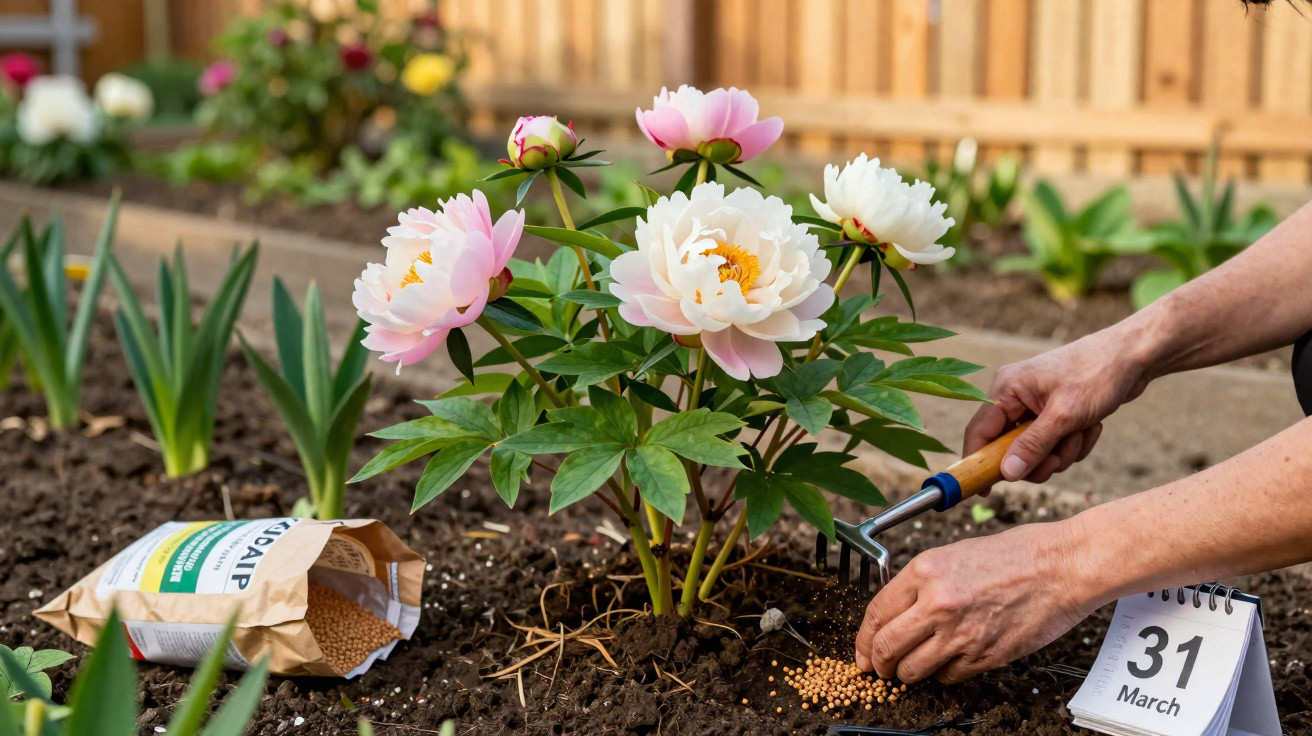
The key is a gentle pass over the soil surface around the plant, paired with a suitable nutrient boost. It takes barely ten minutes per clump, but the effect can carry on for weeks.
How to do it step by step
- Clear the area around the clump to roughly a 20 cm radius
- Push the mulch layer slightly to one side, rather than removing it completely
- Scratch or loosen only the top 3–5 cm of the soil
- Work in an organic fertiliser shallowly
- Water in carefully, without creating waterlogging
Depth is where people most often go wrong. Peonies have many fine roots just beneath the surface. If you dig 15 cm deep, you sever large numbers of these roots. The plant then has to repair damage and puts less energy into buds and flowers.
Which nutrients really make peonies produce bigger blooms
For large, sturdy flowers, a peony essentially needs three things: a short hit of nitrogen for leafy growth, enough phosphorus for bud development, and some potassium to keep stems strong.
A proven approach is to combine two classic organic fertilisers:
- a fast-acting nitrogen source to kick-start growth
- a slow-release reserve of phosphorus and nitrogen to support bud formation
Around 50 g per plant is usually sufficient. Mix it into only the upper centimetres - more like “massaging” the surface than turning it in deeply.
Afterwards, about 1 litre of water is enough to moisten the fertiliser and settle the soil lightly. The ground should be damp, not saturated. Important: keep the peony’s crown (the point where shoots emerge from the soil) clear at all times, and never cover it with soil or mulch.
Extra tip for stronger stems
If you have ever watched heavy peony blooms collapse after a thunderstorm downpour, one additional trick can help: work a small amount of sieved, cold wood ash into the very top layer of soil.
Wood ash provides potassium, which strengthens cell walls. One tablespoon per plant is plenty. Too much can push the soil too alkaline, so use it sparingly.
The biggest spring mistakes with peonies
A lot of well-intended care does more harm than good for peonies. Three issues come up particularly often:
- Digging too deeply: the taproot may remain intact, but the fine feeder roots get cut. Result: weaker growth and fewer buds.
- Overfeeding with nitrogen: the plant produces lush, deep-green foliage but few or no flowers. Many lawn fertilisers contain far too much nitrogen for peonies.
- Mulch kept wet for too long: a thick, soggy mat right against the crown encourages fungal diseases such as grey mould.
Mulch is still a valuable tool when used with restraint. In winter, 5–10 cm of loosely applied chips, leaves, or straw helps protect the soil from harsh fluctuations. In spring, pull the mulch back bit by bit so sunshine can warm the soil again.
“Peonies need protection in winter, but in spring they need air and warmth at the base - too much moisture in the wrong place gives fungi the perfect stage.”
How to adjust care for borders, pots, and different climates
The method described works in most gardens, but it benefits from small tweaks depending on the plant’s age, the site, and the local climate.
Young peonies in the ground
Plants that have only been in the soil for one or two years react more sensitively to feeding. Here, a lighter hand pays off:
- use only half the fertiliser amount
- leave the winter mulch layer a little thicker
- loosen more slowly and even more gently in spring
Young peonies should focus first on building a dependable root system. Too much fertiliser tempts the plant into pushing lots of leaf growth before the underground “foundation” is truly established.
Treating peonies in pots correctly
In containers, peonies experience much bigger temperature swings. The root ball freezes through more quickly, yet it can also dry out faster once spring arrives. A few measures help potted plants through this phase:
- move the pot against a sheltered house wall
- wrap the container with fleece or hessian during severe frost
- loosen only the very surface in early spring
- check the compost for good drainage so waterlogging cannot develop
In a pot, apply spring feed especially sparingly - around one third to at most half of the amount used for plants in the open ground. Container-grown peonies are more sensitive to excess nutrients.
Cooler regions and higher ground
In harsher areas, it’s better to follow the plant rather than the calendar. When the first buds show, that’s the moment to loosen and feed - whether it is mid or late March, or in some years a little later.
If flowering still disappoints despite correct care, it is worth checking the basic site conditions:
- at least four to five hours of sun per day
- planting depth: the peony’s “eyes” should sit only a few centimetres below the surface
- no regular use of strongly nitrogen-heavy all-purpose fertiliser
Background knowledge: why peonies react so strongly to depth and fertiliser
Peonies sit in the soil differently from many other perennials. The buds that produce spring shoots are positioned relatively close to the surface. If they are buried too deeply when planting - or later, after topping up soil - the plant’s internal balance shifts. It may still produce leaves, but often falls short of its potential when it comes to the number of flowers.
Nutrients add another layer to the picture. Nitrogen drives quick growth, but it can upset the balance between foliage and buds. Phosphorus specifically supports flowering and root development, while potassium firms up plant tissue - particularly important when blooms are heavy.
Understanding these links makes it clear why a brief intervention at the end of March can change so much. The plant is just about to start the season, the roots are active, and the buds are already set. In that moment, lightly loosened soil and a balanced feed give the decisive push towards strikingly large blooms.




Comments
No comments yet. Be the first to comment!
Leave a Comment