
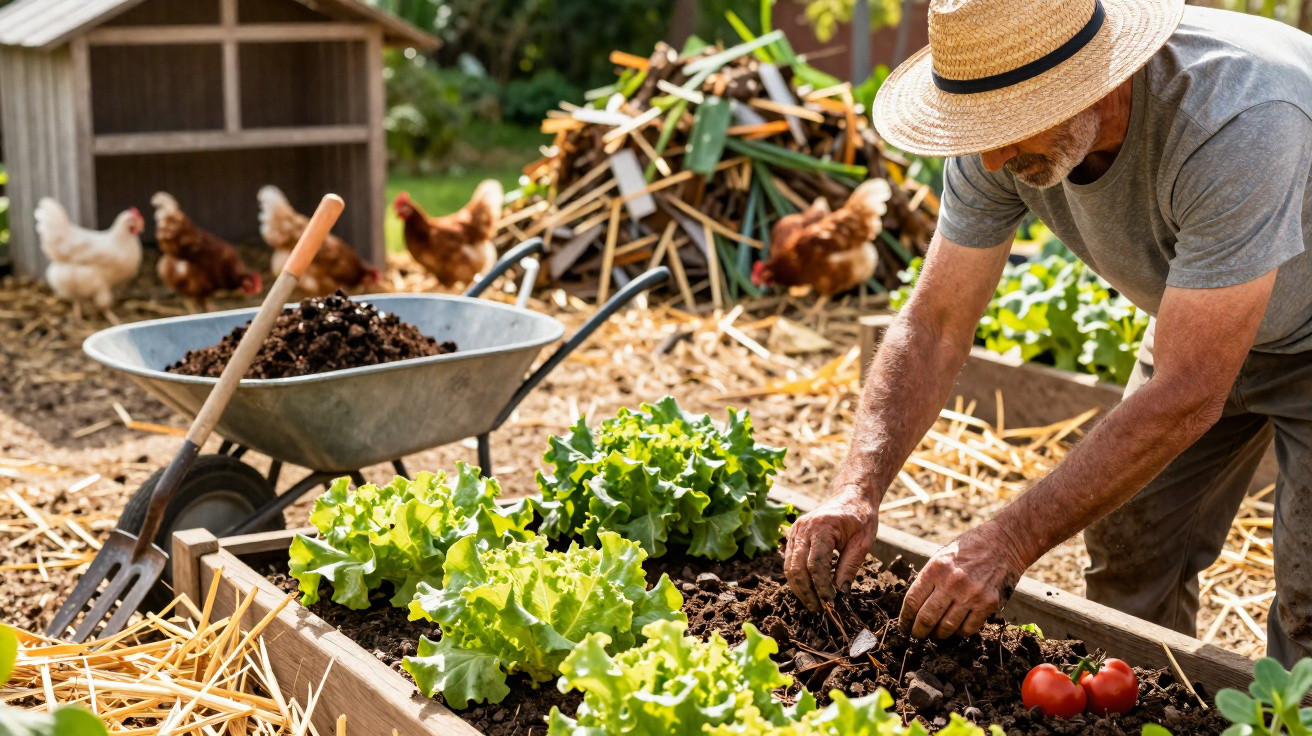
Many keen gardeners reach for bags of specialist fertiliser as soon as spring arrives. But if you keep chickens, you already have a powerful fertiliser at home-freshly produced every day. Chicken manure from the coop can feed vegetable beds and fruit trees with nutrients that easily rival shop-bought products. The key is turning this “waste product” into a plant-friendly, highly effective soil tonic.
Why chicken manure is so valuable in the garden
Among popular animal manures, chicken manure is considered a real heavyweight. It contains noticeably more nitrogen, phosphorus and potassium than manure from cattle, sheep or horses. These are exactly the nutrients that drive leafy growth, flowering and fruit set.
Properly prepared, coop manure becomes “black gold” for tired soils.
In day-to-day life, soiled bedding often ends up dumped on the compost heap without much thought-or even in the general waste. That means giving away a free source of nutrients that can work wonders, especially in vegetable beds.
What’s really in chicken bedding
When you clean out the coop, you usually end up with a mixed bundle of materials:
- Straw or wood shavings
- Feathers
- Chicken manure
- Leftovers of feed and sand
The most useful material is found directly beneath the perches. That’s where most of the droppings collect-highly concentrated and therefore particularly rich in nutrients. This is exactly the blend that later becomes the basis for your fertiliser.
The danger: fresh chicken manure can scorch plants
As powerful as chicken manure is, it can be risky if used straight away. Fresh manure behaves like an overly strong liquid feed. The roots and leaves of young plants are especially sensitive.
If you spread bedding straight from the coop onto a bed, the following can happen very quickly:
- Roots burn and plants start wilting from the bottom up
- Leaves develop brown edges and spots
- Seedlings die within a few days
Gardeners call it a “hot” fertiliser: too much nitrogen delivered too fast. The soil can cope with it, but plants often cannot. That’s why chicken manure needs a maturation period before it goes anywhere near beds or fruit trees.
Six months of rest: manure becomes fine compost
How the maturation process works
The safest route is composting. The bedding from the coop either goes onto a dedicated heap or into your regular compost. From there, a slow transformation begins:
- The heap heats up, killing germs and weed seeds.
- The structure breaks down, becoming finer and more crumbly.
- The sharp smell fades, leaving an earthy scent.
After roughly half a year, the aggressive mix turns into a mild, well-tolerated compost. The nutrients are still there, but now in a form plants can take up gradually.
Moisture and air: no care, no good fertiliser
To make the process work, the heap needs at least a little attention:
- Check moisture: The material should feel like a wrung-out sponge. If it’s dusty-dry, decomposition slows; if it’s soaking wet, it can turn foul.
- Turn it regularly: About every three weeks, loosen and turn it with a garden fork. This brings in oxygen and keeps the micro-organisms active.
The better a heap is aerated and kept moist, the faster “hot” manure turns into fine, crumbly premium compost.
How to use chicken compost in your beds
Vegetable beds: a thin layer, a big effect
Once it has matured, the manure compost is ready to use. For hungry vegetable crops, it works well as a “nutrient crust” around plants:
- Layer thickness: 2 to a maximum of 3 centimetres
- Distance from the stem: leave a few centimetres clear so nothing rots
- Best time: in spring after planting, or in early summer
These crops benefit particularly strongly:
- Tomatoes
- Courgettes and pumpkins
- Aubergines
- Brassicas such as broccoli or white cabbage
With every watering and each rainfall, small amounts of nutrients dissolve and move down to the roots. Plants grow sturdily, form thicker stems and deep green leaves-without synthetic fertiliser.
Fruit trees and berry bushes: a ring, not a pile
Chicken compost also works well beneath apple trees, blackcurrants and raspberries. Here, it’s best applied as a ring:
- Mark the area beneath the canopy.
- Lay a continuous circle of compost, 2 to 3 centimetres thick.
- Leave a gap right next to the trunk so nothing rubs against the bark.
The finest roots are mainly found around the drip line (the outer edge of the canopy). That’s exactly where the compost layer delivers nutrients. The following year, woody plants tend to repay it with more blossom, sturdier new growth and larger fruit.
A protective layer on top: why mulch is the quiet star
Straw, hay, grass clippings: a lid for the nutrient buffet
If compost is left exposed, nutrients can be lost to sun, wind and heavy rain. That’s why a second layer of plant material belongs on top of the compost:
- clean straw
- hay without heavy seed heads
- lightly dried grass clippings
- chopped-down herbaceous plant stems
This mulch cover does several jobs at once:
- It keeps the soil moist for longer.
- It protects nutrients from being washed away.
- It slows weed growth.
- It prevents hard crusts forming after rain.
Compost from the coop plus a plant cover on the bed-this double act makes beds much easier to maintain.
How soil life turns it into “luxury soil”
Under the mulch, earthworms, woodlice and countless micro-organisms thrive. They shred compost and mulch, mix both into the existing soil, and create channels and air pockets as they go.
The results in the ground:
- Soil becomes looser and water drains through more effectively.
- Roots find more air and space.
- The topsoil turns dark, fine-crumbly and holds water like a sponge.
From coop waste to a system: gardening in your own nutrient cycle
Financial and environmental benefits
If you use manure from the chicken coop consistently, you save real money. Expensive bags of specialist fertiliser become unnecessary-or at least far less frequent. At the same time, you reduce how much waste you need to dispose of.
For many self-sufficient growers, there’s another advantage: you gain control over what goes onto your land. You know exactly what ends up in your soil, rather than guessing which additives an industrial producer may have mixed in.
Limits and risks to keep in mind
Despite the enthusiasm, using chicken manure takes a bit of care:
- Never spread fresh manure on beds-always compost it thoroughly.
- On very heavy clay soils, apply a slightly thinner layer.
- In dry summers, water regularly so nutrients can actually reach the roots.
If it’s your first time using chicken compost, it’s wiser to start with a smaller area. That way you can watch how vegetables and fruit trees respond, then adjust the quantity next year.
Practical examples from everyday gardening
A typical routine looks like this: in autumn, you thoroughly muck out the coop and put the material onto a separate heap in a corner of the garden. In spring, you add a bit of grass clippings and dry leaves, turn the heap once or twice-and by late summer you have fine compost ready.
The following year, that compost goes around tomatoes, peppers and cucumbers, topped with a thin layer of straw mulch. Many hobby gardeners then report sturdier plants, less need for watering and tomato plants that keep cropping for surprisingly long.
At the same time, you can reserve part of the compost for one or two fruit trees. A narrow ring under the canopy is enough to end up with visibly fuller fruit bowls on the kitchen table after two years.
If you want to understand your soil better, you can use simple checks as a guide: if a hard crust forms after rain, more mulch is worthwhile. If water drains poorly, a blend of coop compost and coarse structural material such as chipped branches can help. Combined with regular use of chicken fertiliser, this gradually builds a living, resilient soil that copes better with weather extremes.


Comments
No comments yet. Be the first to comment!
Leave a Comment