
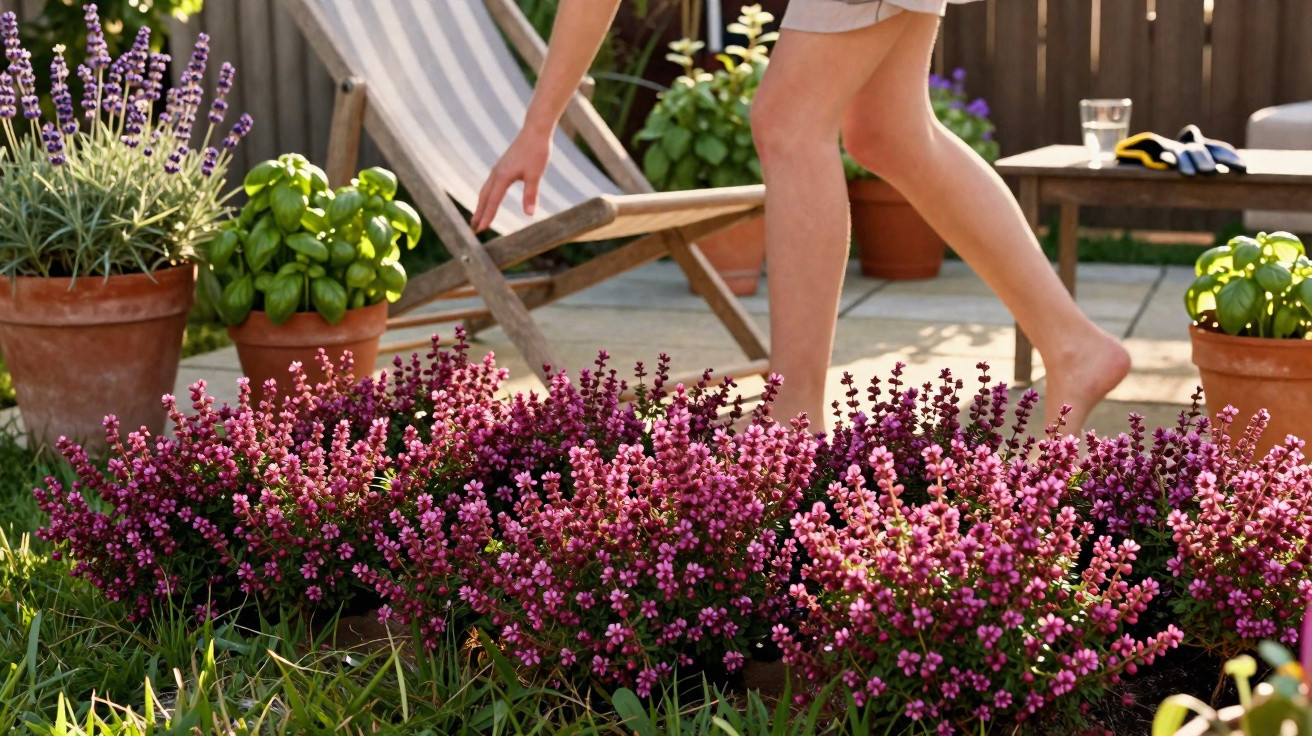
Many home gardeners know the same summer saga: brown patches in the lawn, hosepipe bans, the racket of the mower - and the moment you sit outside, something is buzzing around your ankles and arms. Right there, a low-growing herb can step in and take the edge off several problems at once.
The small groundcover with a big impact
The plant in question is Thymus serpyllum 'Coccineus', often sold as Roter Sand-Thymian or Roter Feld-Thymian. It stays exceptionally low, typically only 5 to 10 centimetres tall, yet spreads like a carpet and can reach 30 to 40 centimetres across per plant.
Instead of individual blades of grass, it forms a dense, soft mat of tiny leaves. From late spring into summer it produces red to purple flowers that attract insects in huge numbers - bees and wild bees in particular seem to adore it.
Roter Sand-Thymian forms a dense, fragrant groundcover carpet that copes with heat and drought far more calmly than a normal lawn.
Its foliage is evergreen and strongly aromatic. Walk over it barefoot and you release a burst of scent that feels like a Mediterranean herb garden. Those essential oils also matter later when it comes to mosquitoes.
Why this plant is a surprisingly good lawn replacement
Sand-Thymian is a classic alternative for areas where grass repeatedly struggles: south-facing spots, stony or very dry ground, banks, or edges alongside patios. It thrives in full sun and does extremely well in lean, free-draining soil - precisely the kind of place where many lawn mixes scorch quickly.
- Position: sunny, hot, ideally gravelly or sandy soil
- Water needs: low; once established, water only during extreme drought
- Winter hardiness: down to around -25 °C - more than sufficient for Central Europe
- Maintenance: little cutting, no mowing, occasional thinning after flowering
Anyone aiming for a flawless, hard-wearing sports-turf finish will not be satisfied. For light use - paths to the patio, areas around the dining set, ornamental sections - this groundcover is ideal. It will tolerate children walking over it now and then, but it is not made for long football matches.
How the thyme carpet spoils mosquitoes’ fun
Mosquitoes favour damp corners, saucers full of water, pots packed tightly together, and lawns that stay wet long after watering. Around patios and balconies, those conditions are often created without meaning to.
A Sand-Thymian carpet helps on two levels:
- Dryer ground: the plant dislikes having “wet feet”. The soil should dry quickly - no waterlogging, no puddles. That removes important breeding and resting spots right by where you sit.
- Fragrant essential oils: when you walk across it or brush the foliage lightly, aromatic oils are released. The strong herbal scent confuses mosquitoes at close range and makes them noticeably less persistent.
The thyme carpet creates a drier, more fragrant environment - mosquitoes don’t like exactly that.
It is not, of course, a miracle cure for every insect. A few mosquitoes will still turn up. But the combination of reduced dampness and powerful herbal fragrance can noticeably cut the nuisance around seating areas - especially compared with perpetually wet lawn and waterlogged planter boxes.
How to plant it successfully around the patio and seating area
The best planting window runs from spring through to autumn, as long as the ground is frost-free and there is no extreme heat. If you want to use the plant as a lawn substitute, it pays to work methodically.
Preparing the area
If you are converting an existing lawn, the first job is simple: remove the grass. The more thoroughly you clear it, the less competition the thyme will face later. Lift out roots and turf remnants as completely as possible, then loosen the soil.
On heavy soils - such as clay - it is worth making a clear drainage improvement. A mix of sand, fine gravel or chippings worked into the top layer does the job. The aim is a base that dries quickly after rain.
Spacing, quantities and early care
Getting a fully closed carpet takes a little patience. As a rough guide:
- Space between plants: 30 to 40 centimetres
- Plants per square metre: around 9 to 12 young plants
Once planted, water in thoroughly. In the first few months, regular watering matters - without keeping the area permanently wet. When the roots have properly established, water demand drops sharply. After that, a small top-up during long hot spells is usually enough.
There is no need for constant mowing. After flowering, you can trim the carpet lightly with scissors or a shrub trimmer to keep it compact and encourage fresh shoots.
Brilliant companion plants against mosquitoes - in pots nearby
Around the dining area, you can create an especially effective pairing by combining the thyme carpet with selected scented herbs. The best choices are strongly aromatic varieties grown in pots:
- Lemon basil: fresh citrus scent, ideal for summer drinks and pasta
- Lemongrass or lemon balm: a classic fragrance that many anti-mosquito candles try to imitate
- Peppermint: strong menthol smell, though best kept in pots because it spreads aggressively
Important: do not leave saucers under pots filled with water. Standing water is effectively a nursery for mosquito larvae. Better to tip out any overflow straight away, or use saucers only as drip protection.
The mix of a dry thyme carpet and strongly scented potted herbs noticeably reduces attractive mosquito zones.
Practical notes, risks and tried-and-tested tips
Sand-Thymian is ideal for nature-friendly gardens, front gardens, sunny slopes and stony areas where conventional lawn mixes fail. A few points are worth knowing in advance:
- Use: excellent for paths to the patio or areas around seating; unsuitable as a play lawn.
- Allergies: anyone highly sensitive to essential oils or to the mint family (such as thyme, sage) should test carefully whether they tolerate the scent.
- Weed pressure: in the early stage, wild plants can still push through. Regular weeding in the first 1–2 years makes it easier for the thyme to form a fully closed cover.
- Slugs: Sand-Thymian is not very appealing to slugs - a welcome side effect.
If you want to reduce your lawn bit by bit, start with a test strip along the patio. You will quickly notice how the microclimate shifts: less watering, a surface that dries fast, and an intense fragrance as you eat outdoors in the evening.
The wider effect on insects is interesting too. While mosquitoes take less pleasure in this setting, the flowers act like a magnet for pollinators. That makes it possible to create a seating area that hums with life, yet involves far less biting - a real improvement for warm summer evenings.


Comments
No comments yet. Be the first to comment!
Leave a Comment