
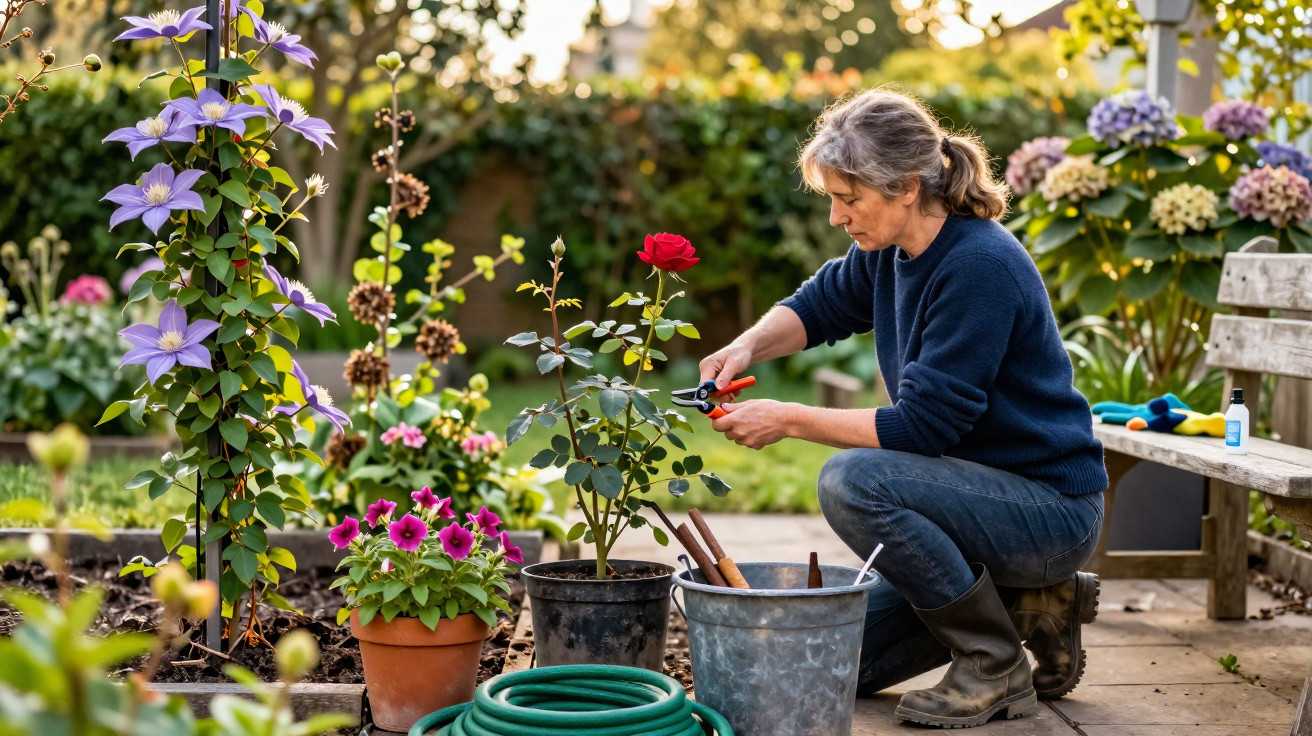
In March, without much fuss, the groundwork is laid for how colourful the garden will look just a few weeks later. While plenty of home gardeners still hover over their borders with secateurs in hand, unsure where to begin, TV gardener Monty Don and plant buyer Julian Palphramand point to a clear approach: five widely grown ornamental shrubs and climbers benefit hugely from a bold spring prune right now-and repay it with noticeably more flowers.
Why March is such a crucial month for pruning
As soon as the days start to lengthen and temperatures begin to lift, shrubs and perennials wake up from their winter pause. If you prune at this early stage, you redirect the plant’s energy into fresh, vigorous new growth. If you leave everything uncut, many plants waste strength maintaining old, diseased or poorly placed wood.
In gardens across the UK-and just as much elsewhere in Europe-March is widely treated as a key month for pruning shrubs that flower on the current season’s growth (new wood). This includes, for example, many roses, buddleia (often called the butterfly bush) and certain hydrangea types.
"If you prune properly in March, you get more light, more air-and far more flowers."
Pruning takes out weak, dead or crossing shoots. That opens the centre of the plant to airflow, which helps reduce the risk of fungal problems. More sunlight can reach developing buds, and the plant is able to build a strong framework for the season ahead.
Monty Don’s one rule that works almost every time
Monty Don sums up his pruning mindset in a simple instruction: always cut “to something”. Behind that phrase is a practical principle that helps beginners and experienced gardeners alike.
- Each cut should finish just above a live bud or a side shoot.
- Make the cut close above it, rather than leaving it in dead wood.
- Don’t leave short “stubs” that dry out and attract disease.
When you cut back to a clearly visible bud, you concentrate the plant’s energy exactly where you want it. A new, healthy shoot grows from that point and, ideally, carries plenty of flowers. If you leave a piece of dead stem with no bud, it dries out, looks untidy and tends to weaken the plant rather than help it.
Monty Don also stresses patience. Many people reach for the secateurs in February when a mild spell arrives. If a hard frost follows, the tender new growth can be damaged. For that reason, he advises waiting until the worst cold snaps are over-typically in March.
These five plants should be pruned in March
Plenty of shrubs will tolerate less-than-perfect timing, but for certain plants it really pays to get March right. The five types below commonly respond with better growth and a visible increase in flowering.
1. Roses – a spring essential for March
Roses appear on almost every list of must-do spring pruning jobs. With a decisive cut, they grow more compactly, stay healthier and produce more buds.
A straightforward method for home gardeners:
- Remove any dead, blackened or very old shoots completely.
- Take out crossing stems so they don’t rub against each other.
- Shorten upright, strong shoots by roughly one third to one half.
- Always cut to an outward-facing bud so the rose grows “outwards” and the centre stays open.
Climbing roses need a slightly different approach: keep the main framework canes, but reduce the side flowering shoots back to just a few buds. This maintains the shape without sacrificing the display.
2. Late-flowering clematis – flowers all the way down, not bare stems
Clematis in pruning group 3 (late-flowering varieties, including many viticella types) bloom on the current year’s growth. If they aren’t cut back, flowers tend to appear only at the very top, leaving the rest of the plant looking bare.
The fix is drastic but effective:
- In March, cut all stems back hard, often to around 30–50 cm above the ground.
- Cut just above a strong pair of buds.
- Remove any dry, thin or weak growth entirely.
After this, the plant breaks strongly from low down, branches more readily and carries flowers over a much greater height.
3. Buddleia (butterfly bush) – hard pruning for bigger flower spikes
The butterfly bush is a classic new-wood bloomer. Without pruning it becomes woody and tired, flowers less and tends to go bare in the upper parts.
In March it can handle a robust cut:
- Reduce the main stems back to a low, sturdy framework.
- Aim for strong buds; a height of about 30–60 cm is often sufficient.
- Remove weak, thin or inward-growing shoots altogether.
This firm prune encourages lots of young shoots, which then produce long, dense flower spikes in summer and prove highly attractive to insects.
4. Lavatera – keeping tree mallow under control
Lavatera grows quickly and can become tall, woody and prone to wind damage if it’s left unpruned. March is an ideal time to bring it back into shape.
To keep it compact and free-flowering:
- Cut it back firmly, usually to a low, well-woody framework.
- Cut only to healthy buds, removing dead wood completely.
- Work towards an even, bushy outline.
With older wood retained, the shrub responds by producing plenty of new growth, branching better and holding its flowers nearer eye level rather than perched on long, bare stems.
5. Fuchsias – wait for signs of life, then cut back
Hardy border fuchsias behave differently from more tender fuchsias grown in pots. Over winter they often die back to near ground level, but they usually regrow strongly from the remaining wood.
The timing matters:
- Wait until you can see the first buds swelling or new shoots starting.
- Then shorten any brown, clearly dead stems.
- Cut back to strong buds, commonly to about 10 cm above the ground.
Afterwards, the plant produces many young shoots and flowers generously in summer. If you cut too early, a late frost can simply kill the new tips again.
Hydrangeas: when a hard prune makes sense
Alongside those five candidates, it’s also worth checking certain hydrangea groups in March-especially Hydrangea paniculata (panicle hydrangea) and Hydrangea arborescens (including the well-known ‘Annabelle’). Both flower on the season’s fresh growth.
| Type | March pruning | Effect |
|---|---|---|
| Panicle hydrangea | Remove old flowerheads, shorten shoots to a strong pair of buds | A sturdier structure, large panicles held well |
| Hydrangea arborescens | Hard cut back to low, healthy stubs | Many new shoots with large, round flower heads |
It’s important to distinguish these from bigleaf hydrangeas (Hydrangea macrophylla), which often bloom on last year’s wood. Those are generally pruned more cautiously, and usually only after flowering.
Tools, hygiene and a tip for colourful winter stems
For pruning to strengthen plants, the tools need to be up to the job. Blunt blades crush stems rather than making a clean cut.
- Bypass secateurs (two blades working like scissors) are particularly suitable.
- For very thin, soft growth, clean household scissors can be enough.
- Disinfect blades after cutting any diseased plant to avoid spreading fungi and bacteria.
Monty Don also highlights tough ornamental shrubs such as dogwood (Cornus) and elder (Sambucus), both of which can be cut back extremely hard in spring. They respond by producing vivid young stems that give structure and colour the following winter.
Why a bold cut pays off over time
Many gardeners hesitate with secateurs and, worried about making mistakes, prune too lightly. The result is often ageing shrubs, fewer flowers and lots of bare wood. For plants that bloom on new shoots, a decisive prune gives you more control over height and shape-and can significantly increase the number of flowers.
If you’re unsure, start with just one plant and watch how it performs over a season. That single real-world trial is often enough to build confidence. With the one-rule approach-always cut back to a living bud-the risk stays low, while the improvement in spring and summer is usually very clear.
Comments
No comments yet. Be the first to comment!
Leave a Comment