
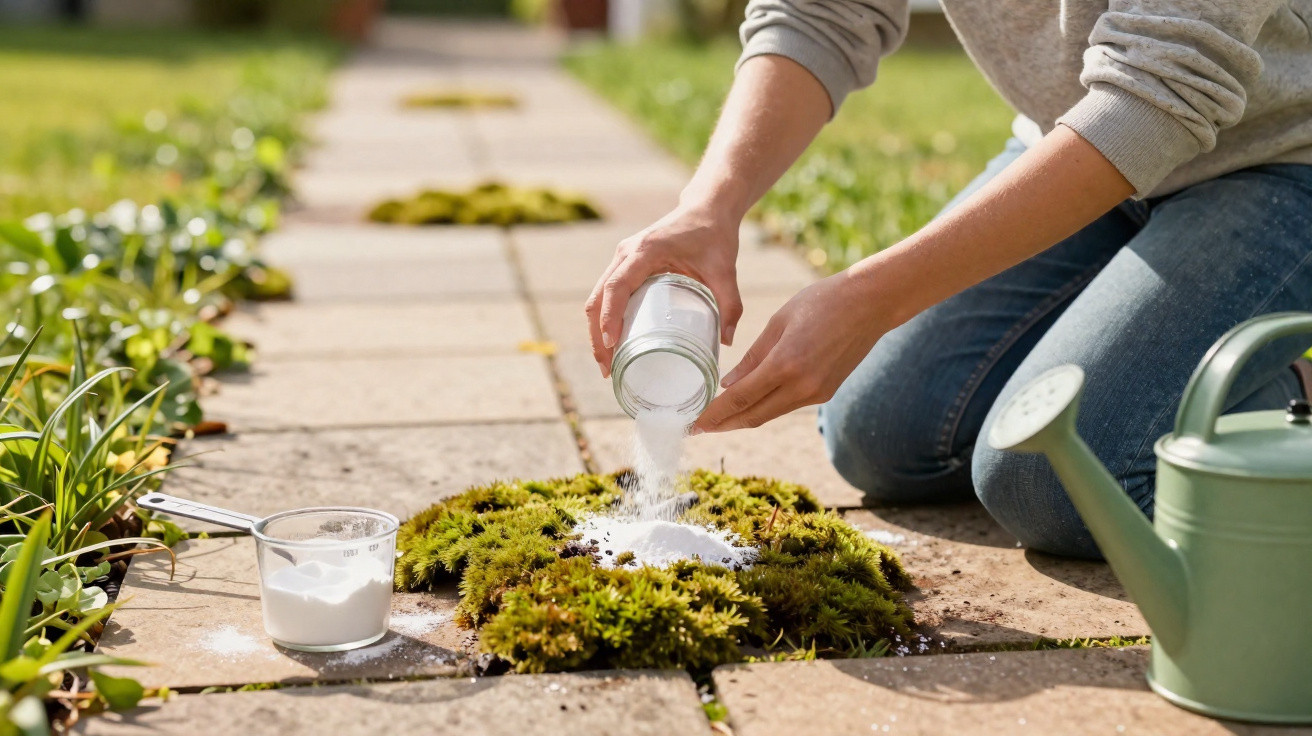
A simple cupboard staple can get green surfaces back into shape.
Plenty of keen gardeners end up staring at greened-over paving and lawns covered in moss, unsure what to do next. Harsh chemical treatments are increasingly restricted, or simply leave an uneasy feeling. Yet the answer is often sitting in the kitchen: inexpensive, effective, and much kinder to your garden and the wider environment.
Why moss thrives in your garden
Scrubbing moss away only removes what you can see - it does nothing to fix the conditions that let it take hold. Moss tends to colonise areas where grass or joint plants struggle to compete.
Common moss magnets in the lawn
In lawns, moss usually spreads in familiar trouble spots:
- acidic soil with a pH below 6
- compacted ground where water collects and lingers
- lots of shade with little air movement
- exhausted patches where the grass thins out and leaves gaps
When grass growth weakens, moss takes advantage. It can blanket the ground like a carpet, rob the lawn of light and hold on to moisture. Over time the grass blades disappear, the surface becomes uneven, and underfoot it can feel soft and spongy.
Moss in joints, on paving and gravel paths
On paths and patios the pattern looks different, but the cause is similar. Damp joints, limited sunlight and dust that builds up in cracks create perfect conditions. A clean driveway can turn into a slippery green strip, particularly through autumn and winter.
As tighter rules restrict many chemical products, gardeners are increasingly looking for alternatives - and that is where the kitchen cupboard comes in.
The kitchen powder that gets rid of moss
The go-to remedy is not exotic at all: bicarbonate of soda (often sold as baking soda). This white powder is commonly used for baking, cleaning and tackling odours - and it can also be used to deal with moss.
Bicarbonate of soda raises the pH in a small area, draws water out of the mossy surface and causes the plant’s cells to die off.
On affected patches, the powder acts like a drying layer. Over a few days the moss cushions turn yellow to brown, break down and can be removed. A key benefit is that you are not spreading a harsh poison around areas where children or pets may be playing.
Bicarbonate of soda on lawns: how to apply it correctly
Using it on grass needs a bit more care. The aim is to weaken the moss while keeping the lawn as unharmed as possible.
Step-by-step guide for the lawn
- Dissolve 2 to 3 tablespoons of bicarbonate of soda in about 1 litre of water.
- Stir thoroughly until no grains remain.
- Spray or water the solution onto the moss cushions only, as precisely as you can.
- Pick a dry day, with no rain forecast for at least 24 hours.
- Wait 2 to 3 days until the area clearly starts to yellow.
- Rake out the dead moss using a leaf rake or lawn rake.
- Lightly overseed bare patches and roll them in.
If your soil is already very acidic, it is sensible to test the method on a small area first. If the grass yellows noticeably, reduce the strength and increase the time between treatments.
How often is it OK to use?
Specialists advise treating a lawn with bicarbonate of soda no more than once or twice a year. If you overdo it, you can effectively sterilise the top layer of soil: microorganisms suffer, grass growth slows, and new plants struggle to germinate.
Gentle pressure rather than constant “blasting”: a small number of treatments combined with soil care lasts longer than repeatedly tipping on more powder.
A moss-free driveway and patio with bicarbonate of soda
On hard surfaces such as block paving, concrete slabs or clay pavers, bicarbonate of soda can be used more directly because you do not have to protect grass roots.
Dry application in joints
For joints between slabs and paving, the dry method works well:
- Sweep thoroughly and remove loose dirt.
- Sprinkle about 20 grams of bicarbonate of soda per linear metre of joint.
- Work it into the gaps using a hand brush or stiff broom.
- Moisture from dew or light rain will gradually dissolve the powder.
Within a few days the moss should change colour. You can then loosen it with a scrubbing brush and sweep it away. Dense, stubborn cushions may need a second application.
Liquid option for very slippery areas
If a driveway is already extremely slick, a water-based mix (as used on lawns) is often more suitable:
- Mix 2 to 3 tablespoons of bicarbonate of soda into 1 litre of water.
- Apply using a watering can or pump sprayer.
- Wet the mossy areas thoroughly, but avoid creating puddles.
- After 1 to 2 days, lightly rinse with water and brush away loosened debris.
The same principle applies here: do not skimp, but do keep the overall amount under control. Overly strong mixes can, over time, leach joints and completely suppress natural growth.
Where the limits are and what to watch out for
As handy as bicarbonate of soda is, it is still a salt-based compound. Spreading large quantities without thinking can cause unwanted side effects.
Common mistakes when using it
- applying it too often on the same area
- putting it down shortly before heavy rain, so it washes away unused
- treating whole areas rather than targeting specific patches
- allowing run-off towards a pond, stream or vegetable bed
Slopes and areas with a clear run-off path towards a productive garden or water are particularly risky. You should make sure no excess water from treated paths can flow down into those areas.
Bicarbonate of soda does not belong in a garden pond or a vegetable plot - avoid any run-off from treated paths reaching them.
What helps against moss in the long term
Even the best household remedy cannot replace the basics. If you want to keep moss at bay, you need to change the conditions that make it so successful.
Steps for a tougher lawn
A few straightforward actions strengthen the grass and reduce opportunities for moss:
- Scarify the lawn in spring and autumn to remove thatch.
- Aerate the soil using a garden fork or dedicated equipment.
- Improve persistently wet spots, for example with sand or drainage pipes.
- If the soil is strongly acidic, apply lime in moderation after a soil test.
- Feed appropriately so the grass grows dense and vigorous.
Where more sunlight reaches the ground, grass usually performs far better. Shade-tolerant seed mixes and thinning dense shrubs around the lawn area can make a significant difference.
Planning path surfaces sensibly
On paths and patios, the gradient matters. Water should run off rather than pooling. Joints filled with unsuitable materials are more prone to silting up. If you are laying new surfaces, you can build in enough fall and include well-draining sub-layers from the outset.
Where moss pressure is high, mineral joint fillers can also help because they hold less humus. Organic material such as soil or compost in the gaps actively encourages moss to establish.
When professional help is worth it
If you still end up with a green carpet across the lawn every year despite bicarbonate of soda, scarifying and soil improvement, it may be time to examine the ground conditions more closely. Very heavy soils with constant waterlogging, or extremely acidic sites, are often beyond what simple home remedies can solve.
A soil laboratory or horticultural adviser can check pH, nutrient levels and soil structure. From there, targeted actions may be recommended - such as deeper loosening, replacing the topsoil, or a complete reseed using a suitable mix.
In many typical home gardens, a combination of targeted bicarbonate of soda use, regular care and patience is enough. By measuring the dose sensibly and understanding your surfaces better, you can reduce moss significantly without resorting to harsh chemical treatments from the garden centre.
Comments
No comments yet. Be the first to comment!
Leave a Comment