
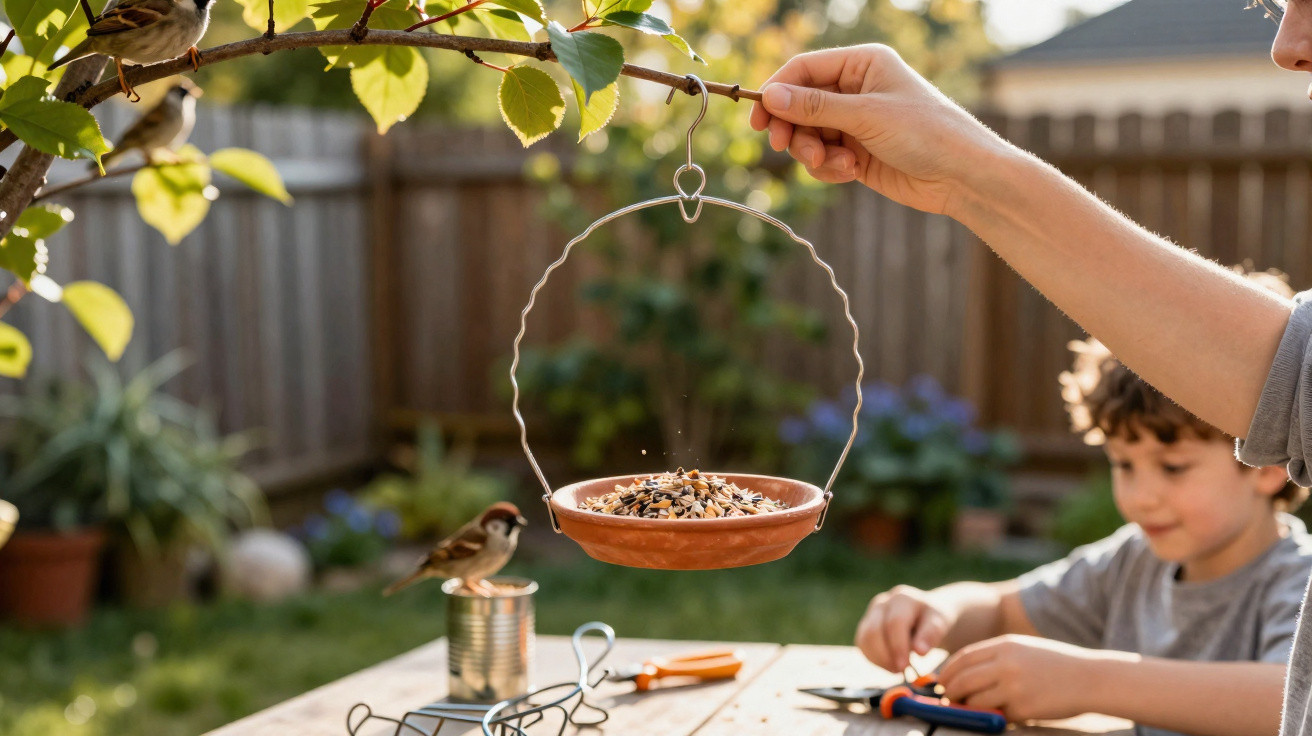
When you pop into a DIY store or garden centre, the prices can be a surprise: plain bird feeding stations quickly come in at €20, €30 or even €50. Yet with a simple metal coat hanger-something many people already have in the wardrobe-you can put together a sturdy, practical feeding spot with no budget, no specialist tools, and in under half an hour.
Why you should make a DIY feeding station now
As winter tails off and early spring arrives, many garden birds are still struggling to find enough to eat. There are hardly any insects about, leftover seeds have largely been picked clean, and fat reserves are running low. A bit of extra food can help them get through the demanding courtship and nesting season.
"A simple feeding station supports tits, sparrows & co. - and in this version it won’t cost you a penny."
At the same time, plenty of hobby gardeners are fed up with expensive ready-made options. Decorative feeders made of wood, metal or ceramic may look smart, but they can leave a noticeable dent in your wallet. This homemade feeding spot solves that issue-and repurposes an item that often ends up in the bin.
The basic material: an old metal coat hanger instead of an expensive bird ‘restaurant’
The core of this project is an ordinary wire coat hanger, the kind you often get back from the dry cleaners. It’s slim, easy to shape, and still strong enough to hold both food and birds.
Why a wire hanger is ideal
- Flexible: With pliers, the wire can be bent and shaped without much effort.
- Sturdy: A standard hanger will comfortably hold 200–300 grams-plenty for seeds or a piece of fruit.
- Recycling: Rather than being thrown away, the hanger gets a useful, long-lasting second life in the garden.
- Versatile: You can try out several designs: a fruit skewer, a seed dish, or a mix of both.
Most households have a few of these hangers tucked away. It’s best to discard ones that are rusty or badly twisted. Smooth hangers that are still in decent shape are the easiest to work with.
Tools and extras: what to have ready
To shape the hanger safely, you only need a basic kit that many homes already have:
- Side cutters – to trim protruding wire ends neatly.
- Round-nose pliers – perfect for making loops, hooks and small curves.
- Work gloves – to protect your hands from sharp edges.
- A food holder – for example, half an apple or the bottom of a plastic bottle.
If you don’t have side cutters, a strong combination pliers can work in a pinch-though you’ll need a bit more force.
How to turn the hanger into a feeding station in just a few steps
The idea is straightforward: you straighten the coat hanger into a long wire rod, attach the food at the lower end, and bend a hook at the top so it can be hung up.
Step 1: Open out the hanger and straighten it
- Place the metal hanger on a firm surface.
- Use pliers to carefully open the twisted join at the bottom.
- Slowly unbend the hanger until you’re left with a long, almost straight piece of wire.
- Roll the wire over the edge of a table or a plank to smooth out larger waves.
You should end up holding a fairly straight rod of roughly 70 to 80 centimetres. Minor bends are fine, as long as it doesn’t feel unstable.
Step 2: Shape the base for the food
There are two easy options, depending on what you want to offer.
| Option | Food | Shape |
|---|---|---|
| Fruit skewer | Apple, pear, halved grapes | Bend the lower third into a spiral, leaving a tip pointing upwards |
| Seed dish | Sunflower seeds, unsalted peanuts, mixed seed | Form the lower third into a tight ring and clamp in the base of a bottle |
For a fruit skewer, bend the lower third into a small spiral about 5 centimetres across. In the centre, leave a short tip that points slightly upwards-this is where you’ll later push on a piece of apple or pear.
For a seed dish, bend the lower section into a round ring that’s just a little smaller than the base of a cut plastic bottle. Press the bottle base down into the ring from above so the ring grips it firmly. You can then fill this little dish with seed.
Step 3: Bend a hanging hook at the top
At the other end of the wire, use round-nose pliers to create a generous hook. It needs to be large enough to sit securely over a branch, a pole, or a hook on your patio.
"The more the hook opens upwards and to the side, the easier it is for the feeding station to hang steadily - even in windy weather."
If you like, you can also make a small side loop just below the hook-for example, to hang an extra piece of fruit on a string.
The right food and the best spot in the garden
For your new feeding point to be worthwhile, you’ll need suitable food and a safe place to hang it.
What garden and balcony birds actually enjoy
Not every type of food works for every season. A few rules of thumb make choosing easier:
- In early spring: sunflower seeds, shelled peanuts (unsalted), oats, small seed mixes.
- Fruit pieces: apple slices, pear chunks or leftover berries attract blackbirds, thrushes and starlings.
- No kitchen scraps: bread and seasoned or salty leftovers are harmful for birds.
- Fat balls only in cold spells: once the days are noticeably milder, it’s better to switch to plain seed mixes.
For small songbirds, 50 to 100 grams of seed per refill is usually enough. It’s better to top up more often than to leave large amounts exposed in the rain.
Where to hang the feeding station safely
Placement determines whether cats, martens or rats have an easy opportunity-or whether birds can feed calmly.
- Hang it at least 1.5 metres above the ground.
- Avoid dense shrubs where cats can creep up unnoticed.
- A clear approach space of around 2 metres in every direction is ideal.
- Put it somewhere you can see from a window, so you get the best view.
Good spots include sturdy, overhanging branches, a carport corner, or the beam under a patio roof. If you only have a balcony, you can hook it onto the railing or attach it to a hanging basket hook.
How this homemade feeding spot helps the environment
This coat-hanger trick isn’t just kind to your wallet-it’s also better for nature. Every reused metal rod is one less item heading to the general rubbish or the scrap-metal bin. Plastic bottle bases that would otherwise be thrown away can also be given a second purpose.
"A disposable product becomes a long-lasting tool - and the variety of birds in your garden will thank you for it."
Regular feeding can also boost biodiversity around your home. Many people are surprised by how many species begin to appear over time: great tits, blue tits, house sparrows, greenfinches, and sometimes even great spotted woodpeckers or nuthatches-depending on where you live.
Hygiene, risks and what to keep an eye on
When lots of birds feed in a small area, the risk of disease increases. A few simple habits reduce that risk:
- Clean the dish or fruit skewer with hot water every few days.
- Remove old, mouldy leftovers consistently.
- In damp weather, put out smaller quantities more often.
- If you notice birds that look unwell, pause feeding briefly and monitor the situation.
The wire itself needs very little attention. If rust appears, you can lightly sand the spot or swap the hanger for another. A thin coating of cooking oil can provide extra protection from moisture, but use it sparingly.
How to expand the idea and make it easy for children to copy
This coat-hanger feeding station is perfect as a family activity. Children can help by cutting fruit, pouring in seed, or assisting with simpler bends. It’s a hands-on way to learn how something that looks like waste can become genuinely useful.
If you enjoy it, you can hang up several versions at once: one station purely for seed, one for fruit, and a higher one for shyer visitors. Add a small water container nearby and it quickly becomes a proper mini oasis for birds-along with a daily, ever-changing scene outside the window.
Comments
No comments yet. Be the first to comment!
Leave a Comment