
What only a few years ago was dismissed as a quirky notion dreamt up by landscape architects is now turning up in perfectly ordinary terraced housing estates: borders where green is no longer the main act, replaced by deep, near-black leaves. The result feels strikingly contemporary - and it also comes with a very practical bonus against annoying pests.
Black garden: why dark foliage is so popular right now
When nothing but green starts to feel a bit dull
Traditional gardens lean heavily on green. Lawns, shrubs, hedges - it can all merge into a single, uniform carpet. Towards the end of winter in particular, when the sun sits low, that blanket of green often looks tired and a little washed out.
Plants with very dark, almost black foliage instantly break up that sameness. They add depth to a border and guide the eye. Your gaze naturally pauses on dark mounds or shrubs, and as a result the lighter leaves and flowers around them appear much brighter.
"Black leaves work like a bold line in a sketch: they add structure and tension with very little effort."
A graphic look without an expensive overhaul
If you want a more modern-feeling garden, you do not need to start moving walls or laying a new patio. Just a handful of dark-leaved plants can shift the whole impression. They act as visual anchor points - in large gardens and on small urban balconies alike.
Combinations that are especially popular include:
- dark foliage as a calm, strong backdrop
- fine grasses that bring movement into the scene
- pale or pastel flowers that read like spotlights
The end result looks like a professionally designed scheme, without the workload spiralling.
The stars of the dark border: black elder and Heuchera
Elder ‘Black Lace’: a shrub with instant impact
A favourite among designers is the black elder cultivar ‘Black Lace’. Botanically, it is simply a form of our familiar elder, but it looks entirely different. The leaves are deep purple through to almost black, finely cut, a little like a Japanese maple - only noticeably tougher.
It grows fairly quickly, stays airy, and never feels clumsy. In the garden it works particularly well:
- as a backdrop within perennial borders
- as a specimen plant on the lawn
- in mixed hedging, where it adds distinctive accents
In early summer the elder does even more: it opens rosy, strongly scented flower heads that draw insects in. Later, dark berries appear which - as with classic elder - can be used on, provided the cultivar is suitable and the berries are heated.
Heuchera ‘Obsidian’: a black ground-level carpet
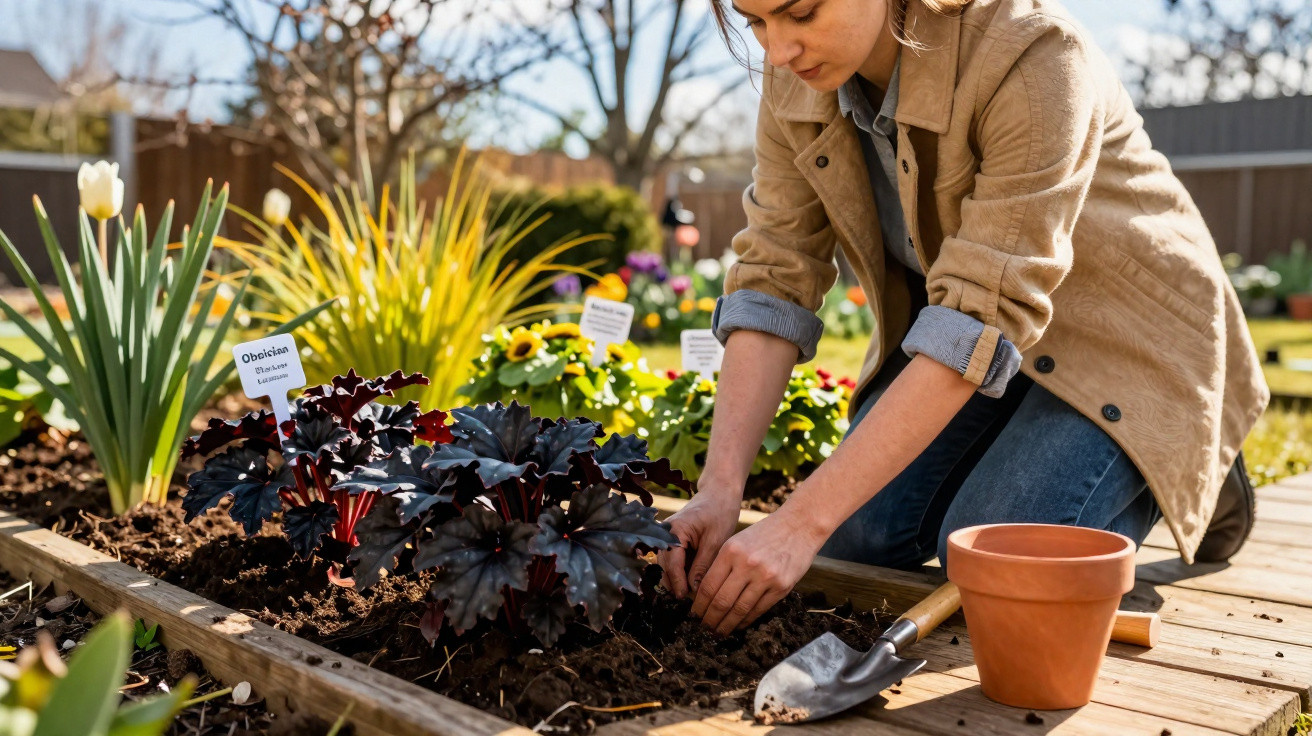
For the front of beds, many gardeners choose coral bells, especially Heuchera ‘Obsidian’. This perennial carries glossy, near-black leaves all year round. The growth habit forms small, soft-looking cushions that knit together to cover the soil densely.
Common places to use it include:
- at the base of shrubs or trees
- as edging along paths
- in pots by front doors or on balconies
Against that dark sea of leaves, pale flowers, grasses or silvery foliage look twice as intense. If you want to push the colour play further, pair it with a yellow-leaved grass or white-flowering perennials - the contrast can feel like a studio design trick.
Fewer pests thanks to dark pigments
What anthocyanins really do in the garden
That almost-black foliage colour comes from a high concentration of anthocyanins - pigments that, among other things, help protect plants from UV radiation. But they do not only change colour; they also affect how appealing leaves are to sap-sucking and chewing insects.
Many pests are drawn to soft, pale leaves. Dark foliage that is slightly leathery or thicker often interests them less. Aphids in particular tend to avoid such plants or fail to multiply as strongly.
"Dark foliage can mean certain pests do not even get established - without sprays and without constant intervention."
There is a second advantage that is purely visual: small bite marks show up far less on black leaves than on fresh light green. The garden can look tidy even if a few insects are active here and there.
How dark plants encourage beneficial insects
Black elder has another strength: it is an insect magnet. Its blossoms provide plenty of nectar and pollen. That benefits not only bees, but also hoverflies and ladybirds - classic allies against aphids and other nuisances.
By planting in this way, you are effectively building a small, natural defence system. Pests find fewer favourite targets, while their opponents move in and deal with what remains.
Why late winter is the best time to plant
February as the starting point for a black garden
Many hobby gardeners wait to begin new projects until it is properly warm. For shrubs and perennials, that often is not ideal. Late winter and early spring offer a clear advantage: the soil is usually free of frost, yet plants have not fully come into growth.
If you get elder, Heuchera and other perennials into the ground now, they gain a head start. Roots can establish quietly before hot spells arrive. The outcome is sturdier plants, less watering stress in summer, and much better establishment rates.
Easy to look after from day one
Another appeal of the “black garden” is that its key plants are considered straightforward. Coral bells cope well with ordinary garden soil, a little partial shade, and regular watering. Black elder will even tolerate short dry spells and the odd pruning mistake.
To get off to a good start, a few simple steps are enough:
- Water in thoroughly, one plant at a time - especially during the first few weeks.
- Mulch the soil around the plants so it stays moist for longer.
- For elder, remove old, weak shoots once in late winter so fresh, strong new growth can follow.
How black plants really shine in a border
Use contrast deliberately
A bed that is dark all over can quickly feel gloomy. It becomes genuinely exciting when contrast is planned carefully. A few proven pairings:
| Dark plant | Partner | Effect in the border |
|---|---|---|
| Heuchera ‘Obsidian’ | yellow-leaved grass | strong light–dark contrast, very modern |
| Elder ‘Black Lace’ | white or blush-pink perennials | romantic feel with a crisp outline |
| other dark-leaved perennials | silvery foliage plants | elegant, almost Mediterranean impression |
You do not need much space: one dark shrub plus one or two groups of black-leaved perennials can change the feel of an entire garden - especially when placed where they are clearly seen, such as along the edge of a patio or near the front door.
How the garden shifts through the year
If you plant in late winter, you will notice the impact by spring at the latest. Bright tulips, daffodils, or later roses look far more vivid against a dark background. Many gardeners say they suddenly see their own borders differently, even though they have barely increased the planted area.
In summer, the dark leaves provide a calm frame while other plants hit their stride. And in autumn, when many perennials start to look tired, coral bells and similar plants often hold the picture together for surprisingly long.
Practical tips and small pitfalls
Position, soil and the risk of buying the wrong thing
For all their toughness, it still pays to think briefly about siting. Black elder is happiest in free-draining, fairly nutrient-rich soil, and prefers sun to partial shade. If it is too shaded, the foliage loses intensity and shifts more towards dark green.
Dark-leaved plants in containers need a little more attention with watering, because dark compost and dark pots heat up more in the sun. If you are prone to forgetting to water, it is better to choose larger containers that do not dry out so quickly.
When shopping, check labels twice: not every dark-leaved cultivar is truly near-black - some look more red or brown once planted. If you have a clear image in mind, ask specifically for cultivars known for strong contrast.
How to combine the dark trend with other garden ideas
A “black garden” can be blended easily with current approaches to gardening: insect-friendly planting, fewer chemicals, more structure, and longer flowering seasons. Elder and coral bells fit particularly well into nature-friendly schemes, because they offer many animals both food and shelter.
And if you are dealing with drought, you can still adopt the style. In very sunny, leaner beds, for example, dark-leaved ornamental grasses or drought-tolerant perennials with dark foliage can work well. They combine a distinctive look with a degree of resilience to climatic extremes.
Overall, the move towards a black garden delivers more than a fashionable effect. It adds structure, eases pest pressure, and opens up new design options - especially now, as the season is only just getting going.




Comments
No comments yet. Be the first to comment!
Leave a Comment