
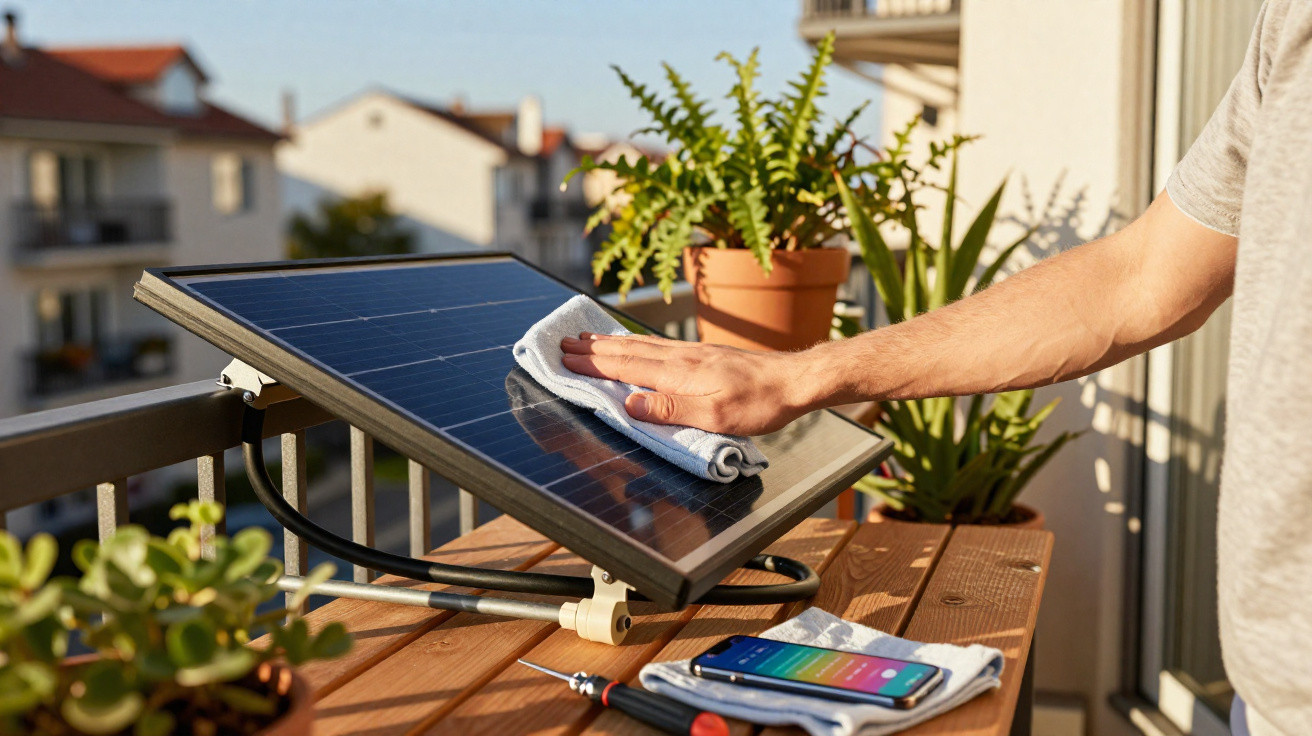
If you let your mini solar power station run after the clock change exactly as it did in winter, you will often be leaving real money on the table. With a few targeted tweaks, you can pull noticeably more yield from your modules - while also keeping everything operating safely.
Why spring is the best time to check your balcony solar power station
Solar modules still generate electricity in winter, but cold snaps, storms, ice and persistently damp weather all take their toll on the hardware. When spring arrives, the sun sits higher - yet the strain on materials often increases too: more wind, more pollen, more birds, more activity on the balcony. This is the point in the year when it becomes clear whether your balcony solar power station will make the most of peak season, or whether it will run with the handbrake on.
"A quick check in spring can noticeably boost your annual yield - and prevents expensive damage caused by loose brackets or damaged cables."
The five steps below apply to typical plug-in solar devices used on a balcony, terrace, garage roof or in the garden. Many of these checks can be done in under an hour.
1. Safety check: is the system still rock-solid?
Winter storms and frost can loosen fixings, bend mounting rails and make plastics brittle. Even a slightly loose installation can become hazardous in strong winds - for passers-by, neighbours and your own façade.
Check brackets and frames
- Tighten all bolts and nuts by hand.
- Look for rust spots or bent rails.
- Gently lift the modules and carefully wobble them: nothing should move or flex.
- Inspect balustrade or wall fixings closely - especially on older railings.
If you live in a rented property, also consider whether the original mounting still suits how you use the balcony today. A heavy planter attached to the same rail section as the module is not a good combination.
Inspect cables and plugs
These are the winter’s usual weak points:
- If cables are routed through windows or doors, check for crushing marks.
- Examine plug connections for moisture, verdigris, or discolouration.
- Treat any cracks in insulation as urgent and replace the affected cable.
If a plug shows brown marks or signs of melting, it must be replaced. These traces point to excessive heat build-up - and therefore a fire risk.
2. Reassess orientation and shading
In winter, trees are bare, parasols are folded away, and neighbours are on their balconies or terraces less often. In spring, the surroundings of your balcony solar power station can change completely - and so can shading.
Identify new sources of shade
Common springtime “yield killers” include:
- wide tree canopies with fresh leaves
- new balcony furniture or awnings on your side
- neighbours’ parasols, privacy screens or climbing plants
- satellite dishes, clothes airers or planters placed near the modules
Choose a sunny day and watch for one to two hours how shadows move across the modules. Even partial shading can cut output dramatically; depending on how the modules are wired, production can drop to a minimum.
Adjust the tilt angle for the spring sun
In winter the sun is low, so a steeper tilt tends to capture more energy. In spring the sun rises much higher, which usually suits a flatter angle.
As a rough rule of thumb for fixed balcony solar power stations in Germany:
| Season | Recommended tilt |
|---|---|
| Winter | 40–60 degrees |
| Spring / Autumn | 25–35 degrees |
| Summer | 10–25 degrees |
If your mounting system is adjustable, it is worth changing the angle. If you cannot alter it, at least make sure the modules face as close as possible to the midday sun - and are not stuck in permanent shade.
3. Gentle cleaning: dirt reduces yield immediately
More collects on module surfaces than most people expect: soot particles, pollen, bird droppings, traces of road salt, blossom dust and cobwebs. All of this reduces light transmission - and therefore your electricity yield.
"Even a light film of dust and pollen can push performance down by a few per cent - with stubborn dirt, the loss can be higher still."
Clean properly - without causing damage
For most balcony solar power stations, simple care is enough:
- use clean, lukewarm water
- use a soft cloth or soft sponge
- wipe in circular motions without applying heavy pressure
Avoid:
- aggressive cleaners or solvents
- abrasive pads, stiff brushes or metal parts
- pressure washers - the force can destroy seals and drive water into the module
If you spot bird droppings or resin-like marks, soak them with water first and then remove them gently. Scraping with hard objects quickly creates micro-scratches - which not only look bad later, but also permanently reduce performance.
4. Check app settings and updates
Many modern balcony solar power stations can be monitored and controlled via an app. What many people overlook is that settings age - and manufacturers often deliver improvements only through software updates.
Keep firmware and the app up to date
Opening the app is not just for the statistics obsessed. Check:
- is there new firmware for the inverter?
- is the app version on your phone current?
- have new functions been enabled, for example for consumption control?
Updates often improve stability and sometimes also efficiency or safety features. A lot of users waste potential here by dismissing update prompts.
Set power limits and self-consumption
In many apps you can adjust key parameters such as:
- the inverter’s maximum output power
- limits for feeding into the grid
- the balance between direct self-consumption and optional storage
For example, if you use a small home battery, pay close attention to how the system works together: if the battery charges too late or too early, the system misses its strengths during sunny hours. If you are mainly at home during the day, you will often benefit more from high immediate use than from maximising export.
5. Keep rules, reporting duties and technical limits in mind
As the number of balcony solar power stations has grown, the requirements have been revised several times. If you adjust your system, connect an additional module or replace the inverter, do not ignore the legal side.
Market Master Data Register and grid operator
In Germany, plug-in solar devices generally have to be registered in the Market Master Data Register. If the output, location or operator changes, the entry needs to be updated accordingly.
Also crucial is the export limit: if your system exceeds the currently permitted maximum of 800 watts, extra requirements apply. At that point, factors such as the type of feed-in socket, a possible meter change and close coordination with the grid operator become important.
What to consider when upgrading output
Many owners are tempted to clip on an extra module in spring. Before you do, make sure you have clarified:
- can the existing inverter handle the additional power?
- will you remain within the permitted export limit?
- is the cable sizing suitable for the new total output?
If you push too far, you risk not only trouble with the grid operator but, in the worst case, overheated components.
How to fit the check into everyday life
A thorough spring check is a strong start. Your balcony solar power station will run even better if you build a few small routines. A quick look every few weeks is often enough:
- Is there new leaf debris or pollen dust on the modules?
- Is a parasol casting shade onto the modules?
- Does the app show unusually low daily yields compared with previous days?
Checking the app is particularly worthwhile after sudden drops in output. Not every fluctuation signals a fault, but a clear reduction on sunny days should be taken seriously.
Common terms explained briefly
Many technical terms around balcony solar power stations sound more complicated than they really are:
- Export power: the maximum power your system can theoretically feed into the electricity grid.
- Self-consumption: electricity your household uses directly while the system is generating.
- Inverter: the device that converts the modules’ direct current into usable alternating current for your home and the grid.
- Shading: anything that blocks light reaching the modules - from branches to the balcony railing.
If you understand these basics, you will also see why the 5-step check after the clock change can make such a difference: every bolt, every app setting and every film of dust has a direct effect on your meter.
Ideally, combine technical upkeep with smart electricity use: run the washing machine, dishwasher or chargers mainly when the sun is shining and the balcony solar power station is working at full tilt. That way you reduce your electricity bill more noticeably - and make the most of the longer spring days.






Comments
No comments yet. Be the first to comment!
Leave a Comment