
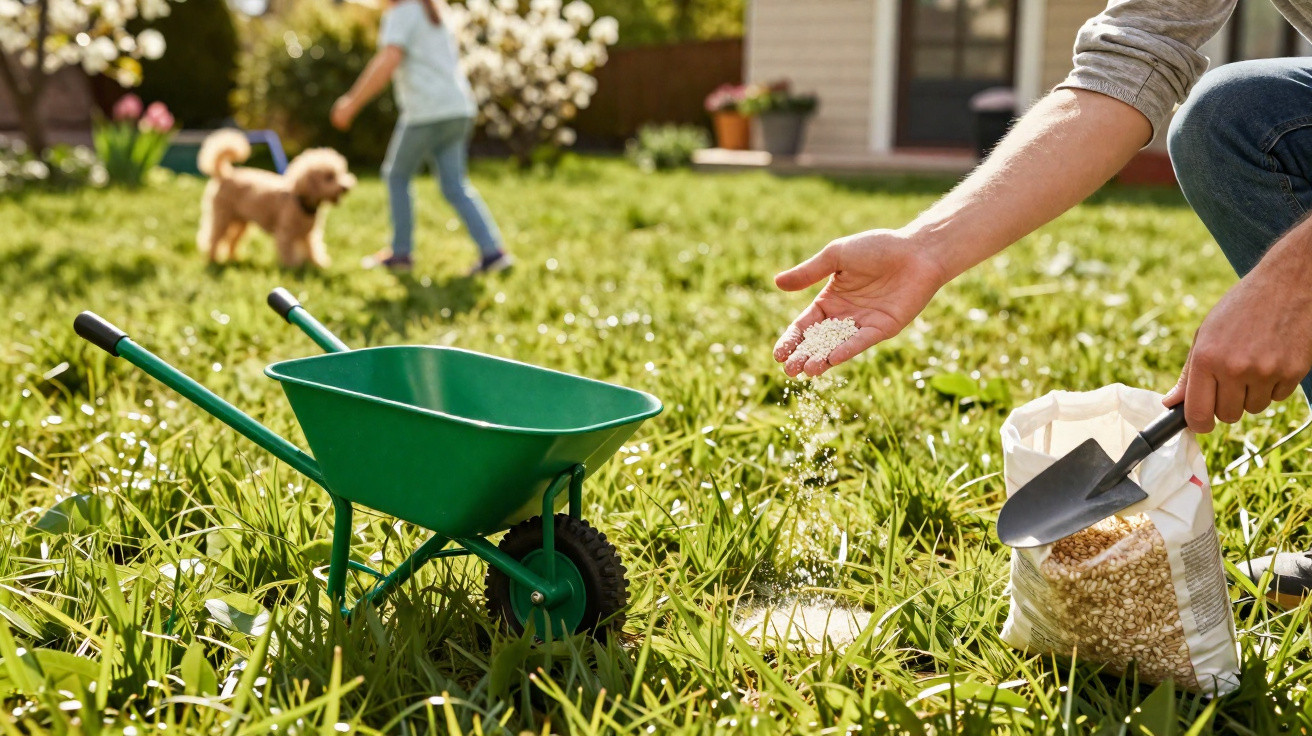
As the days draw out and the ground slowly thaws, the lawn starts to wake up too. If you simply fire up the mower now, you’re leaving results on the table. The real renewal happens out of sight, down in the roots - and that’s where the right fertiliser makes the difference. What matters most is the type, the timing and how carefully you apply it.
Why fertiliser in spring can completely change how your lawn looks
Most lawn fertilisers carry three numbers on the pack - the well-known NPK formula. Those figures stand for three nutrients, each with a specific job:
- N for nitrogen - drives growth and delivers a rich, dark green colour.
- P for phosphorus - supports root development and helps the lawn recover.
- K for potassium - makes the sward tougher against drought, heat and disease.
Many garden professionals plan two feeds per year: one in spring and another in late summer or autumn. Heavily used areas - for example, play lawns with children and a dog - often get an extra light feed in early summer.
The best moment to start in spring depends on soil temperature. When it reaches around 10 to 12°C, grass growth properly kicks in. In many areas that’s between March and April; in cooler locations it may not happen until May. If the soil stays cold and wet for longer, everything shifts back.
"Pale blades, low density and lots of moss are clear signs: the lawn is short of nutrients - time for a feed."
If you wait too long at this stage - or skip feeding altogether - you’ll end up with a lawn that recovers slowly, dries out faster and remains more vulnerable to moss and weeds.
Which fertiliser suits spring: organic, organo-mineral or mineral?
Organic fertiliser: gentle, sustainable - ideal for family gardens
In gardens where children play or pets roam, many people prefer organic fertiliser. Common ingredients include:
- dried poultry manure (for example, chicken manure pellets),
- guano from natural seabird deposits,
- horn meal or horn grit,
- dried blood meal,
- ground feathers or other animal by-products.
These feeds don’t work instantly; they release nutrients gradually. Soil micro-organisms break the material down over time, making nutrients available steadily and feeding the grass evenly. That reduces the risk of scorch and helps keep the sward resilient over the long term.
A particularly soil-friendly approach is topdressing. First, you scarify the lawn (lightly cutting into the surface) to loosen thatch and moss. Then you spread a thin layer of mature compost mixed with high-quality topsoil. The blend settles between the blades, fills small dips and brings more life into the soil. Earthworms and micro-organisms work it in and keep releasing nutrients continuously.
Organo-mineral fertiliser: a quicker boost, still comparatively gentle
If you want a noticeable spring lift without relying solely on pure mineral salts, an organo-mineral fertiliser is a good middle ground. A common example is NPK 10-2-4. These products combine:
- a moderate nitrogen share for a faster start,
- a little phosphorus to support roots,
- potassium for resilience,
- organic components for a longer-lasting effect.
They’re especially useful when the lawn looks visibly weakened after winter but you don’t want to wait several weeks for results. Growth can pick up noticeably, the lawn can thicken, and gaps may reduce at the same time.
Mineral fertiliser: turbo results with added risk
You’ll also find highly concentrated, purely mineral fertilisers. Typical examples include:
- high-nitrogen formulas such as 30-5-5 for strong spring growth,
- blends such as 12-5-20 with more potassium for later points in the season.
Some of these products use slow-release or controlled-release technology. That means nutrients don’t arrive all at once, but are delivered step by step at the root zone. This lowers the risk of scorch, but it doesn’t replace careful measuring.
"Mineral fertiliser works fast, but it barely forgives mistakes: overapply - or spread in hot weather - and you’ll damage the lawn instead of helping it."
One rule matters above all: never apply in strong sunshine or onto bone-dry soil. In those conditions the blades are more sensitive, the fertiliser can effectively ‘burn’ them, and unsightly brown patches appear.
Match the fertiliser to the condition of your lawn
Slightly tired but still dense lawn
If the lawn is nicely closed but looks a bit washed-out and lacking in freshness, a gentle pick-me-up is often enough. An organic fertiliser at a low dose can get it moving again. Many amateur gardeners also support this with simple household options.
A popular choice is coffee grounds. They contain small amounts of nitrogen, potassium and trace elements, and they attract earthworms. You can:
- mix them into water (around 250 g to 15 litres), shake well and water the lawn with it, or
- spread a thin, even layer over the surface and lightly rake in.
Another option is so-called compost tea: a small bag of mature compost is steeped in water, then filtered and applied well diluted. Around 4 litres per 100 m² every two to four weeks provides a mild nutrient boost.
Yellow, patchy problem lawn
If larger areas are brown or yellow, growth is uneven and moss is taking over, you’ll usually need a clearer reset across several steps:
- Scarify: use a scarifier or a rake to pull out moss and thatch so air and water can reach the soil again.
- Topdress: apply a thin compost–soil mix, fill holes and uneven spots, and improve soil structure.
- Organo-mineral fertiliser: spread a product around 10-2-4 to kick-start recovery.
If significant bare patches remain, it’s worth overseeding those areas. Specialist overseeding mixes germinate quickly and close gaps.
Young lawn after a new sowing
Newly seeded lawns shouldn’t be pushed too hard at the start. Young roots can be sensitive to high salt concentrations in the soil.
Basic rules for young areas:
- Don’t fertilise until after several cuts (at least two to three).
- Reduce the recommended dose significantly.
- Choose only mild products, ideally organic or organo-mineral.
That way the grass gets a careful start without damaging delicate new blades.
Spring fertilising step by step
A common mistake is scattering fertiliser “more or less” evenly. A structured approach produces noticeably better outcomes.
- Mow a little higher: around 4 to 6 cm is ideal. Cutting too short stresses the grass and encourages weeds.
- Remove moss and thatch: scarify if needed, or rake through thoroughly with a lawn rake.
- Lightly moisten the soil: the ground shouldn’t be dusty-dry, but it shouldn’t be waterlogged either.
- Apply evenly: a wheeled spreader or handheld spreader helps prevent overapplication, especially along edges.
- Keep paths, patios and beds clear: sweep fertiliser off hard surfaces immediately to avoid staining and to stop it washing into drains.
- Water in afterwards: a thorough soak or a longer spell of rain dissolves granules and carries nutrients down to the roots.
"Even the best fertiliser mix is wasted if it’s spread unevenly - use a spreader instead of ‘guessing by hand’."
What the NPK number means - a quick overview
| Label | Typical time to use | Effect |
|---|---|---|
| NPK 10-2-4 | Spring, after winter | Strong start, quick effect, still relatively long-lasting |
| NPK 30-5-5 | Early spring, settled weather | Big growth surge, denser sward, higher risk of scorch |
| NPK 12-5-20 | Late spring, early summer | More potassium, tougher blades, preparation for heat |
The numbers show the percentage share of nitrogen, phosphorus and potassium. The higher the first figure, the stronger the growth push. A lawn that’s already being watered and mown often doesn’t need extreme doses long term - it benefits more from steady, balanced nutrition.
How a well-fed lawn pays off in everyday life
A deep-green lawn isn’t only about looks. It absorbs noise, cools the surrounding area on hot days and traps fine dust. Children would rather play on soft, dense grass than on dusty soil with bare patches. If you barbeque or use garden furniture, a tough sward copes better with foot traffic and chair legs instead of immediately showing worn spots.
At the same time, smart feeding reduces ongoing maintenance: a healthy lawn naturally holds weeds and moss at bay more effectively. You’ll need to overseed less often, reach for the scarifier less, and you’ll face fewer long-term issues with fungal diseases.
Use spring deliberately and you set the foundation for the whole season. Check the lawn honestly: what condition is it really in? Then choose the right fertiliser, measure it correctly, spread it carefully and help it in with water. This is how a tired winter lawn gradually becomes a green stage for summer in the garden.






Comments
No comments yet. Be the first to comment!
Leave a Comment