
Gardeners are warning: we’re throwing away pure plant gold.
Plenty of amateur gardeners pay for pricey liquid fertiliser from the DIY shop, even though a genuinely useful source of nutrients is created right in the kitchen: banana peels. What looks like rubbish is packed with minerals that can give window boxes, houseplants and vegetable beds a real boost - as long as you use it correctly.
Why banana peels are so valuable in the garden
Bananas are among the most popular fruits in UK households. They’re sweet, convenient and provide energy. For plants, though, the really interesting part is something else entirely: the peel.
"Banana peels contain lots of potassium - one of the most important nutrients for strong, healthy plants."
Potassium helps reinforce cell walls, supports sturdy stems and enables plants to use water more efficiently. As a result, many plants cope better with dry spells and are less prone to disease. At the same time, potassium encourages abundant flowering and can stimulate fruit development.
The peel also contains:
- small amounts of phosphorus - important for root growth and flower formation
- trace elements - such as magnesium and calcium for vigorous foliage
- organic matter - which helps keep soil looser and more biologically active
Flowers such as roses, dahlias and geraniums respond particularly well to a potassium-rich feed, as do tomatoes, peppers and strawberries.
Never just throw raw peels on the soil
As tempting as it sounds, pushing a fresh banana peel straight into a plant pot is one of the classic beginner mistakes.
Unprocessed peels can:
- attract fruit flies, ants or even mice
- start to smell unpleasant as they rot slowly
- develop mould - which has no place in a pot
That’s why experienced gardeners always prepare the peel first before it ends up in the garden or on the balcony. You keep the nutrients, but avoid the downsides.
Option 1: Use banana peels in the compost
The standard approach for anyone with a compost heap: simply add the peel to the caddy or composter.
"In the compost, the banana peel gradually turns into humus - a natural long-term fertiliser for the whole bed."
A few practical tips help:
- Chop peels into small pieces so they break down more quickly.
- Don’t add too many at once, otherwise the layer can become too wet.
- Mix with dry material such as leaves or cardboard.
It becomes even more effective in worm composting (a wormery). Compost worms break down the peels into especially nutrient-rich worm castings. Gardeners often call this fine compost "black gold" because it improves the soil’s ability to hold water and promotes highly active soil life.
Option 2: Dried peel as a slow-release fertiliser
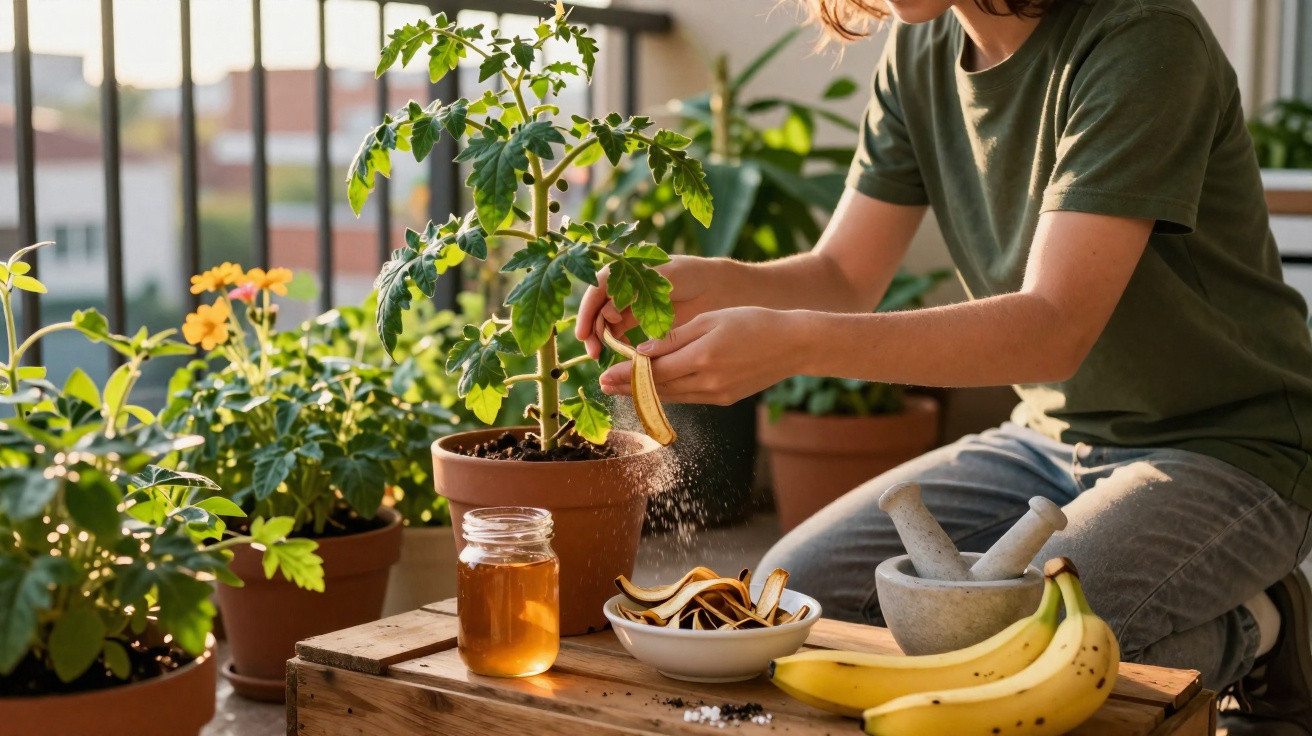
If you don’t have a composter, you can still use banana peels as a soil improver - but only once they’ve been dried and crushed.
How to make banana peel powder
- Rinse the peels thoroughly with water and pat them dry.
- Cut into strips and spread out on a baking tray.
- Dry completely in a warm, dry place or in the oven at a low temperature (max. 60°C, with the oven door slightly open).
- Once bone-dry, grind the peels into a powder using a blender or pestle and mortar.
- Store the powder in an airtight jar.
You can mix this powder into the compost when repotting, or lightly work it into the top layer of soil. The nutrients are released gradually, supplying potassium over several weeks. For container plants that stay in the same pot for a long time, this “slow-release boost” can be particularly beneficial.
Option 3: Make a liquid fertiliser from banana peels
If you’d rather feed by watering than sprinkling, you can make a simple liquid fertiliser from banana peels.
Recipe for banana peel tea
For a gentle plant “tea”, it only takes a few steps:
- Cut 1–2 banana peels into pieces.
- Put them into a large jar or jug and cover with water.
- Leave to steep for 2–3 days at room temperature.
- Remove the peels, briefly bring the liquid to the boil, then let it cool.
- Before watering, dilute with water at roughly a 1:3 ratio.
"Banana peel tea acts like a mild liquid fertiliser, ideal for potted plants and houseplants that don’t tolerate strong feeds."
You can also pour the mixture into a spray bottle and mist the leaves. Particularly with weakened plants, this often brings a visible improvement in vigour and leaf colour.
Which plants benefit most
Potassium-heavy feeds don’t suit every plant equally well. A simple guide helps you avoid overdoing it.
| Plant group | Suitability of banana peels |
|---|---|
| Flowering plants (roses, geraniums, dahlias) | very suitable, promotes blooms and sturdy growth |
| Fruiting vegetables (tomatoes, peppers, chillies) | well suited, supports fruit formation |
| Houseplants (peace lily, rubber plant, monstera) | suitable in moderate amounts, ideally as a diluted liquid feed |
| Young seedlings and sprouts | fertilise very cautiously, highly diluted |
Risks to watch out for
Supermarket bananas are often treated with crop-protection products. Some residue can remain on or in the peel. If you’re using peels as fertiliser, wash them thoroughly first. Organic bananas have a clear advantage here.
Also, too much organic material in small pots can lead to a musty smell and mould. It’s better to start with small amounts and observe how the plant responds rather than mixing in large quantities straight away.
Practical everyday examples
In day-to-day life, peels are easy to incorporate: when baking banana bread, don’t throw the peels straight into the bin - set them aside, wash them, chop them, and prepare them either for composting or drying. If you make banana smoothies regularly, you’ll effectively have a steady supply for the garden.
Many balcony gardeners keep a small screw-top jar of banana peel powder right next to their potting compost. When repotting, a spoonful goes into the pot automatically. Especially in rented flats without a garden, it’s a straightforward way to feed houseplants using kitchen scraps.
Why reaching for banana peels pays off twice
Using banana peels in the garden cuts down on kitchen waste and saves money on fertiliser products. At the same time, fewer chemicals end up in the soil when you rely on gentle, organic nutrient sources. Anyone who consistently composts or uses plant-based leftovers such as coffee grounds, eggshells and banana peels gradually builds a living, fertile soil.
For many amateur gardeners, this triggers a shift in mindset: not everything that looks like “waste” belongs in the general rubbish. Some of it is a valuable resource - and bananas are an especially easy example that anyone can start using straight away.
Comments
No comments yet. Be the first to comment!
Leave a Comment