
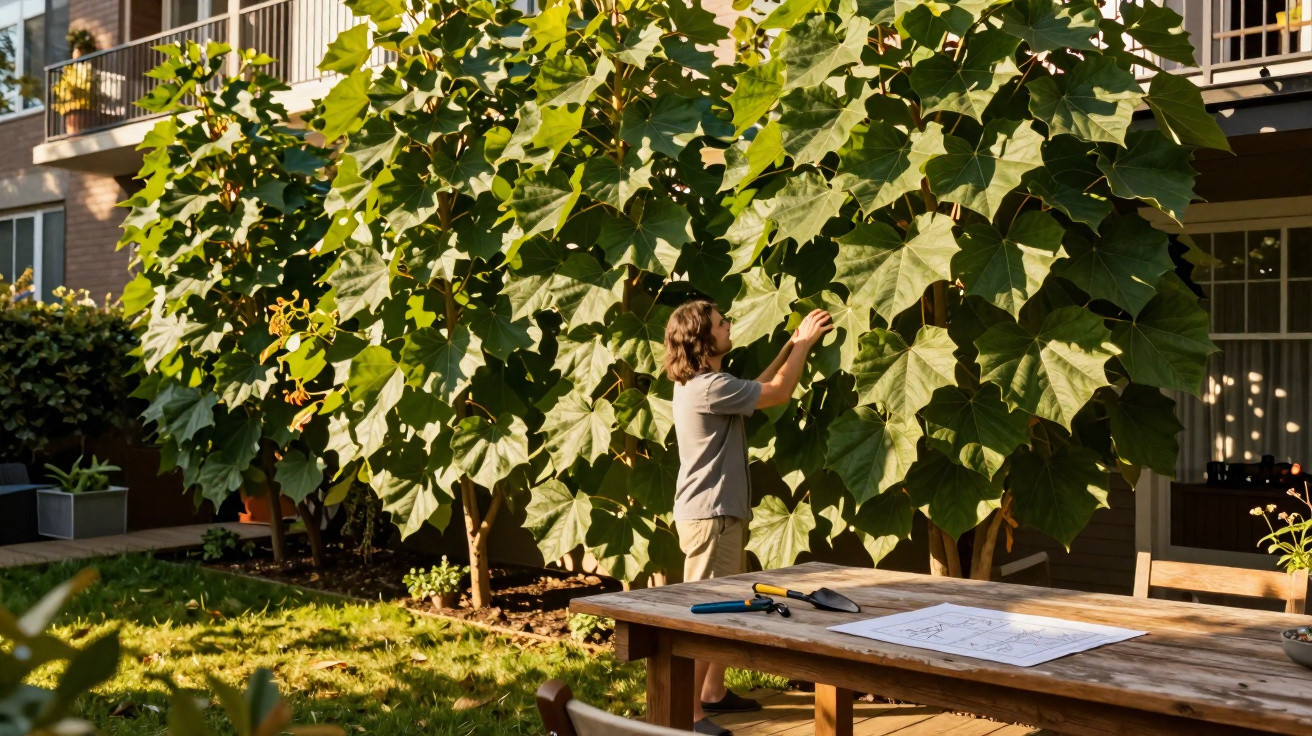
Many homeowners reach for privacy screens, reed mats or timber panels. They can bring quick relief, but they also block light, fade fast and often make the garden feel narrower. Things get far more interesting when a tree can form a living, tall green canopy within just a few years - and, almost as a side effect, take the edge off prying eyes.
When the neighbour’s balcony looks straight onto your patio
It’s a familiar story: the house next door gains an extra storey, a balcony appears, or a new roof terrace suddenly has a direct view into your plot. From one summer to the next, the garden stops feeling like a retreat and starts feeling like a stage.
A lot of people respond with quick, off-the-shelf fixes: timber or plastic fence panels, side awnings, tall reed screens. The upsides are obvious, but the downsides tend to show up just as quickly:
- Materials weather and go grey, often needing replacement
- Heavy shading, especially in winter
- A hard, less welcoming look
- Frequent planning/permission and height-limit complications
If you opt for a “green roof” instead, you’re not only gaining privacy - you also get cooling effects, natural shade and a completely different sense of space. This is where a tree comes in, one that can outpace traditional hedges in a surprising way.
Fast-growing hedges: effective, but often bulky and gloomy
Many garden owners know the usual “turbo hedges”: cypress and thuja grow quickly and create a dense wall. Depending on the site, Leyland cypress mixes can put on around 1 metre a year, and thuja varieties such as “Green Giant” can grow just as vigorously, reaching heights of around 15 metres.
The catch is that these green walls become huge, cast deep shade and need regular trimming to stop them turning into trees and darkening the whole plot. If you prefer something airier and more contemporary - a broad, parasol-like green form rather than a sealed-off barrier - a deciduous tree is often the next step.
“The aim is a tree that gains height quickly, carries large leaves and still feels friendly - not a dark conifer barricade, but a living, light-filled canopy.”
The “speed tree”: Paulownia tomentosa and its rapid growth
The so-called bluebell tree - botanically Paulownia tomentosa - stands out immediately in gardens. That’s not only down to the violet-blue flowers on mature specimens, but above all the enormous leaves. They can grow up to 60 centimetres across and look like natural solar panels.
That sheer leaf area is exactly what drives its pace: in good conditions, the tree can add up to 2 metres per year. Within a handful of seasons, you get a tall, spreading umbrella of growth that reliably removes neighbouring balconies and roof windows from your line of sight.
Real-world example: full screening in three years
A typical set-up shows what can be achieved: three paulownias are planted 4 metres apart in front of a two-storey block of flats. After three years, the green curtain grows to more than 5 metres tall. From May to November, the neighbours’ balconies can no longer be seen from the patio.
That timing matters, because those are the months when the garden is used most. In winter, bare branches are usually an acceptable trade-off - as long as the July barbecue is back in a sheltered “outdoor living room”.
How to plant a dense privacy screen in three years
If you want to use Paulownia specifically for privacy, it’s not enough to plant any young tree and hope for the best. The pruning approach in the first years determines whether you end up with a tall, open tree - or a compact, dense canopy.
Getting it right from the start: site, soil, timing
- Planting time: autumn or early spring, as long as the ground isn’t frozen
- Soil: deep, free-draining, with no waterlogging
- Position: sunny and, ideally, sheltered from strong winds
- Spacing: at least 2 metres from the boundary, with 3–4 metres between trees
After planting, the first two summers require consistent watering. Around 20 litres of water per week per tree is a sensible guide, plus a thick mulch layer of bark chips or grass clippings to help the soil stay moist for longer.
The density trick: a hard cut-back
A key step is coppicing after the first winter. The young stem is cut back to roughly 10 centimetres above ground level. It looks drastic, but it encourages vigorous new shoots the following year.
“If you cut the young tree back firmly once, you’ll get several strong shoots the next year - the foundation for a dense, opaque crown.”
From these new shoots, keep the strongest three to four and remove the rest. This creates a compact framework that later develops into a broad, closed canopy. Combined with plenty of water in the early years, this pruning is the basis for the fast growth.
Legal requirements: boundary distance isn’t a minor detail
Before you put a spade in the ground, it’s worth checking local neighbour and boundary rules. In many regulations, the rule of thumb is: trees that grow taller than 2 metres must be planted at least 2 metres from the boundary. If you plant closer, you may have to keep the height permanently limited - which makes little sense if you’re trying to screen a roof balcony.
If you ignore the spacing, a neighbour can later insist the tree is pruned back or even removed. Planning sufficient distance from the outset helps you avoid disputes and prevents costly corrections a few years down the line.
Strong roots, strong canopy: what’s happening underground
A tree that can add several metres above ground in a short time also works hard below the surface. Paulownia roots actively seek water and nutrients and, over time, can lift paving or lighter patio structures.
If you’re planting near hard landscaping, it’s best to install a root barrier. These plastic barriers extend to around 1 metre deep and guide roots away from slabs, foundation corners or services.
Seasonal privacy and possible combinations
The bluebell tree drops its leaves in autumn. From May through to November, it offers an almost complete privacy screen; in winter, the view opens up again. That can be a benefit, as it lets more light into the house. If, however, you want cover even in January, you can pair the tree with other elements:
- a low evergreen hedge (for example, a narrowly trained cypress or thuja)
- a light pergola with climbers such as clematis or honeysuckle
- partly transparent fence panels along the lower section
This creates a tiered system: year-round screening at ground level, with seasonal shade above from a large leaf canopy. The garden stays bright, feels more spacious and still remains protected.
Keeping both opportunities and risks in view
When you work with fast-growing trees, it pays to think beyond the first three years. If a Paulownia is happy, it can grow well beyond the intended 5 or 6 metres. Regular checks and targeted pruning keep it within a manageable size.
In return, the tree brings useful side benefits: the large leaves trap dust, provide shade and improve the garden’s microclimate. On hot summer days, the area beneath the crown feels noticeably cooler. In densely built-up neighbourhoods, that can be what makes a patio usable in July - or not.
Anyone who enjoys the dramatic leaves and rapid growth should also get comfortable with ideas such as coppicing, root barriers and boundary distances. They may sound technical, but they’re straightforward in practice and help you avoid expensive mistakes.
Ultimately, it’s a choice between a quick solution that often looks harsh - or investing a few years and gaining a living, cooling and visually striking “green room”. For many, it’s precisely this mix of privacy, a closer feel to nature and a touch of wildness that makes Paulownia so appealing.


Comments
No comments yet. Be the first to comment!
Leave a Comment