
A few targeted tweaks are often enough to turn things around surprisingly quickly.
Plenty of houseplant lovers picture a lush hanging basket covered in dangling “babies”. Instead, they end up with a pot of spider plant (botanically Chlorophytum comosum) that keeps pushing out leaves but never produces a single plantlet. It can feel like something is wrong - but what, exactly?
Why your spider plant still isn’t making babies
The spider plant’s well-known “babies” are small offshoots that form at the tips of long, arching stems. Those stems typically appear after the plant has flowered, producing modest little white blooms. If neither flowers nor plantlets show up, it’s easy to start guessing.
One common myth is that you’ve somehow bought a “male” plant that can’t produce babies. That isn’t true. The spider plant isn’t a plant with separate male and female individuals; it carries hermaphroditic flowers and can reproduce both sexually (via seed) and asexually (via plantlets).
“In almost all cases, the issue isn’t the plant itself, but light, pot size and care - the spider plant is too comfortable to bother producing offspring.”
Three causes come up again and again:
- Too young: In the first months, the plant mainly invests in roots and leaves. Before its first birthday, it usually won’t produce offspring.
- Too dark: Without enough light, the spider plant rarely flowers - and without flowers, there’s no starting point for stems that carry babies.
- Too cosy: An oversized pot plus lots of fertiliser creates lush foliage, but removes the “pressure” to reproduce.
So if you have an older but still “childless” spider plant, start by checking the basics: its age, where it stands, and whether you’ve been generous with pot size and feeding.
Three levers for lots of plantlets
To turn a plain green tuft into a fountain of offshoots, you need a well-matched combination of light, pot choice and day–night rhythm. The plant responds particularly strongly to three factors.
1. Bright, indirect light - not a dim corner
Chlorophytum comosum thrives in bright but filtered light. It shouldn’t be baked in direct sun, yet it does best close to a bright window. Good options include:
- East- or west-facing windows, right by the glass or just in front of it
- A south-facing window with a little distance and, if needed, a thin curtain
- A north-facing window only if it’s very large and not shaded
If your spider plant sits in a dark room or tucked into a corner, it tends to run in “economy mode”: it will still make leaves, but it often skips flowers and the baby-bearing stems.
Day length matters too. Studies show that plantlet formation depends strongly on the number of light hours per day. If the plant receives several weeks of strong light but less than 12 hours of bright light per day, it is more likely to set flowers and, later, stolons with babies.
2. A pot that feels slightly on the small side
When you care about a plant, it’s tempting to give it a big pot and plenty of root room. That may be appealing for leafy growth, but it’s not ideal for producing babies. Spider plants form thickened underground roots that store water and nutrients. Only when those storage roots have largely filled the container does the plant tend to switch into reproduction mode.
“A slightly ‘constricted’ spider plant never suffers - it answers with flowers and plenty of offspring.”
A simple real-life check:
- Roots are already poking out of the drainage holes.
- With a gentle tug, the root ball almost slides out in one piece.
- You can see lots of pale, firm roots densely woven through the compost.
If that’s the case, repot into a container only one size larger. Jumping from a tiny pot straight into a huge one can slow plantlet production again. Standard, loose potting compost with a slightly acidic tendency (pH about 6.0–6.5) works well.
3. Properly dark nights - not constant light
Spider plants clearly register the difference between day and night. In many homes, lights stay on late, the television glows, or street lighting spills into the room. It may hardly register for people, but for the plant it can mean: the day never truly ends.
For the plantlet phase, a small three-week trial can be worthwhile:
- During the day, place the plant at a bright window for 6–10 hours of strong, indirect light.
- From early evening, drastically reduce nearby light sources; close curtains and avoid shining lamps directly at the plant.
- Don’t run a grow light overnight.
This artificial “short day” paired with genuinely dark nights encourages the plant to develop flowering stems. First you’ll notice narrow, arching shoots, then small white flowers, and afterwards tiny, fully formed mini spider plants.
The simple care protocol for a “baby flood”
A straightforward step-by-step plan can greatly improve your chances of getting lots of plantlets. A typical routine might look like this:
| Step | Action |
|---|---|
| 1 | Check age: under one year, be patient; from one year onwards, you can actively encourage it. |
| 2 | Inspect the root ball: if the pot is well filled with roots, repot only slightly larger or keep it in the current pot. |
| 3 | Change position: move it right up to a bright window and out of the dim corner. |
| 4 | Adjust watering: only water once the top layer of compost has dried; don’t allow standing water in the saucer. |
| 5 | Cut back feeding: light, sparing fertiliser during the growing season; very little or none in winter. |
| 6 | Introduce a dark phase: for three weeks, stay consistently below 12 hours of light per day. |
The spider plant is most comfortable at around 15–25 °C. Short-term swings above or below are usually tolerated, but very dry central-heating air combined with constantly wet compost is more likely to cause trouble.
How to grow on the new babies
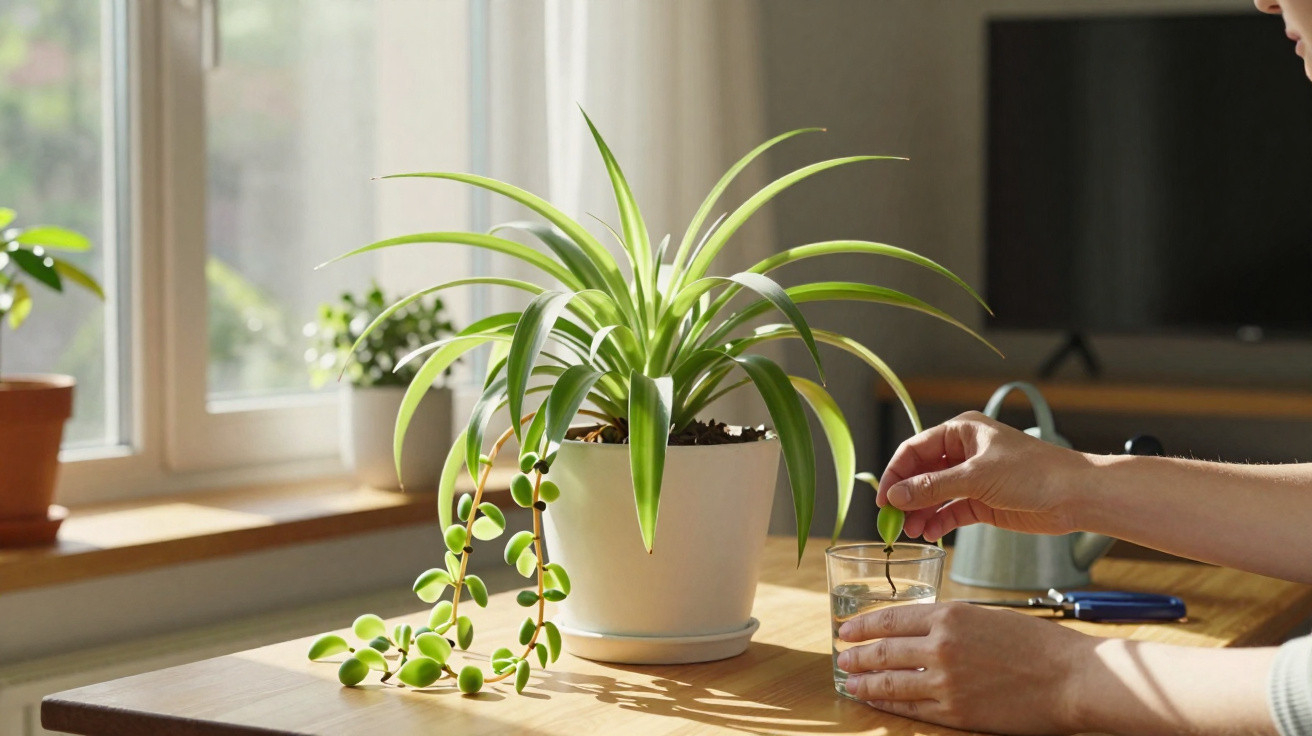
Once you can see small, complete mini plants on the stems - with their own little leaves - they can be encouraged into independence. If you don’t rush and wait until the first small roots are visible, your success rate goes up noticeably.
Three straightforward approaches work well:
- Potting up directly: Snip off the plantlet and place it into a small pot of lightly moist potting compost. Keep it bright but out of harsh sun, and maintain an evenly lightly moist compost.
- Starting in a glass of water: Root the baby in a glass of water and pot it on afterwards - ideal for impatient growers who want to watch the roots develop.
- A “nursery” while still attached: Put a small pot of compost under the baby, rest the plantlet on top, and only cut it free once it has rooted through on its own.
In rented flats where space is limited, the spider plant can become a mini self-sufficiency project: one pot quickly becomes ten, and ten can turn into a whole green wall - in hanging baskets, on shelves, or lined up along a windowsill.
What makes the spider plant so tough - and where problems begin
The plant’s thicker roots act as storage organs for water and nutrients. Specialist articles describe them as surprisingly rich in fibre, minerals and other reserves. These stores are why the plant can cope with a drier weekend without immediately collapsing.
That same toughness can lead to avoidable mistakes in day-to-day care:
- Constant “just in case” watering causes waterlogging and rotting roots.
- Too much fertiliser can produce huge clumps of leaves but very few plantlets.
- A pot that’s too large keeps the plant focused on building below ground rather than moving into reproduction.
Typical warning signs include yellowing leaves, mushy roots when repotting, or a musty smell coming from the pot. The remedy is straightforward: remove old compost, cut away any rotten parts, and replant into fresh, airy substrate - this time with better drainage and more restrained watering.
Practical examples from everyday life
Anyone who keeps a spider plant on an office windowsill may have seen this pattern: in summer, when the plant gets plenty of daylight but little artificial light in the evening, it suddenly sends out stems covered in babies. In winter, when ceiling lights are used for long hours, those stems often fail to appear. Even a simple plug-in timer for lamps can make a real difference.
In small city flats with just one bright window, it can pay to treat the spider plant as the “main tenant” of the window and move other plants slightly further back. The plant usually rewards that premium spot within a few weeks with its first flower stems - and that’s the clearest sign the baby wave is about to start.

Comments
No comments yet. Be the first to comment!
Leave a Comment