
Many amateur gardeners assume February is a quiet month outdoors. In reality, these weeks quietly determine how rich in wildlife your garden will feel in spring. Ornithologists point this out year after year: act now and you greatly improve young birds’ chances; do nothing and you risk parasite problems, empty nest boxes and a noticeably quieter garden.
Why February is so crucial for garden birds
Even while we are still wrapped up in winter coats, great tits, blue tits, house sparrows and others have already begun looking for a place to breed. From mid-February they inspect every suitable nook and cranny, checking nest boxes and natural tree cavities. If your garden offers a clean, safe nesting site at that point, it has a clear advantage.
This matters especially in towns and suburbs, where old hollow trees are scarce. Suitable cavities are in short supply and competition is fierce. Many pairs have effectively made their choice before we feel any sign of spring. If you only get going in March or April, you are often too late - the birds will already have settled on another garden.
"In February it’s often decided whether your garden will be full of birdsong in a few weeks - or become alarmingly quiet."
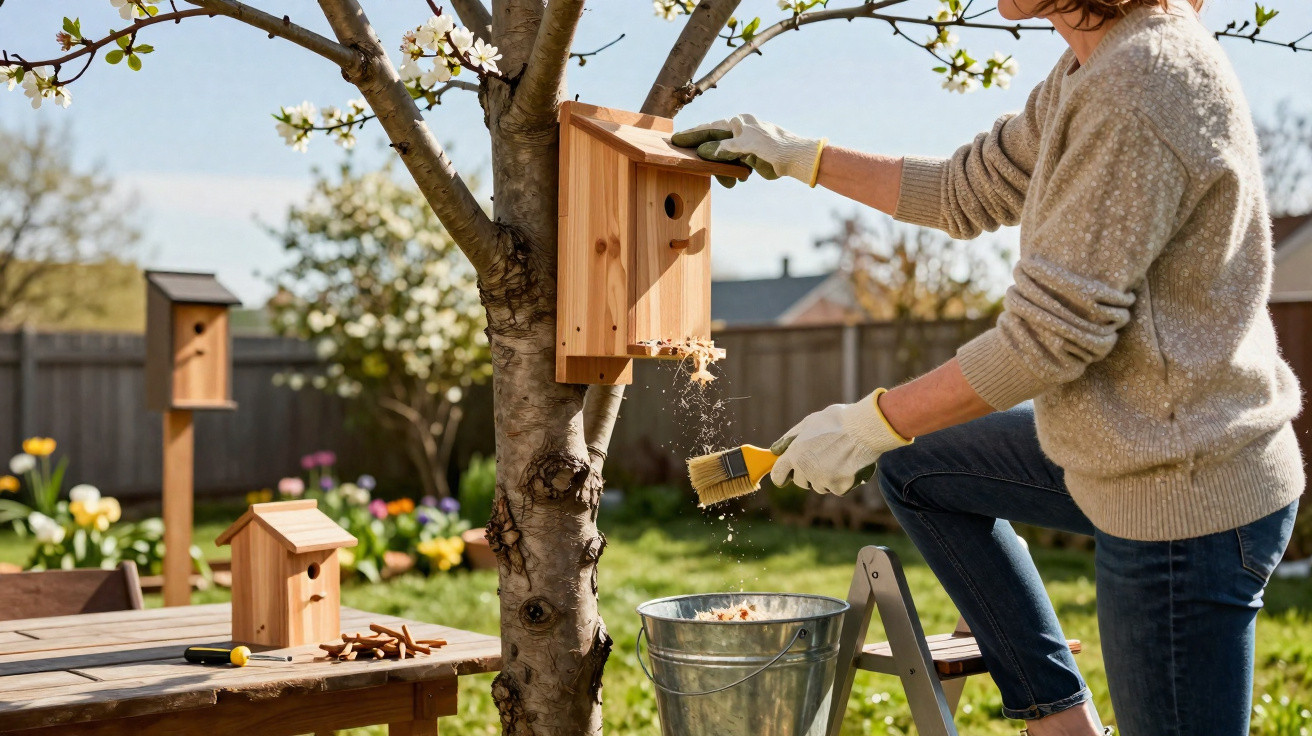
That is why ornithologists advise putting up nest boxes now, or repairing and rehanging those you already own. Given a bit of time outdoors, boxes feel familiar, lose their ‘human’ scent and are more readily accepted.
The most important step: thoroughly clean old nest boxes
If you already have nest boxes up, it is worth resisting the temptation to wait for something to move in ‘by itself’. What makes the biggest difference is a proper inspection followed by careful cleaning.
Why old nests can become a hazard
After autumn, the used nest often remains inside the box: moss, hair, feathers and plant fibres. Those materials are exactly where parasites such as fleas, mites and other pests can overwinter. Come spring, they are essentially lying in wait for defenceless chicks.
The impact can be severe: weakened nestlings, slower growth and higher mortality. A significant share of losses in the first days of life can be traced back to these parasites - and the risk can be reduced with very little effort.
How to clean a nest box properly
- Remove the entire old nest, including loose feathers and bits of moss.
- Scrub the inside firmly with a stiff brush.
- Do not use any chemical cleaners - residues can harm birds.
- If you wish, rinse with hot water (up to near-boiling) to kill parasites.
- Let the box dry completely, and only then put it back outside.
This rarely takes more than ten minutes per box, yet it can be the difference between a healthy clutch and a failed brood.
"A clean nest box matters to chicks as much as clean bedding matters to us - except their enemies are fleas and mites, not just dust."
New nest boxes: the right size determines who moves in
If you do not yet have any nest boxes in the garden, now is the ideal time to start. Appearance is not the main point - the practical details are. One of the key questions is: how large is the entrance hole?
That opening works like a filter. It favours smaller species, while keeping out larger birds and some predators. Here is a quick guide to common sizes:
| Entrance hole diameter | Suitable species |
|---|---|
| approx. 26–28 mm | Blue tit, coal tit, marsh tit |
| approx. 32–34 mm | Great tit, house sparrow, Eurasian nuthatch |
| Half-open front | Robin, black redstart, spotted flycatcher |
If you want to support particular species, choose the entrance size accordingly. For beginners, a model with an opening of around 32 mm is especially practical, as many widespread garden birds will use it.
Materials: what birds actually need
Unpainted, durable timber such as larch, oak or cedar is best. It insulates well against both cold and heat, and it also sits naturally in the garden. The walls should be at least 1.5 centimetres thick; otherwise, chicks can lose too much heat on cold nights.
Experts clearly advise against:
- Metal nest boxes - they can become dangerously hot in direct sun.
- Very cheap, thin wooden boxes - they offer little protection.
- Brightly coloured decorative boxes - pleasing for people, often unsuitable for birds.
A sturdy, plain wooden box will bring far more life into your garden than any colourful ‘decor’ birdhouse from a garden centre.
The perfect spot: how to hang nest boxes correctly
Even the best box will not do its job if it is positioned poorly. Birds are highly sensitive to safety and shelter from the weather. A few basic rules make choosing the location much easier.
Direction, height and protection - the key points
- Direction: Ideally, face the entrance hole east or south-east. That way the morning sun warms the box, but it is less likely to overheat later in the day. Westerly rain and wind are also less likely to drive straight into the opening.
- Height: Around 2–3 metres above the ground is a good compromise - high enough to deter cats and curious children, yet still reachable for the annual clean.
- Fixing: Attach it very securely to a trunk or wall - boxes that wobble are often avoided. A slight forward tilt helps stop rainwater running in.
- Clear approach: Avoid branches directly in front of the entrance. They can make access easier for predators such as cats or martens.
"A securely hung nest box feels to birds like a home in a good location: quiet, dry, with a clear way in."
Why the effort pays off twice over in your own garden
Helping birds to breed now brings several benefits later. A family of tits will feed their chicks thousands of caterpillars and insects during the nesting period. This natural pest control takes pressure off vegetable beds, roses and fruit trees - without any poisons.
At the same time, biodiversity increases. More birds can draw in more wildlife: insects, spiders and small mammals. Step by step, the garden becomes a small ecosystem that copes more steadily with weather extremes and pest outbreaks.
Practical extra tips for a bird-friendly garden
A handful of simple steps can make nest boxes far more effective:
- Do not clear away every leaf pile - birds find food there, and insects use it as shelter.
- Plant a few native shrubs, such as dog rose (rosehips) or elder, to provide cover and food.
- Avoid insecticides so there is enough food for chicks.
- Clean bird baths regularly and refill them with fresh water, especially on warm days.
If you like, you can mix different box styles: boxes for tits, open-fronted boxes for robins, and perhaps a box for starlings as well. This creates a whole ‘bird neighbourhood’ that keeps the garden active throughout the year.
Many terms in ornithology sound more complicated than they are. "Cavity nesters", for example, are species that breed only in sheltered holes - such as tree cavities or nest boxes. Without suitable options, they gradually disappear from densely built-up areas. A single well-placed box can be enough to influence whether a species remains present in a neighbourhood.
If you invest a few hours now, you can watch up close in spring as busy parent birds shuttle back and forth with food. It is a spectacle that fascinates children and adults alike - and it starts with one simple, timely action in February.

Comments
No comments yet. Be the first to comment!
Leave a Comment