
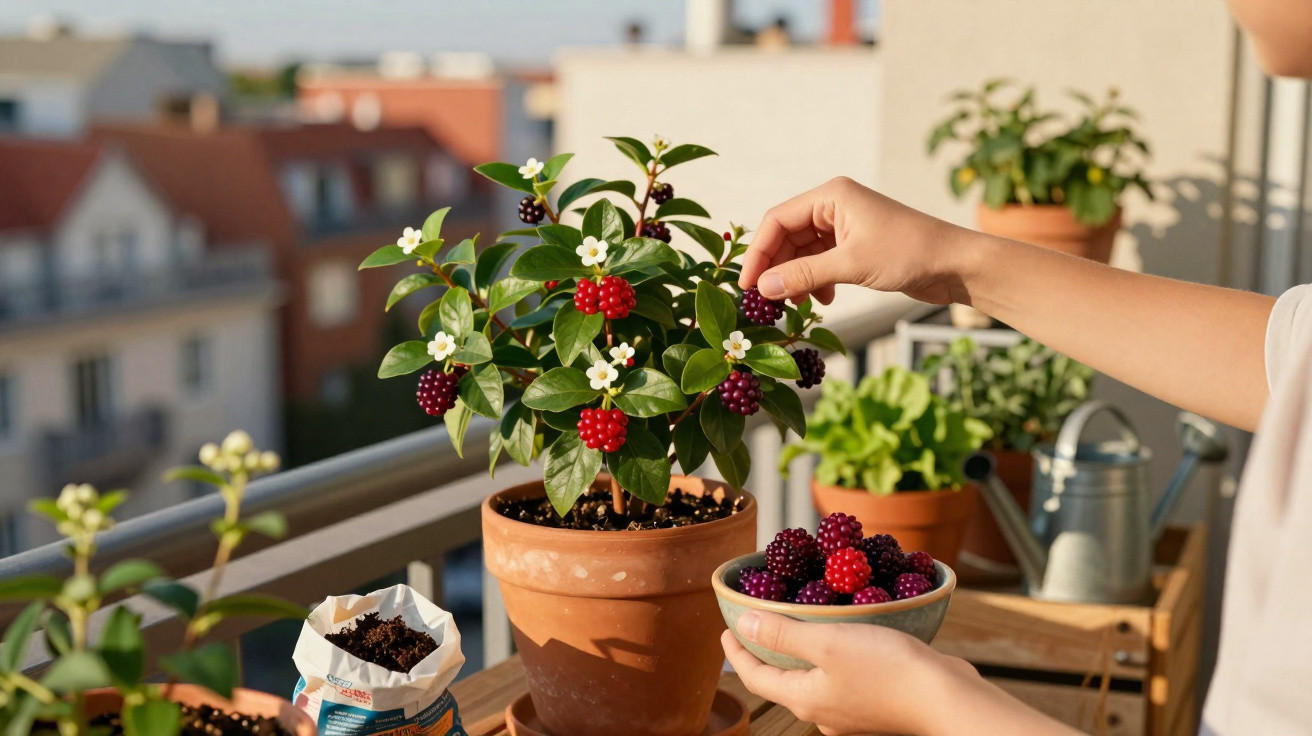
Leafing through the new garden catalogues in late winter, it’s easy to start daydreaming about a touch of the tropics and growing unusual fruit at home. Plenty of people drop the idea straight away because they’ve neither the space for a garden nor the budget for a greenhouse. This is exactly where an under-the-radar shrub from South America comes in-long valued in its homeland, and seemingly made for being grown in a pot here.
A small shrub with a big name: what lies behind Murtilla
Murtilla (botanical name Ugni molinae), often called the Chilean guava shrub in English, comes from the temperate parts of the Andes. There it grows in cool, damp woodland-conditions that suit our climate far better than you might expect from “exotic fruit”.
Naturally, the shrub stays compact. In a container it usually reaches 80–120 cm, and only rarely grows much beyond 1.50 m. Its shoots branch readily, creating a dense, bushy crown. That’s precisely what makes it appealing if you’ve only got a small balcony, a loggia, or a narrow terrace to work with.
"Murtilla is one of the few true fruit shrubs that will happily settle into an ordinary container on a city balcony, without being forced."
While traditional fruit trees such as apple or cherry demand a lot of space even in dwarf forms, Murtilla remains manageable by nature. It grows slowly, doesn’t require constant repotting, and can live in one suitably large pot for years.
Fragrant flowers, evergreen leaves and fruit with a surprise factor
Visually, this shrub offers far more than its harvest. It carries small, firm, glossy, deep-green leaves and stays evergreen throughout the year. So even in December it doesn’t look bare; instead it resembles a tidy ornamental shrub.
In late spring-typically from May onwards-countless small, bell-shaped flowers appear. They are white to pale pink, hang slightly downward, and are reminiscent of tiny ornamental-cherry bells. The standout feature is their scent: sweet, warm and gently vanilla-like, noticeable on sunny days even in a tightly built-up courtyard.
Later in the year these develop into round berries that range from red to dark purple. At first glance they look a bit like small blueberries or lingonberries, but the flavour goes in a different direction.
What does Murtilla actually taste like?
The berries surprise many people with a very distinctive aroma. Gardeners often describe it like this:
- a base note similar to sweet wild strawberry
- plus a hint of kiwi
- a delicate tropical note akin to guava
- a mild, warm spiciness that recalls baked apple
The skin is thin and the flesh is firm, without becoming mealy. The berries are great for snacking straight from the shrub, and they also work well in jams, jellies, syrup, or as a topping for yoghurt and fruit salad.
Tough, not temperamental: how frost-hardy this Andean shrub is
Despite its exotic origins, Murtilla behaves surprisingly robustly. In its native range it faces cool winters, wind and wet weather. That natural hardiness is what makes it interesting for Central and Northern European balconies.
Planted in the ground, a well-established shrub can cope with short spells down to around −10 °C. In a pot, the roots are more exposed, but a simple approach keeps the plant safe:
- position the container close to a sheltered house wall
- wrap the pot with hessian, fleece or bubble wrap
- stand the pot on wooden slats or a plant stand so it isn’t sitting directly on freezing ground
An unheated but bright hallway, a cool stairwell or a frost-free conservatory can also be suitable if your area regularly gets significantly colder.
"If you have a normal balcony with a bit of shelter from easterly winds, you can keep Murtilla outdoors all year-only the pot needs a ‘winter coat’."
The right compost: lime-free, rich in humus
The key variable for this shrub isn’t temperature so much as the growing medium. Murtilla belongs in the same camp as rhododendron, blueberry and azalea: it really doesn’t like lime-rich soils.
For container growing, a blend like the following works well:
| Component | Proportion | Purpose |
|---|---|---|
| Compost for ericaceous plants (e.g. rhododendron compost) | 60–70 % | acidic pH, loose base structure |
| Well-rotted compost | 20–30 % | nutrient source and moisture retention |
| Bark humus or fine pine bark | 10–20 % | structure, gradual acidification, less compaction |
Tap water with a high limescale content can cause issues over time. If you live in a hard-water area, rainwater from a butt-or tap water left to stand-tends to be a better choice.
Watering, feeding, pruning: keeping Murtilla productive in a pot
The shrub’s root system sits fairly close to the surface. It doesn’t tolerate drought stress well, so it needs extra attention in midsummer:
- keep the compost consistently lightly moist rather than bone-dry
- avoid waterlogging-pour away any water sitting in the saucer
- in hot weather, water moderately morning and evening rather than flooding it all at once
A thick mulch layer on the surface of the pot is extremely useful. Pine bark, wood chips or flax straw help the compost stay moist for longer and cut evaporation. Over time, these materials break down and support the gently acidic conditions the plant prefers.
For strong fruiting, Murtilla needs nutrients-but not heavy feeding. An organic berry fertiliser in spring and a light top-up in early summer are usually sufficient.
When it comes to pruning, the guiding principle is: less is more. Once a year-ideally in late February or early March-remove:
- dry, dead shoots
- branches growing strongly inwards
- very long tips that have lost their shape
The crown should stay airy but compact. Each cut encourages new side shoots-and those side shoots are where next year’s flowers and fruit will form.
A late harvest, a big reward: when the berries are ready
Unlike many classic garden fruits, Murtilla is a late-season performer. Depending on the position, berries ripen from October and often remain on the plant into December, provided frosts don’t become too severe.
You can tell fruit is ripe by an even dark-red to purple colour and a slight give under gentle pressure. At that stage they almost detach by themselves. If you pick earlier, the flavour is fresher and less sweet-which can actually be desirable for mixed jams.
In the kitchen, there’s plenty you can do with them. Popular options include:
- jams blended with wild strawberries or raspberries
- jelly with a dash of white wine or sparkling wine
- fruit sauces for panna cotta, crêpes or ice cream
- dried berries as a topping for muesli
Why Murtilla fits the urban gardening trend perfectly
This shrub ticks several current boxes for hobby gardeners: it brings an exotic look and flavour, yet stays easy to care for. It’s ideal for “edible balconies”, where ornamental and productive plants are grown side by side.
"If you plant Murtilla, you’re not only planting for yourself, but also creating a small buffet for bees and other insects."
The fragrant flowers provide food for pollinators in densely built-up neighbourhoods. The evergreen foliage offers birds places to hide, and the berries are not only for people-now and then, feathered visitors will help themselves too.
Combined with blueberries, lingonberries or cranberries, you can create a small “acid bed” in containers. Several shrubs placed next to one another can form a low, fruit-bearing hedge on a balcony or terrace. If you enjoy experimenting, you can underplant Murtilla with low-growing, shade-tolerant herbs-such as sweet woodruff-or woodland-style ground covers to heighten the decorative effect.
For many urban gardeners, that blend is the point: Murtilla looks good, smells wonderful, produces delicious fruit, doesn’t require complicated kit, and can work even on a fifth-floor north-west-facing balcony-so long as the pot size, compost and watering are right. That turns a South American insider tip into a genuinely realistic project for next spring across the German-speaking world.
Comments
No comments yet. Be the first to comment!
Leave a Comment