
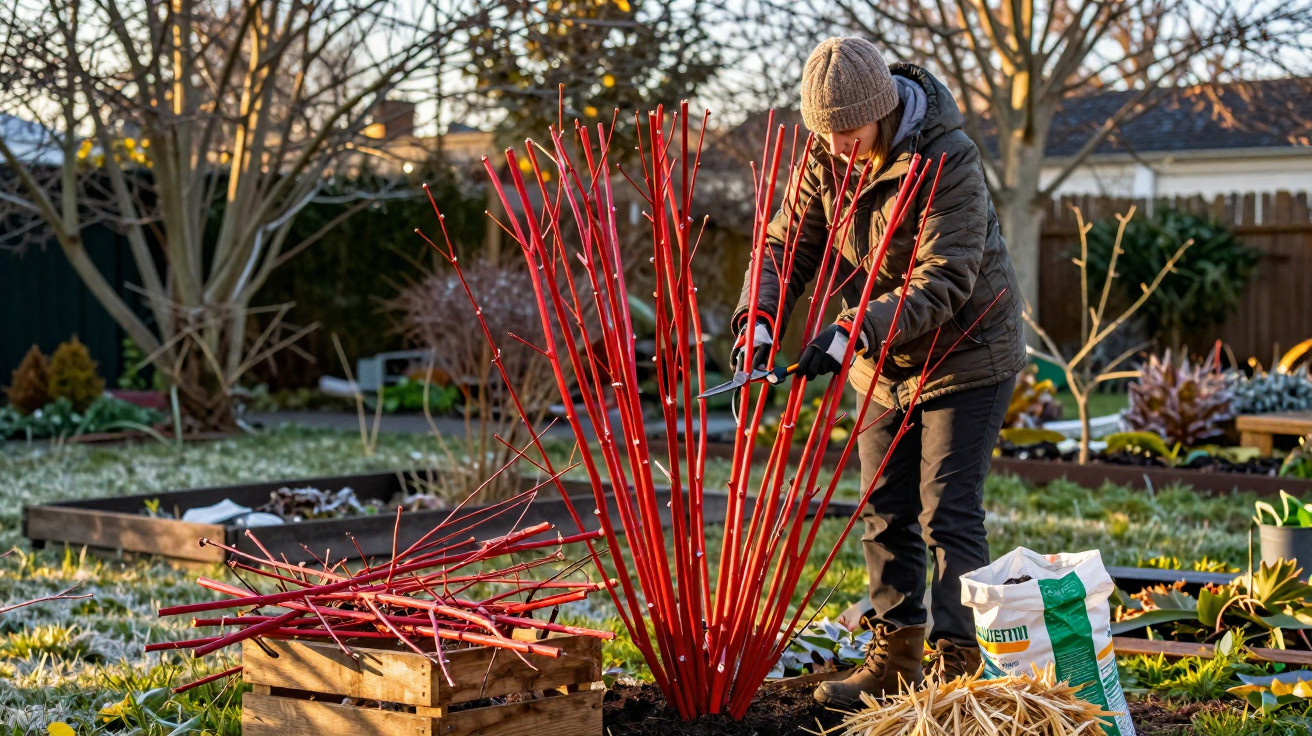
If you pass shrubs with glowing red or golden-yellow stems in February, it often looks like magic. In reality, it’s usually the result of a fairly drastic prune. With ornamental Cornus-such as bloodtwig dogwood (Cornus sanguinea)-these weeks decide whether the shrub will blaze through next winter or simply fade into the background as another grey thicket.
Why Cornus shrubs often disappoint in winter
Cornus sanguinea, Cornus alba and their cultivars are classic choices for colourful winter stems. In brochures they burn in fire-engine red, punchy orange or neon yellow. In many gardens, though, they end up looking like “just a shrub with branches”.
The reason is simple: the strongest colour sits in young bark. As stems age, the bark thickens, toughens and dulls to grey. That helps the plant cope with cold and bad weather-but it also removes the very thing you planted it for: those vivid winter colours.
"Only young wood shows the spectacular reds-if you don’t prune, you’re left looking at grey poles."
Left to grow on without proper cutting back, Cornus soon resembles any ordinary hedge shrub. If you keep pushing out new young stems, by contrast, you get a winter bed feature that looks as if it’s been lit from within.
The key question in February: prune - yes or no?
With Cornus, February always brings the same decision: do you reach for the secateurs, or let everything carry on? If you hesitate, you effectively give up a whole year of colour. The window is short-and, horticulturally speaking, incredibly valuable.
The best window: 10 to 25 February
Professional gardeners tend to stick to a clear period for Cornus: roughly between 10 and 25 February. The plant is gearing up for spring, but the main surge of sap hasn’t properly started yet.
- Too early, in the depths of winter: cut surfaces stay open for longer, and frost can damage the wood.
- Too late, in March: buds are already moving; the plant has already invested energy in growth that you then remove.
- Just right, in February: the plant is waking up, can seal cuts quickly, and puts its full energy into fresh young shoots.
A confident prune at this point channels vigour into new wood-exactly what you need for intensely coloured bark.
Young, middle-aged, old: how to spot the right stems
To prune Cornus properly, it helps to judge how old the stems are. You don’t need expert knowledge-your eyes are enough.
- 1-year-old shoots: very smooth, slender, uncracked. Colour is strong and saturated: rich red, orange or yellow depending on the variety.
- 2-year-old shoots: still colourful, but already slightly dulled at the base. They begin to branch.
- 3+ year-old wood: noticeably greyer, cracked, with small bumps. It reads as brown-grey rather than coloured.
A straightforward rule of thumb is:
"Anything that looks clearly grey, cracked and several years old is stealing colour-and should come out."
Once you remove that older wood, light reaches the centre of the shrub and the plant responds by sending up fresh, strongly coloured stems from low down.
Radical rejuvenation: how coppicing works (cutting back to a stool)
If you want the strongest colour effect, it’s hard to avoid a tougher approach: cutting back hard to a stool-coppicing, also known as “recépage”. It sounds severe, but for Cornus it’s essentially a rejuvenation treatment.
Step by step to a “red broom”
For a vigorous Cornus alba or bloodtwig dogwood, the method works like this:
- Prepare your tools: use sharp, clean, disinfected blades. For thicker stems, use loppers.
- Make the cuts: cut all main stems back to about 10–15 cm above ground level.
- Keep cuts clean: don’t crush; cut smoothly, ideally on a slight angle so water can run off.
- Check afterwards: remove weak, dried-out or diseased-looking stumps entirely.
At first, the result looks harsh: a bare “stool” with lots of sawn-off stems. By April or May, however, the shrub typically bursts into strong new growth and forms a dense bundle of coloured rods.
"A consistent hard prune every two years keeps winter stems glowing year after year."
If a full cut-back feels like too much, start more gently: each year remove roughly a third of the oldest, greyest stems right at the base. The shrub renews itself more slowly, but it still stays tidy and improves in colour.
Aftercare following pruning: feed, water, mulch
A hard cut-back is not a problem for Cornus, but it does take energy. With a little support, the shrub repays the effort with exceptionally strong new shoots.
What the shrub needs now
- Nutrients: work in a layer of well-rotted compost or an organic all-purpose fertiliser around the root area.
- Loosen the soil: incorporate lightly with a hoe or by hand, taking care not to damage roots.
- Mulch: bark mulch, leaf mould or woodchip helps hold moisture and protects soil life.
- Water: in dry springs, water regularly so the plant can push new growth without stress.
Get these basics right and, often by the very first winter after the cut-back, you’ll be looking at a thick cluster of bright, slender stems that stand in the border like coloured glass rods.
What to do with the cut stems
Many people automatically dump the prunings into the garden waste bin. With Cornus that’s a shame, because the stems are not only richly coloured but also surprisingly flexible.
They’re useful for:
- Indoor decoration: long rods in a large glass vase can look almost like modern sculpture.
- Plant supports: in the veg patch, as colourful stakes for peas, beans or ornamental climbers.
- Simple weaving: small rings, wreaths or low edging for beds.
"When you prune Cornus, you gain instant colour in the garden and free decorating material at the same time."
Varieties that are especially worth growing
Not every Cornus glows with the same intensity. Some cultivars are renowned for their standout colour.
| Variety | Stem colour | Special feature |
|---|---|---|
| Cornus alba ‘Sibirica’ | Bright red | A classic for “red brooms”, very tolerant of hard pruning |
| Cornus alba ‘Elegantissima’ | Red | Variegated leaves in summer, coloured stems in winter |
| Cornus sanguinea ‘Midwinter Fire’ | Yellow–orange–red | A gradient like a small campfire |
| Cornus sericea ‘Flaviramea’ | Yellow-green | Strong contrast in snow or against dark hedges |
Combine several cultivars and you can turn whole borders into a winter bonfire: vivid red stems beside neon yellow and orange shoots, set off by dark evergreens or grasses.
Risks, mistakes and a few honest tips
To many gardeners, a hard cut-back looks brutal at first. Two points usually help reassure:
- Cornus species are exceptionally tough and reliably regrow even after very heavy pruning.
- The visible “bare patch” only lasts a few weeks-by spring the shrub is green again, and by next winter it’s colourful.
Trouble most often starts when pruning has been neglected for years. The centre becomes extremely woody, and one single severe cut can weaken the plant. In those cases, it’s better to rejuvenate gradually over two to three years.
It’s also worth thinking about siting: a position in sun to partial shade brings out stronger colour than a very dark, damp corner. Cornus doesn’t like waterlogged ground, but it does well in fresh, free-draining soils.
Why it’s genuinely worth picking up the secateurs in February
If you treat Cornus as “just another shrub”, you miss one of the most dramatic winter effects a garden can offer. One well-timed cut in February often decides whether you spend January staring at dull grey branches-or at a bundle of vivid colour strokes that lift even the gloomiest days.
For most shrubs, the job takes only a few minutes, and the impact lasts for years. And each winter, the quiet satisfaction grows-especially when passers-by pause at the fence and wonder why, in the middle of all that grey, this particular garden is suddenly glowing in red and gold.


Comments
No comments yet. Be the first to comment!
Leave a Comment