
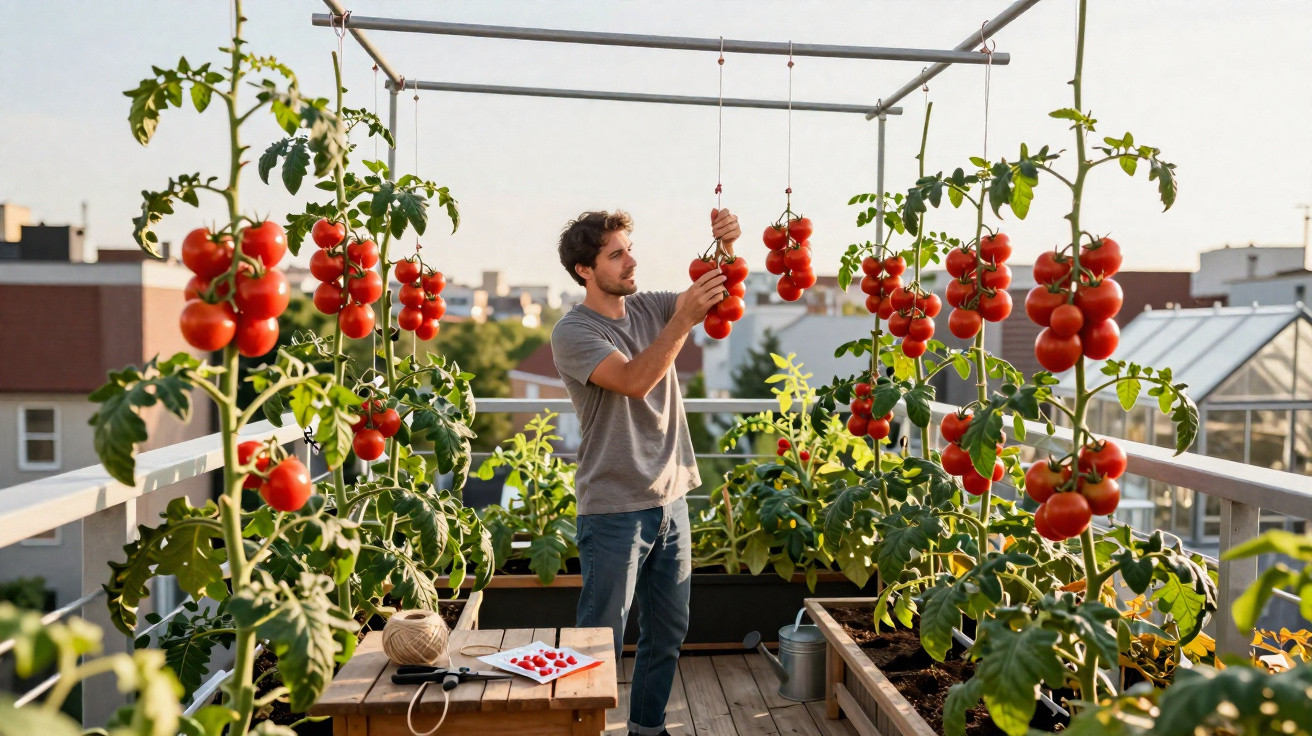
A straightforward setup can take the place of traditional canes.
Every summer, plenty of hobby gardeners end up annoyed by leaning wooden canes, bent metal supports and tomato rows so cramped you can barely get through. Commercial greenhouses have solved that problem for years-using a space-saving approach that’s now making its way into private gardens and even onto balconies: tomatoes are trained upwards on strings or a suspended frame, without any of the usual stakes.
Why tomato canes are annoying more and more gardeners
The familiar scene goes like this: each tomato plant gets a wooden or metal cane pushed vertically into the soil, then tied in with string. It works, but it comes with some obvious drawbacks.
- Canes take up space and get in the way.
- In strong winds or loose ground, they can topple easily.
- Plants can snap or crease when they become too heavy.
- Harvesting is awkward-you’re constantly bending down.
In small gardens, raised beds or on balconies, the whole thing can look cluttered very quickly. When space is limited, individual canes waste valuable growing area.
"The solution: the tomato hangs-not the gardener. A string or wire does the guiding, and the ground stays clear."
How hanging tomato growing works in practice
Instead of tying each plant to its own stake, you use strings or wires that come down from above or are stretched across the row. The method comes from professional greenhouse production and can be adapted easily for a balcony, terrace or garden.
Basic principle of suspended training
At its heart, the system is surprisingly simple:
- Fit a sturdy support overhead-such as a pergola, metal frame, timber structure, beam or the roof of a small arbour.
- From that point, hang one length of twine or a wire down per plant, or run a strong line horizontally along the row.
- Train the tomato plant up the string as it grows, either by gently twisting it around the line or fixing it with soft clips.
- With each growth spurt, keep guiding it upwards until it reaches an impressive height.
This approach suits indeterminate tomatoes particularly well-varieties that don’t stop at about a metre, but can easily reach 2 metres or more. That’s exactly where hanging strings show their advantage.
More room, more air, less hassle
The biggest benefit is that it frees up the ground. The plants go up, and the space beneath remains usable.
- Extra room for herbs or salad greens under the tomatoes
- Easier movement in a bed or on a balcony
- Plant more closely without everything turning into a jungle
It can also improve plant health. With a clearer structure and more height, air circulates better. Leaves dry more quickly and moisture is less likely to linger, which can noticeably reduce the risk of diseases such as blight.
"The fruit trusses hang freely, well away from damp soil-making plants hardier and harvesting simpler."
It’s kinder on your back as well: many tomatoes end up around eye level. Instead of kneeling and rummaging, you can cut ripe fruit comfortably while standing.
Which materials work best?
To get started you don’t need expensive specialist equipment. With a few low-cost parts, the system is often up and running in under an hour.
| Component | Suitable options | Practical tip |
|---|---|---|
| Support structure | Pergola, greenhouse frame, timber beam, metal frame, garden arch | It must safely carry the weight of plants and fruit. |
| String / wire | Garden twine or tomato string, coir cord, plastic rope, thin coated wire | Don’t go too thin, or it can cut into the stems. |
| Fixings | Soft clips, rubber rings, fabric strips, plant ties | Always fasten loosely so shoots aren’t crushed. |
A major plus: many parts can be reused year after year. If you choose robust materials, you’ll have a setup that lasts and only needs occasional adjustment.
Getting started with hanging tomatoes for the season
To help plants settle into the system, it’s best to begin early.
Timing it right
Ideally, have the frame and strings in place before your tomatoes go into the bed or into containers. That way, young plants can be tied in from day one rather than needing to be “moved over” later.
Once plants are about 20–30 centimetres tall, give them their first loose tie. As growth speeds up over the following weeks, check weekly and keep guiding the main stem upwards.
Care tips for the best yield
- Pinch out side shoots regularly so plants don’t become too bushy.
- Keep leading the main stem along the string without sharply bending it.
- Check string tension and tighten if needed.
- In pots, pay extra attention to watering, as plants tend to build more leaf mass.
"If you give your tomatoes a quick weekly check, you avoid chaos in the leaf canopy-and end up with tidy, easy-to-reach rows."
Ideal for greenhouses, polytunnels and city balconies
In professional production, hanging strings have long been standard. In a greenhouse, they’re fixed to the roof structure, and plants hang as if from a curtain rail. The same idea works on a smaller scale: a simple crossbeam in a hobby greenhouse is often enough.
In polytunnels, strings can be attached to cross-bracing; on balconies, to the ceiling, railings or a homemade frame. If you place two raised beds opposite each other, you can lay a beam across the top and tie the strings from it-creating a small “tomato tunnel”.
When veg becomes décor
Alongside the practical benefits, the method has an aesthetic appeal that many people only notice once it’s in place. Hanging tomato rows can look like a living curtain or an edible wall.
- A greened garden arch at the entrance to the garden
- A red “tomato curtain” along the patio
- A planted corner on the balcony that provides shade and privacy
With smart pairing, you can plant basil or marigolds below and tomatoes above-attractive to look at and also helpful for drawing in insects that support pollination.
Which varieties are especially suitable
Varieties with long, unrestricted growth benefit most. That includes many classic cordon tomatoes, cherry tomatoes and some beefsteak types. Bush tomatoes or compact balcony varieties can work too, but they make less use of the height.
It’s also sensible not to position very heavy fruit types right at the top. Large beefsteak tomatoes are better kept at mid-height so stems don’t break under the load. If needed, support individual trusses with extra loops beneath the clusters.
Risks, common mistakes, and how to avoid them
Like any technique, the hanging method can go wrong if a few basics are ignored:
- String that’s too thin: it can cut into stems-choose a slightly thicker option.
- Weak anchoring overhead: can cause plants to fall in a storm-always secure connections twice.
- Clips that are too tight: they crush the transport tissues and slow growth-leave a little slack.
- Not enough nutrients: vigorous, tall plants need good feeding, especially in containers.
If you keep these points in mind, you can tweak the setup each season and keep improving it. Many gardeners say that after just one summer, they never want to go back to traditional canes.
The mix of better airflow, clear ground space and a more comfortable harvest makes this approach particularly appealing for small urban gardens. With a bit of DIY confidence, even a narrow balcony can become a productive tomato wall-and the old cane can be relegated to the corner.

Comments
No comments yet. Be the first to comment!
Leave a Comment