
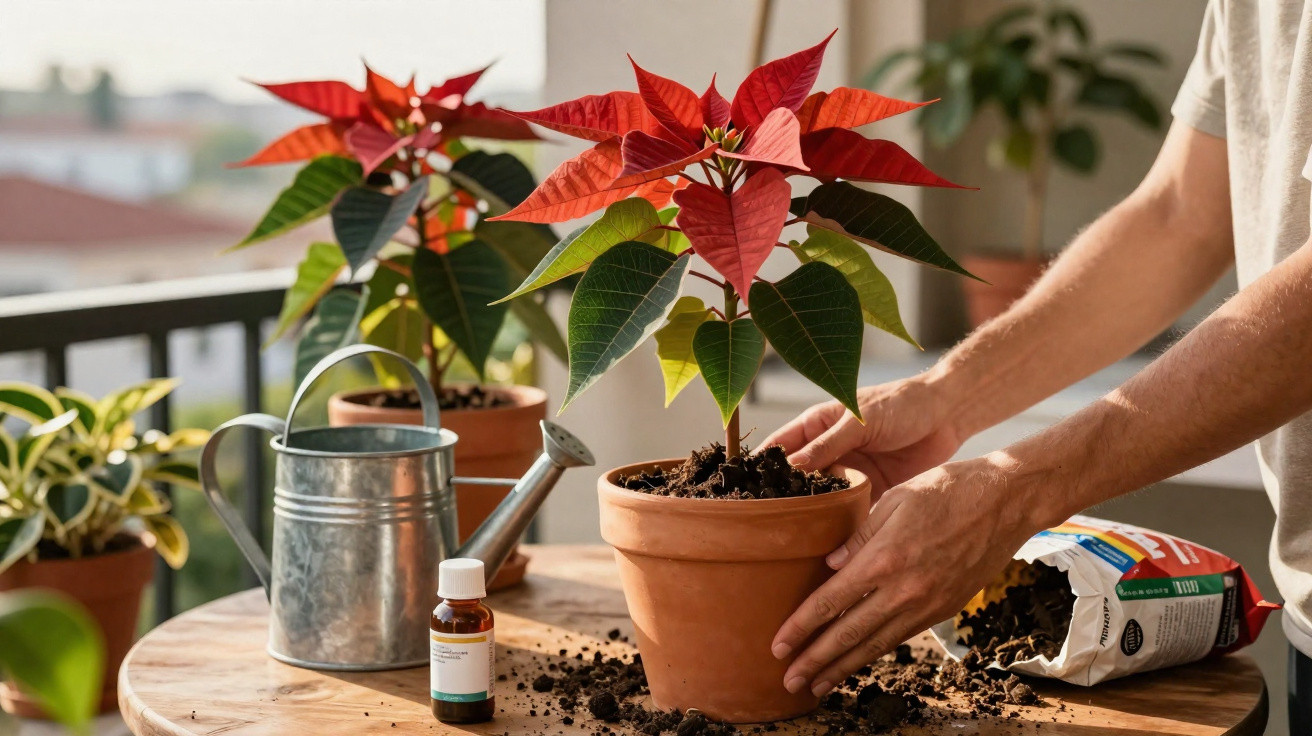
Anyone who avoids one specific mistake now can keep their poinsettia as a vigorous green plant all summer.
The red sheen has dulled, a few leaves are already scattered across the windowsill, and the pot looks miserable. In many homes, that is the point at which the poinsettia is written off. Yet there is far more life left in the plant than it seems to have once the festive season is over. What matters most are the weeks in March and April: this is when it becomes clear whether the poinsettia dries out, rots - or carries on through the summer as an attractive green houseplant.
Poinsettia in brief: not throwaway décor
The poinsettia’s botanical name is Euphorbia pulcherrima. It originally comes from Mexico, where it grows as a shrub. In a pot it stays more compact, typically around 30 to 60 cm tall and 30 to 50 cm wide.
| Latin name | Euphorbia pulcherrima |
| Common name | Poinsettia |
| Size in a pot | approx. 30–60 cm tall, 30–50 cm wide |
| Light | bright, but no harsh direct sun; in summer, semi-shade outdoors |
| Temperature | sensitive to frost; keep consistently above 13 °C |
| Leaves | evergreen indoors; leaf drop under stress or due to care mistakes |
Many people treat poinsettias as short-lived seasonal decoration. Specialists take a different view: the plant can live for several years, develop into a dense shrub, and produce colourful bracts again each winter - provided it is handled correctly in spring.
The critical period is March and April: if you water incorrectly or fail to adjust the position, you lose the plant - if you respond properly, you gain a long-lasting houseplant.
In March: respect the resting phase instead of “drowning” it
Towards the end of winter, the poinsettia enters a rest period. The coloured bracts fade, and some leaves turn yellow. Many people interpret this as “the plant is finished” and throw it away. In reality, this is when its recovery phase begins.
The biggest mistake in March: watering as if it were December
Over the Christmas period, poinsettias are often watered generously to keep them lush. In March, the same amount of water almost inevitably causes trouble: roots rot and leaves drop in large numbers.
- Position: a bright spot, but cooler than a living room; 13 to 16 °C is ideal.
- Distance from heat sources: not above a radiator, and avoid draughts from windows.
- Watering: very sparingly, only when the compost is almost completely dry.
- Water in saucers: always pour it away fully; no waterlogging.
If you carry on watering as you did in Advent, you make exactly the mistake that needlessly kills the plant in spring. At this stage, a poinsettia needs “rest rather than pampering”.
Gentle care instead of a drastic cut-back
Many hobby gardeners reach for the secateurs at this point and cut everything right back. That is rarely necessary. It is usually better to intervene carefully:
- Remove only dried-out, brown leaves.
- Avoid cutting back hard into old wood.
- Wear gloves when removing plant material: the white milky sap can irritate skin.
This approach allows the plant to use its remaining reserves and slowly prepare for a fresh start.
In April: trigger a restart with the right repotting
From April, small green shoots begin to appear on the stems. That is the signal that the rest period is ending and the plant wants to grow again.
New pot, fresh compost - but only one size up
Now is the time to repot into fresh compost. Choose a pot that is only slightly larger than the old one, so the roots are not sitting in an oversized volume of compost.
- Pot choice: free-draining, with drainage holes.
- Compost: high-quality houseplant compost, ideally loose and airy.
- Drainage: a layer of expanded clay pellets (or similar) at the bottom of the pot.
When repotting, gently loosen the old root ball and remove compacted compost. Afterwards, water moderately - do not soak the plant.
The second common mistake: too much sun, too much water
Spring brings brighter days, and many people move their poinsettia straight into full sun on a south-facing windowsill. Combined with frequent watering, that quickly leads to stress:
- Leaves become limp and droop.
- Edges dry out or scorch.
- If water sits in the pot, the roots begin to rot.
In April, poinsettias prefer:
- a bright position without full sun,
- indoor temperatures of around 18 to 20 °C,
- a simple finger test for watering: if the top layer of compost is dry, water with lukewarm, low-limescale water; if it still feels damp, wait a few more days.
Spring is not the cue for constant watering, but a phase of cautious rebuilding - those who increase care slowly end up with a robust summer plant.
From late April: from winter guest to summer-green houseplant
Once temperatures become consistently milder, poinsettias start growing much more strongly. Care can be a little more generous again - but it should still be structured.
Watering and feeding schedule for a strong summer poinsettia
As light levels rise, so does the plant’s need for water. Even so, the key rule remains: slightly too dry is better than too wet. A liquid feed for flowering houseplants about every two weeks supports dense, richly green growth.
- Water regularly, but in measured amounts.
- Feed from late April to August every two to three weeks.
- Do not allow standing water in an outer pot.
This is how a poinsettia develops into an appealing, bushy green plant that looks decorative even without red bracts.
Out to the balcony or terrace - with a gradual transition
Once the risk of night frost has passed, the poinsettia can move outdoors for periods. A semi-shaded spot on a balcony or terrace works well. It does not cope well with strong midday sun; morning or evening sun is enough.
If you acclimatise the plant step by step - for example, starting with a few hours outside each day - you reduce the risk of sun scorch and temperature shock. Over summer, the poinsettia behaves like a tropical foliage plant and can even be used as a focal point among grouped plantings.
Requirement for red bracts in winter
A common question is: will my poinsettia ever turn red again? The answer depends heavily on how it is cared for in spring and summer. A strong, well-developed plant responds much better to the later “light control” in autumn.
For coloured bracts to form, the poinsettia needs a period of long, dark nights in autumn - around 14 hours of darkness per day for eight to ten weeks. If you have strengthened the plant over summer, your chances of a red return in Advent are much higher.
Practical tips and small everyday risks
One aspect many people underestimate is the milky sap. When you prune or repot, a white sap can leak out and irritate the skin. Gloves are therefore sensible, especially if you have sensitive skin. If you have pets, it is best not to leave any plant debris within reach or where it could be chewed.
It is also helpful to distinguish between leaf drop caused by care mistakes and the normal resting phase: if the poinsettia suddenly loses a lot of leaves, the cause is usually a problem with watering or a cold draught. If only a few older leaves drop while new shoots appear, the plant is simply moving through its normal growth cycle.
Anyone who pays close attention in March and April to watering amounts, location, and the right time to repot stops treating the poinsettia as a disposable product. What seems like “spent” festive décor can then become a resilient, attractive green houseplant that keeps the home feeling lively and verdant not only at Christmas, but throughout the entire summer.
Comments
No comments yet. Be the first to comment!
Leave a Comment