
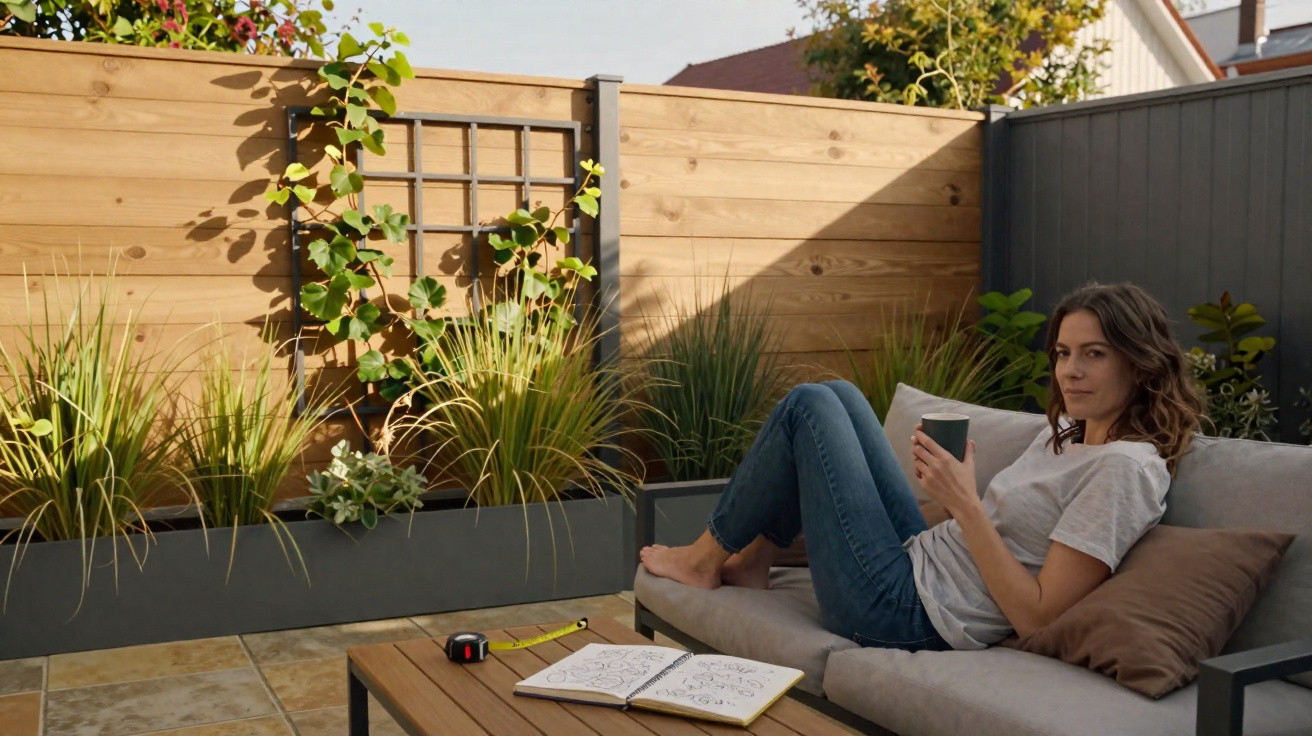
The first thing on show from the pavement usually isn’t your lounge or your kitchen. It’s that run of uprights marking the edge of your world. A sagging chain-link, a sun-bleached panel, a wall half-hidden by ivy - your fence signals your style long before anyone reaches the front door.
One Saturday, mug of coffee in hand, you clock your neighbour’s new fence. It isn’t taller. It isn’t chunkier. It’s simply… more considered. Timber slats paired with planting and light, catching shadows like a cinema screen. Their garden instantly feels deeper, quieter, more deliberate. Yours, by comparison, seems exposed and a bit flat.
And you start asking yourself: what if this “boundary” could do far more than just block a view?
Your fence is a backdrop, not a barricade
When most people hear “fence”, they imagine a blunt fix: make it high, make it solid, job done. Privacy achieved. Yet a fence that does nothing but shut things out often ends up shrinking the garden as well. You lose distance, layering, and that subtle sense of atmosphere.
A well-planned fence works more like stage scenery than a prison wall. It frames what’s inside, adds depth, and guides the eye exactly where you want it to go. The right cadence of posts, slats and intentional openings can visually elongate a small garden while still keeping your day-to-day life discreet from passers-by.
You don’t need more fencing. You need a smarter fence.
Picture a narrow city garden wedged between two brick terraces. One homeowner chooses a solid 1.8 m (6 ft) panel in a flat brown stain. Yes, it provides privacy - but the whole space starts to read like a box. A few doors down, someone installs horizontal cedar slats with a 1 cm gap between each, set in a slim black metal frame, and fronts it with tall ornamental grasses.
Stand in that second garden and your brain instantly reads layers: fence, planting, and the sky sifted through slats. The footprint hasn’t changed, but it feels longer, calmer, and more breathable. You get privacy without the weight of a fortress.
That’s the difference between a simple boundary and a background that actually composes the view.
The reason is straightforward visual psychology. Our eyes respond to depth and repetition. Vertical slats, fine gaps, alternating materials - timber beside metal, smooth beside rough - all encourage the mind to sense space beyond the fence line.
A flat, opaque wall stops the gaze abruptly. A designed fence slows it down, gives it “steps” to move across, and then lets it wander. It can also separate your garden into “quiet” and “active” areas without a single signpost.
Once you see the fence as scenery, each panel becomes a chance to improve the garden rather than a compromise you tolerate.
Use layers, not height, to create privacy and character
If you want more privacy, the instinct is to raise the fence. But height on its own can quickly feel heavy - especially in a smaller outdoor space. A more effective approach is layering: combine a sensibly sized fence with plants, screens and light so privacy builds in soft, overlapping bands.
Begin with a simple base fence that looks good on its own. Then add slim trellis sections above or in front, introduce climbers, or place laser-cut metal inserts in a few strategic spots. The result is less monotony, and views are filtered rather than slammed shut.
You’ll notice a quiet shift: your attention goes to the living textures, not the boundary.
Plenty of homeowners have a familiar “first privacy project” regret. The pattern is predictable: one weekend, tired of being overlooked, they install the tallest, most solid panels permitted. By Monday, the garden is private… and strangely airless. Evening light feels trapped, breezes don’t move through, and children’s voices bounce off hard surfaces.
A better method is to block sightlines, not the whole horizon. If the real problem is a neighbour’s upstairs window, add an extra layer of vertical slats only along that stretch - or set a tall bamboo planter where it interrupts the view. Keep the open sky everywhere else.
All at once, the space feels designed rather than defensive.
Here’s a plain truth people rarely mention: most visitors will spend more time looking at your fence than your flowerbeds.
So your fence should carry a bit of story. Pick one main material that reads as “home” - warm timber, sharp black steel, painted masonry - then repeat it in furniture, planters, or even the colour of your front door. The fence becomes the visual glue that pulls the outside together.
A landscape designer once told me, “The smartest fence is the one you stop noticing because you’re too busy enjoying what it makes possible.”
- Add vertical variety: combine full-height panels with lower runs and open trellis sections.
- Use light creatively: festoon lighting, wall sconces, or concealed LEDs can completely change a plain fence after dark.
- Let planting act as soft armour: grasses, climbers and shrubs provide privacy without visual heaviness.
- Keep one “feature panel”: a section in a different colour or pattern to anchor the whole garden.
- Preserve at least one borrowed view: an intentional gap or lower section that lets your eye reach a tree, skyline, or field.
A fence that changes how you use your outdoor life
Once you treat the fence as a tool rather than an afterthought, how you use the garden starts to change. That neglected corner becomes a cosy reading spot when one section is made taller and more sheltering. The scruffy side passage turns into a tidy vertical garden when slim shelves and hooks are fixed to the posts.
The fence stops being something you merely look at and becomes something you actively use. It can support lighting, artwork, tools - even a narrow bar ledge facing the sunset. Without building new walls, the garden gains “rooms”, simply by making the perimeter work harder.
The structure that used to say “stop here” starts whispering “stay a little longer.”
| Key point | Detail | Value for the reader |
|---|---|---|
| Think backdrop, not barrier | Use rhythm, gaps and textures instead of a flat, solid wall | Yard looks larger and calmer without losing privacy |
| Layer for privacy | Combine moderate fence height with plants and partial screens | More intimacy, less “boxed-in” feeling |
| Let the fence work for you | Attach lighting, storage, seating, or decor to the structure | Transforms wasted edges into functional, character-filled spaces |
FAQ:
- How tall should a privacy fence be without overwhelming my yard? Most people find 1.5–1.8 m enough for privacy, especially when combined with plants or trellises. Keep a consistent height only where you’re overlooked, and drop other sections slightly to avoid a bunker feel.
- What fence material adds character but is still low maintenance? Composite slats in a warm wood tone or powder-coated metal panels are strong options. They give a natural-material look with far less upkeep, and pair well with real-wood accents.
- Can I create privacy without blocking all the light? Yes. Slatted fencing, perforated metal, bamboo screens and tall grasses screen views while still letting daylight through. Think sunglasses for your garden rather than blackout curtains.
- How do I stop my fence from making the garden feel smaller? Use horizontal lines, vary panel heights, and layer planting in front of the fence. Push darker colours to the boundary and keep lighter, brighter tones nearer the house to extend perspective.
- Is it worth decorating a fence I already have? Absolutely. Paint, a few vertical planters and carefully positioned lighting can turn a dull boundary into a genuine feature. You don’t need to rebuild from scratch to gain depth, privacy and personality.

Comments
No comments yet. Be the first to comment!
Leave a Comment