
The neighbour’s pump sprayer whirred into life just as the sun dropped behind the rooftops. A fine chemical haze drifted over the fence, catching the last light - almost pretty, if it didn’t sting the nose. Next door sat a modest veg patch: tomatoes tied up with tired string, lettuce in a wonky line, basil squeezed into any spare corner. No sprays, no blue pellets. Instead, there was an unexpected thicket of soft, feathery green plants moving between the crops.
He glanced at the unused sprayer propped against the shed and shook his head. “You’ll lose everything to aphids,” he shouted.
A few weeks on, his broccoli leaves were chewed into lace. Hers were nearly flawless.
One quiet, easily overlooked plant had been doing most of the work.
The feathery bodyguard hiding in plain sight
If you’ve ever brushed a carrot row and noticed that sweet, earthy smell, you already know the culprit. It doesn’t look like a hero: no bold blooms, no hefty stems, no dramatic leaves - just fine, lace-like foliage that seems far too delicate to matter.
And yet those airy tops can be one of the strongest defences you can add to a vegetable bed. Not through anything mystical, but through a simple, observable chain of events - the kind you can actually watch if you look closely around dusk.
That unassuming companion is the carrot - specifically, a carrot you allow to flower.
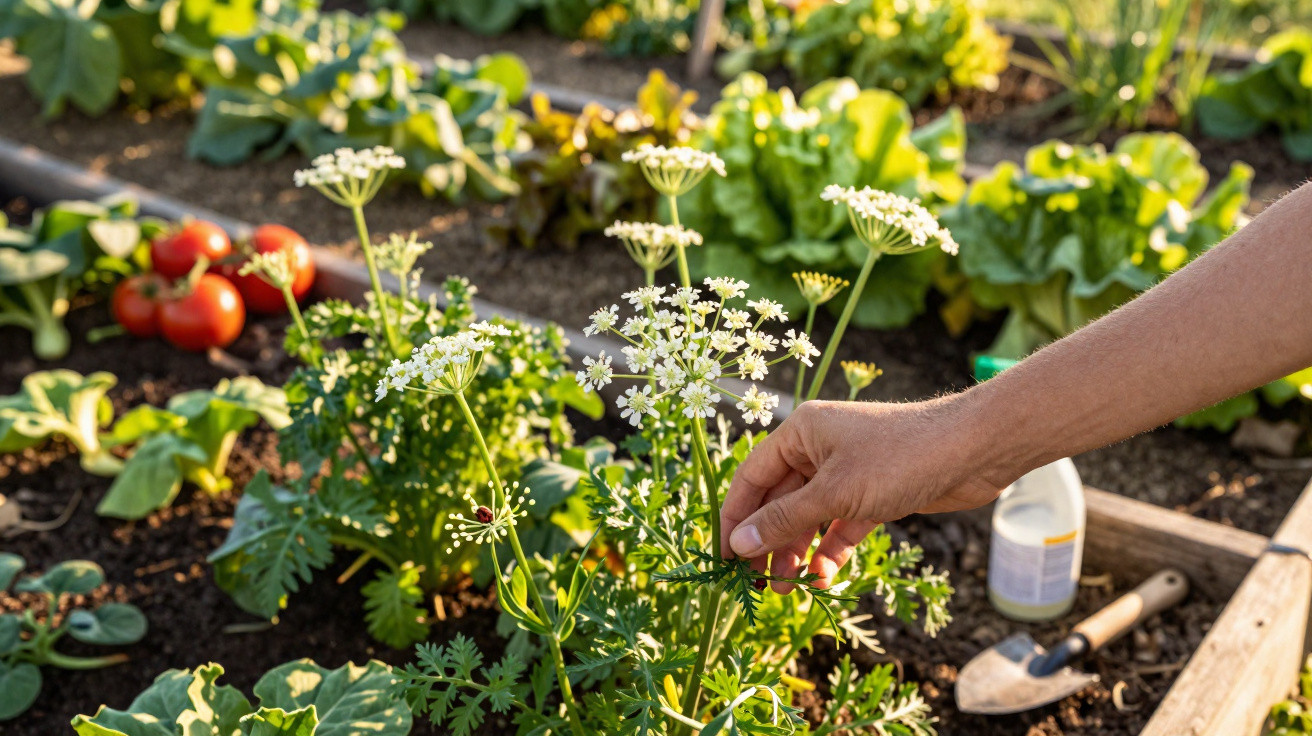
Most of us lift carrots the moment the roots reach a decent size and treat it as a job well done. One row pulled, one recipe tried, one photo taken, and then the leaves go to the compost and that’s that. Leave a few behind to bolt, though, and they change into tall, airy plants topped with white umbels that seem to vibrate with activity.
Those tiny blooms are irresistible to helpful visitors. Ladybirds, lacewings, hoverflies, parasitic wasps - they come in for nectar and pollen, then head straight for the nearest supply of aphids and caterpillars. Your tomatoes, your kale, your beans.
One gardener monitoring a small suburban plot noted it clearly: beds with flowering carrots hosted three times more beneficial insects than beds without. The difference wasn’t subtle - you could see it without any special equipment.
This isn’t old gardening lore; it’s basic ecology at work. Carrots sit in the Apiaceae family, alongside dill, fennel and parsley - plants whose umbrella-shaped flowers are well known for drawing in beneficial insects. Even when their young are ruthless predators, the adults still need nectar. Without a reliable source, they simply won’t stick around.
Sprays tend to wipe out pests and helpers alike. Flowering carrots do the reverse: they feed the helpers so they can deal with the pests on your behalf. In effect, you give up a few roots in exchange for a living security team that patrols around the clock.
It’s less about battling nature, and more about bringing it onto the payroll.
How to turn carrots into a living pest-control system
The approach is almost comically straightforward. When you sow carrots, you’re not only planting for the kitchen - you’re planting for the wider garden system. Sprinkle a few extra seeds along bed borders or between crops that tend to suffer most: tomatoes, peppers, cabbages, lettuce.
As the season progresses, harvest the carrots in the middle as you normally would. Thin them, pull them, eat them - enjoy the lot. But on the edges, keep a handful of the strongest, healthiest plants in place. Let them keep building foliage, then push up a tall central stalk, then set buds, then open into those flat, white flower heads.
The crucial part is ignoring that final urge to harvest. That’s the point at which the real payoff begins.
Plenty of gardeners decide carrots “don’t work” as companion plants after a frustrating year. They sow too thickly, skip thinning, and then blame the carrots when roots fork or stay thin and spindly. Or they yank the lot out as soon as flowers appear, worried they’ve left it too late and “missed” the crop.
It’s also understandable to worry that letting plants linger will “invite pests”. The blunt reality is that many of us have been taught to treat any imperfection as a failure - a leaf with holes, a bolting plant, a dried stem. But those supposedly messy stages are often exactly what feeds birds, insects and the life in the soil.
Choose to let just a small number of carrots bolt on purpose and you’re not abandoning your patch - you’re strengthening it. And, honestly, no one manages this perfectly every day. Still, once you’ve watched a cluster of ladybird larvae tearing through aphids on a carrot stem, trusting the method becomes much easier.
“Last year, I swore off chemical sprays,” says Anne, a home gardener who turned half her lawn into vegetables. “My cabbages were full of caterpillars by June. I was ready to give up. A more experienced gardener told me: ‘Stop ripping out your carrots so fast, let them flower.’ I thought it sounded almost too simple.
By August, those tall carrot flowers were buzzing. Hoverflies everywhere. Their larvae ate the aphids off my kale in a week. I didn’t change anything else, but my second sowing stayed almost untouched. I felt like I’d finally stopped gardening alone.”
- Where to plant companion carrots
Place them along bed edges, at row ends, or in small groups near trouble spots such as cabbages and broad beans. - When to let them bolt
Keep a few plants from your earliest sowing. Lift most of the row, but leave about 2–3 per metre to flower. - What to pair them with
Tomatoes, peppers, brassicas, lettuce, beans and peas all do better with carrot flowers nearby. - What you gain
Reduced dependence on sprays, more beneficial insects on patrol, and a steadier, more resilient garden.
A different way of seeing “messy” beds
Once you start treating carrots as companions, you begin to read the garden differently. Plants you used to remove the instant they bolted start to look like helpers. Beds become a touch wilder and less show-garden tidy - and yet they feel noticeably more alive. Birds flick in and out. You notice tiny wasps you’d never paid attention to before. Spider webs catch the light between the tall carrot stems.
Most people know that sinking feeling: you spot a leaf riddled with holes and assume you’ve done something wrong. A flowering carrot nearby can quietly change the narrative. Instead of reaching for another spray, the question becomes: “If I feed the right insects, who turns up to help?”
That mindset shift doesn’t only safeguard your vegetables - it gradually changes you as the gardener. You spend less time on edge and more time responding to what’s actually happening. The boundary between control and cooperation starts to blur. You’ll still eat plenty of carrots - sweet, crisp roots on the plate - but a few will be left to ‘retire’ as bodyguards. Oddly enough, those are often the ones you remember.
| Key point | Detail | Value for the reader |
|---|---|---|
| Flowering carrots attract allies | Umbel flowers feed ladybirds, hoverflies, lacewings and tiny parasitic wasps | Natural pest control without relying on chemical sprays |
| Planting strategy matters | Keep a few carrots on bed edges and let them bolt while harvesting the rest | Protects vulnerable crops like tomatoes and cabbages with minimal extra work |
| “Imperfect” beds are stronger | Allowing some plants to flower and age increases biodiversity | More resilient garden, fewer crises, and often healthier yields over time |
FAQ:
- Question 1: Will leaving carrots to flower reduce my overall harvest?
Answer 1: You’ll sacrifice a few individual roots, but in return you gain extra protection for the rest of your vegetables. For most gardeners, dedicating only 10–20% of a single row to flowering carrots is enough to notice the benefits.- Question 2: Do I have to let carrots flower every year for pest control?
Answer 2: Yes - it’s the flowers that draw in beneficial insects. You can change where you let them bolt each year, but every season you’ll need some carrot or other Apiaceae flowers to keep that support going.- Question 3: Won’t flowering carrots attract carrot fly and create more issues?
Answer 3: Carrot fly is mainly attracted by the smell released when foliage and soil are disturbed during thinning or harvesting. Flowering plants higher up are less likely to trigger it, and the increased number of predators often helps keep populations under control.- Question 4: Can I use other plants instead of carrots for the same effect?
Answer 4: Yes. Dill, fennel, coriander and parsley left to flower also bring in beneficial insects. Carrots are simply a convenient choice if you already grow them to eat.- Question 5: Is this method enough on its own to stop all pests?
Answer 5: No approach is flawless. Flowering carrots heavily tilt the odds in your favour, but you may still need to hand-pick caterpillars or accept losing the odd plant. The aim is fewer outbreaks, not a guarantee of zero pests.
Comments
No comments yet. Be the first to comment!
Leave a Comment