
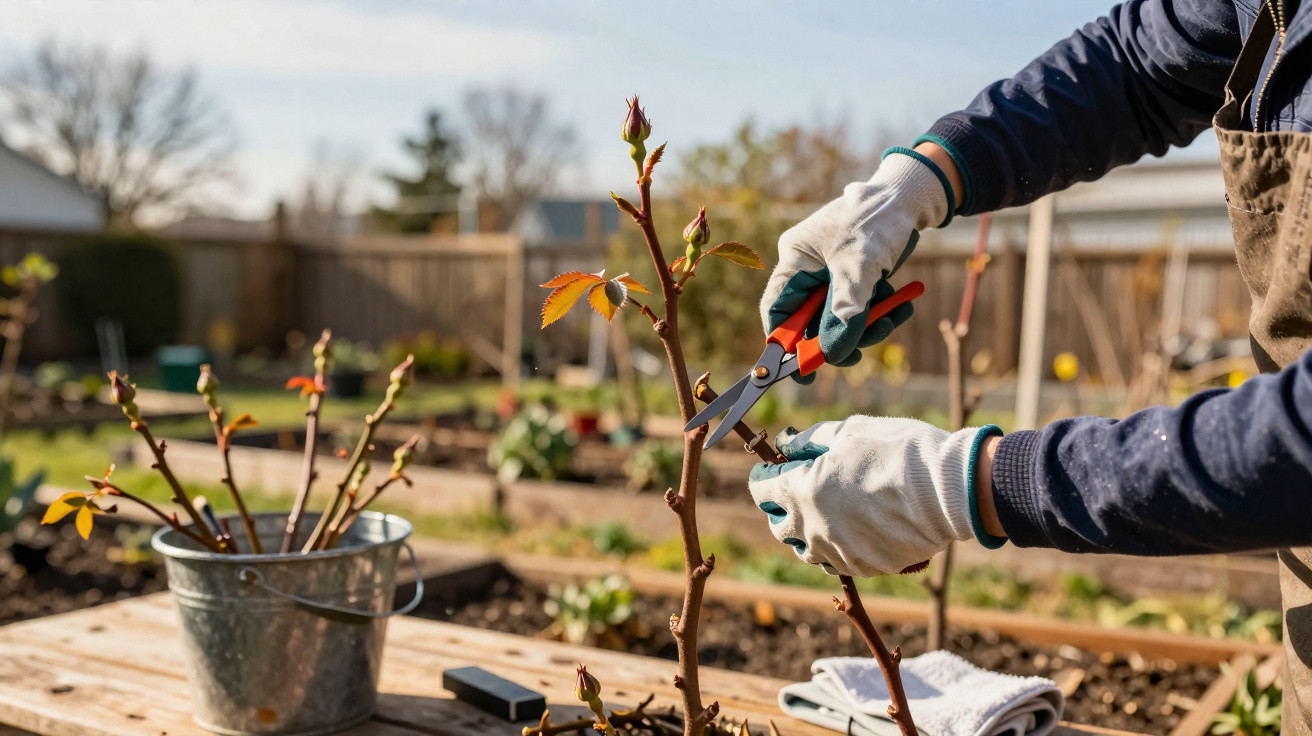
Plenty of amateur gardeners find themselves staring at their roses each year, unsure what to do: by February, your hand is already itching for the secateurs, yet hard frosts can still hit overnight. Leave it too long, though, and the plant has already poured its energy into leaves and shoots you’ll end up removing anyway. The good news is that there’s a fairly clear window in which pruning strengthens a rose rather than setting it back - and it’s the moment when you lay the groundwork for a spring explosion of flowers.
The crucial window: when rose pruning is ideal
Roses have a reputation for being tough, but they are surprisingly sensitive when it comes to pruning time. When you cut affects how many blooms you get, how vigorously the plant grows, and how well it copes with disease. The key period is the changeover from winter to early spring.
"The best time to prune roses is usually between mid-February and mid-March - shortly before new growth begins."
At this point the plant is waking up: the sap is starting to rise, but the foliage hasn’t opened out yet. That is exactly when pruning can redirect the rose’s energy into selected buds, rather than spreading it thinly across lots of growth.
Why pruning too early is risky
If you cut back hard in January or very early February, you can pull the rose out of dormancy too soon. It will push soft, watery new shoots - and those tender tips are magnets for frost damage. One truly cold night is often enough to ruin the fresh growth.
Worse still, cold can penetrate deep into the canes through newly made cuts. That weakens the entire plant, and the shrub may need weeks to recover - with noticeably fewer flowers in early summer.
The real go-ahead: once severe frosts have eased
Calendar dates are only a rough guide. Temperature is the real cue. As a rule of thumb, if hard frosts are still likely, the secateurs stay in the shed.
"The right moment has arrived when nights are mostly above 0°C and only light ground frosts occur."
In many areas this tends to fall somewhere between late February and mid-March. If another cold snap does arrive, a well-prepared rose that hasn’t fully leafed out yet will cope far better than one with freshly cut, tender new shoots.
Read the plant: buds give the signal
If you’d rather not rely on dates alone, watch the rose itself. It usually shows clearly when it’s ready to get going.
Swelling buds as the best guide
As soon as buds begin to plump up and small red or pink “dots” appear along the stems, the rose is entering its early growth phase. The leaves are not fully formed yet, but sap flow is starting.
"The ideal moment: the buds are clearly swollen and lightly coloured, but not yet open."
At this stage, pruning targets exactly where the plant is directing its energy. You leave fewer buds, but in better positions - and those drive strong flowering stems.
If leaves have already emerged: act quickly
If you wait - whether through lack of time or uncertainty - until the rose is already carrying plenty of foliage, you’re losing potential. By then, the plant has spent part of its winter reserves on leaves and weaker shoots.
When those have to be removed during late pruning, the rose effectively has to do the work twice. Here the principle is: better late than never, but step in promptly so the plant doesn’t become overly depleted.
Regional differences: not every border runs to the same timetable
The broad recommendation of “mid-February to mid-March” doesn’t fit every garden. Climate, altitude, and the difference between city and countryside can shift the window quite noticeably.
Mild areas: an earlier start can work
If you garden in a region with gentle winters - such as vine-growing climates, river valleys, or sheltered urban heat islands - you can often begin a little sooner. After the end of February, hard frosts are typically less common.
- Mild western and south-western areas: pruning is often possible from the second half of February
- Sheltered city gardens: frequently frost-free well before the surrounding countryside
- Signs to watch: snowdrops and crocuses have been flowering for a while, and the ground is barely frozen
Colder regions and higher ground: patience pays
Further north, in more continental areas, or at higher elevations, winter often lingers. In these places, sharp frosts can still arrive well into March.
"In cooler areas, pruning is usually only done from mid-March, and where late frosts threaten, not until the end of March."
A rose rewards that patience with sturdier new shoots and fewer frost injuries. If you’re unsure, it’s better to wait a few extra days while also keeping an eye on how the buds are developing.
Getting the cut right: technique on the day
Once the timing is settled, how you handle the secateurs makes a major difference to health and flowering. Ragged, crushed or smeared cuts provide an easy entry point for fungi and bacteria.
Prepare your tools: clean and sharp
Before you start pruning, run through a quick checklist:
- Clean and dry the secateurs thoroughly
- Sharpen the blades; replace blunt tools
- Wipe metal parts with alcohol or a disinfectant
This helps prevent diseases being carried from an infected plant to a healthy rose.
The three-bud rule for bush roses
For classic bedding and bush roses, a simple guideline works well: leave around three strong buds on each stem, counted from the base upwards.
"Cut just above the third robust, outward-facing bud."
This encourages growth outwards rather than creating a dense, disease-prone tangle in the centre. Later on, the rose should look open, balanced and evenly shaped.
The correct cutting angle
Make each cut slightly slanted, about 5 mm above the chosen bud. The slope should angle away from the bud so rainwater runs off easily and doesn’t sit at the bud base. This significantly lowers the risk of rot and fungal infection.
Spring clean for the shrub: make room for new energy
The main cut is only part of the job. Just as important is thinning and tidying the plant. Old, diseased or weak wood drains energy without contributing much to flowering.
Remove dead and weak wood without compromise
Dead stems are usually grey-brown to black and feel dry, brittle and breakable. Living wood shows a green or pale, creamy layer inside if you lightly scratch it.
- Remove dead stems right back to their point of origin
- Cut out very thin, stunted twigs
- Reduce crooked, inward-growing short shoots
What remains should be strong, well-placed framework growth that will carry the new blooms.
Bring light and air into the middle
A common rule of thumb among rose growers is that a small bird should, in theory, be able to fly through the shrub without constantly bumping into stems. The reasoning is straightforward: in an open plant, leaves and shoots dry out more quickly after rain.
"Less moisture in the centre means fewer fungal diseases and healthier foliage."
So remove any stems that cross, rub against one another, or grow straight into the middle of the shrub. This lets sunlight reach the interior and allows the entire plant to push on strongly.
Care after pruning: how to support your rose properly
After pruning, the rose is essentially rebooting. It has lost material and stored energy in wood and buds, but now needs to produce new shoots quickly. A few simple steps help it recover.
Wound protection and a nutrient boost
On thicker canes, you can paint larger cuts with a wound sealant, especially in wetter regions. That reduces the exposed area where fungi can enter. After that, it’s worth applying a first feed with a dedicated rose fertiliser or well-rotted compost, lightly worked into the top layer of soil.
| Measure | Ideal timing |
|---|---|
| Pruning | Mid-February to mid-/late March, depending on the region |
| First feed | Directly after pruning, once the soil is frost-free |
| Renew mulch layer | After feeding, before the warmer spell begins |
Protection and monitoring in the following weeks
In the weeks that follow, keep a close eye out for aphid colonies and the first signs of fungal spotting. A newly pruned rose in active growth can be sensitive to stress. Soil that’s loose and evenly moist, plus a thin mulch layer of composted bark or shredded prunings, helps retain moisture and smooth out temperature swings.
Why timing makes a long-term difference
Pruning “sometime around spring” is not automatically the right approach. A difference of a few weeks can have clear effects for the rest of the year: shrubs cut within the right window develop stronger framework canes, flower for longer, and show noticeably lower disease pressure.
On top of that, consistent pruning regularly pushes the rose towards fresh, vigorous growth. Old, exhausted stems are removed, the shrub stays open, and it continues to flower freely. This can noticeably extend the lifespan of a whole planting - particularly in small gardens where every square metre matters.
If, over time, you build confidence not only with the right date but also with pruning technique, you can shape your roses deliberately: as a low cloud of flowers beside a seating area, a tall screen for privacy, or an elegant cascade trained along a trellis. Then the window between late winter and early spring becomes more than a routine task - it turns into the creative centrepiece of the entire rose season.






Comments
No comments yet. Be the first to comment!
Leave a Comment