
With the first warmer days of the year, many people start tidying their gardens: tools are put away, shrubs are cut back, and winter debris is cleared. One everyday item, however, is often left behind without a second thought. It looks harmless, sits flat on the ground-and that is exactly why it can become a favourite spot for reptiles that urgently need warmth after winter.
Why snakes are especially likely to appear in gardens right now
Snakes are classed as cold-blooded animals, meaning they cannot regulate their body temperature on their own and instead depend on external conditions. To become active, hunt prey, or mate, they generally need temperatures in the region of 25 to 30 °C.
Spring creates a mismatch: during the day the sun can already feel strong and the air may seem mild, yet the ground itself often remains fairly cool. In this window, snakes look for places that heat up quickly while still allowing them to stay out of sight and undisturbed.
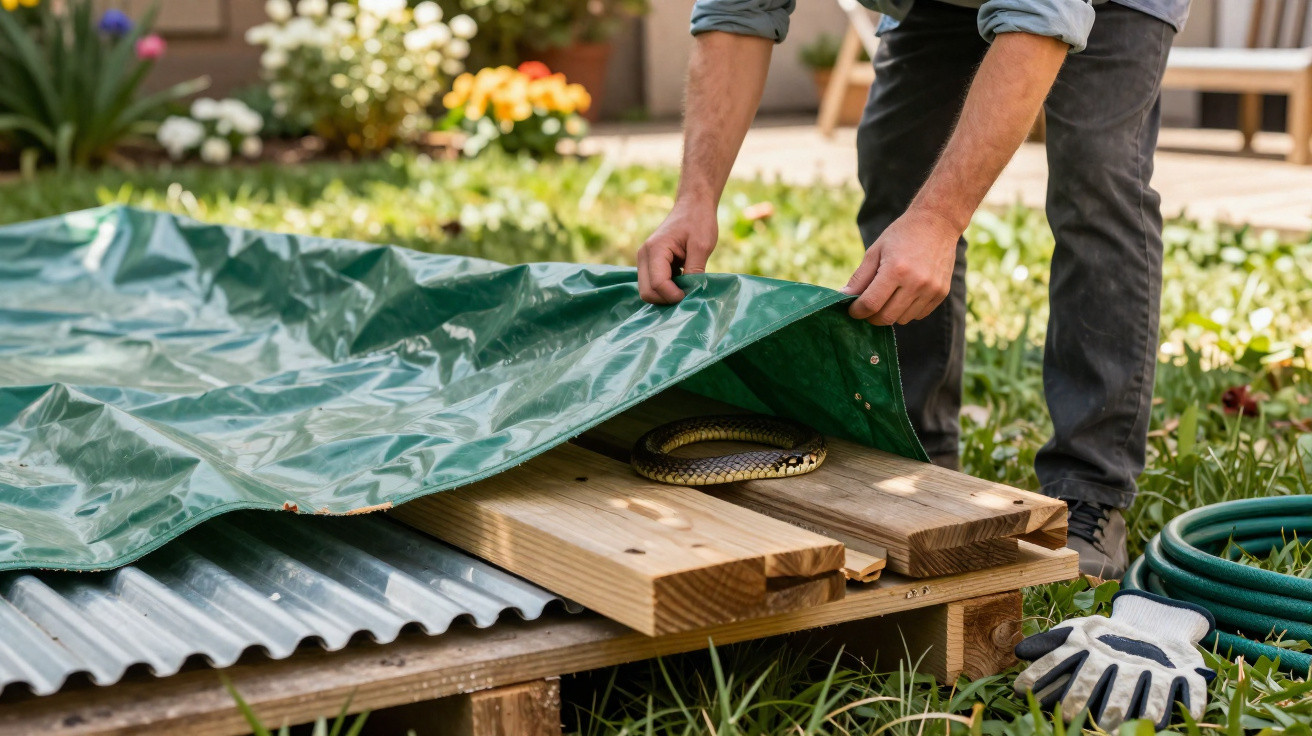
Particularly risky: flat items placed directly on the ground create a hidden, well-warmed cavity-an ideal retreat for snakes.
The underestimated risk: tarpaulins and metal sheets
In many gardens, the biggest issue comes from a particular type of everyday object: large tarpaulins, plastic sheeting, or flat panels made of metal or fibre cement. They are commonly used to:
- protect stacked wood or building materials from rain,
- suppress weeds on paths or beds,
- cover compost, soil, or rubble,
- secure cleared areas “temporarily”.
Once the job is done, these sheets and panels are often simply left where they are. That is when things can become problematic. Black or very dark sheeting in particular absorbs sunlight strongly, heats up quickly, and transfers that heat to the ground beneath. The space between soil and cover then behaves like a small warming cabinet.
If the cover is large, slightly lifted at the edges, and not pulled tight, a shallow cavity forms underneath. From the outside it looks unremarkable; underneath it is warm, dry, and sheltered-almost perfect conditions for a snake.
How a “snake spa” forms on the lawn
The mix of a dark cover and still-cool spring soil produces an effect similar to a miniature greenhouse. Air becomes trapped under the sheet, wind cannot reach it, and predators such as birds of prey cannot see in. The result is a heated, protected hideaway.
What looks like a forgotten tarpaulin to a garden owner can work for a snake like underfloor heating with built-in camouflage.
These hiding places are often found exactly where people spend time-at the boundary between lawn and hedge, along walls, or close to compost heaps-so they can be right where you stand while clearing up, mowing, or playing with children.
Typical mistakes that attract snakes into the garden
Many risky spots arise simply because it is convenient-or because there never seems to be enough time. Knowing the most common triggers makes it easier to avoid them deliberately.
| Behaviour that causes problems | Effect |
|---|---|
| Leaving a tarpaulin flat on the ground after finishing work | Creates a warm, sheltered cavity for reptiles |
| Stacking wood directly on soil and covering it only loosely | Forms extra hiding places between timber and earth |
| Storing old metal or fibre-cement panels in a back corner | Creates long-term retreats that are rarely checked |
| Keeping tall, unmown grass edges by patios, play equipment, or ponds | Provides cover for snakes, allowing them to move on from there |
How to make your garden less attractive to snakes
If you do not want snakes right by the house, patio, or children’s play area, the key is to remove the easy lounging and warming spots. A few simple steps are often enough.
Store tarpaulins, panels, and wood correctly
- Never leave tarpaulins lying flat on the ground. Either remove them, or pull them tight and anchor them so there is no cavity underneath.
- Raise wood stacks. Create at least 20 cm of clearance beneath pallets or beams. This makes the area underneath far less appealing for snakes.
- Dispose of old metal or fibre-cement panels. Avoid “temporary” storage along the garden edge whenever possible.
- Choose smooth, controlled storage. Roll up tarpaulins and hang them up, ideally in a shed, garage, or cellar.
The fewer warm cavities you have at ground level, the less likely snakes are to linger near the house and play areas.
Keep clear sight lines around the home
Snakes generally avoid open areas where they are easily seen. By removing cover as a precaution, you can greatly reduce the chances of unwanted encounters.
- Keep lawns around the house, patio, and paths regularly cut short.
- Thin out shrubs and dense growth in areas where people spend time.
- Move tall grass patches and deadwood piles to the rear, less-used part of the garden.
- Do not position compost areas directly next to seating spots or a sandpit.
What to do if there is already a snake in your garden
Even with good prevention, you may still find a snake resting under a cover you forgot about. Feeling startled is understandable, but panicking is the worst response.
The most important action is to keep your distance. About 1–2 m is usually enough for the animal to feel safe. Snakes typically strike only when they feel threatened or cannot see a way to escape.
Never reach under a sheet with bare hands or yank it up quickly-always assume an animal could be underneath and check first.
If you need to remove a cover, you should:
- wear gloves,
- use a spade or a long handle to lift the sheet carefully,
- stand to the side rather than directly over the edge,
- if you spot a snake, step back slowly and allow it to move away on its own.
Trying to catch, chase off, or kill snakes is not only dangerous, but also illegal in many countries. In central Europe, all native species are protected, and violations can result in fines.
When help makes sense-and who might be responsible
In most situations, a snake will leave on its own once it can see a clear escape route. If the animal remains close to living areas or keeps reappearing, it can be worth calling an experienced organisation. Possible contact points include:
- the local council or public order office,
- local nature conservation groups,
- wildlife rescue or rehabilitation centres.
Specialists there are familiar with local species and can judge whether there is any particular risk or whether relocation is appropriate.
How dangerous are snakes in the garden really?
Many people react strongly out of fear when they see a snake. The reassuring news is that, in most regions, the species you are likely to encounter are harmless to humans and will retreat as soon as someone approaches.
Even where venomous species occur, the risk is usually low as long as nobody tries to catch or provoke the animal. Most incidents happen when people suddenly get very close-such as when reaching under a cover, into a wood store, or into dense scrub.
Working carefully, wearing protective gloves, and never feeling into cavities with bare hands greatly reduces the risk of a bite injury.
Practical extra tips for a safer summer in the garden
A few simple habits are easy to build into daily routines and can improve safety-without turning your garden into a “sterile” space.
- Wear sturdy gloves when gardening, especially when clearing wood, stones, or sheets.
- Tell children not to crawl under tarpaulins, pallets, or boards.
- Ensure garden and play areas are well lit if you are outside in the evening.
- Keep open water sources clean, as they attract insects and amphibians, which in turn can draw snakes.
If you enjoy a wildlife-friendly garden, you do not have to give up variety. What matters is placement: wilder corners, stone piles, and deadwood are best kept at the edge of the property, while near the home it is better to avoid flat covers and messy material storage.
That way the garden stays lively and still provides space for animals-while you can enjoy the first warm spring day without risking an unpleasant surprise when you lift the next tarpaulin.

Comments
No comments yet. Be the first to comment!
Leave a Comment