
Many homeowners will recognise the pattern: in spring the gravel path looks as though it has just been laid, but after a few hot weeks dandelions, chickweed and the like start pushing up between the stones. You end up weeding while bent double, at the same time as local authorities restrict watering - that combination is enough to push many hobby gardeners to their limit. The good news is that there are a few surprisingly straightforward, natural steps that keep a path tidy right through to autumn, without chemicals and without constant watering.
Why a gravel path suddenly turns into a weed patch
A gravel surface can look, from a distance, like a sealed layer. In reality it is anything but tight. Dust, fallen leaves and tiny bits of plant matter gradually build up in the gaps between the stones. Over time, this creates a thin yet highly fertile layer - essentially a miniature seedbed right in the middle of the path.
Seeds arrive on the wind, birds drop them, and rain washes in even more organic debris. If the stones are too small or the gravel has only been spread as a shallow layer, enough light still reaches the ground underneath. That is exactly what allows unwanted plants to take off within just a few weeks.
Summer adds a second driver: the combination of heat, brief thunderstorms and lingering moisture below the surface acts like a growth accelerator for pioneer species. Leave them unchecked and you soon have a proper web of roots running through the path.
"Weeds in gravel exploit every weak point: a layer that’s too thin, too much organic matter, and too little routine maintenance."
Those roots knit the sub-layer together, hold onto moisture, and can make sections slippery or muddy. Many people then reach for chemical weedkiller. However, active ingredients such as glyphosate can end up in soil and groundwater and harm beneficial wildlife like wild bees and soil organisms. A purely mechanical, low-water approach makes far more sense - and that is where three simple steps come in.
Three natural measures that drastically reduce weeding
1. The mineral surface as the foundation: building gravel properly
The most important step happens before summer really gets going: how the path is constructed. Getting this right removes much of the space weeds need.
- Weed thoroughly first: Remove old root remnants, runners and moss pads completely.
- A permeable barrier layer: A water-permeable fleece or geotextile limits light while still letting rainwater through.
- Choose the right gravel: Crushed, angular gravel between 6–14 millimetres interlocks better than rounded, washed decorative gravel.
- Enough depth: At least 5–7 centimetres helps ensure hardly any light reaches the soil.
- Neat edges: Solid edging made from stone, metal or wood stops lawn roots or neighbouring plants from creeping in.
Once this base is in place, upkeep is minimal. A quick check once or twice a month is worthwhile: clear away leaves, small twigs and any soil using a rake or leaf blower. That prevents a new humus layer from forming - and without that, seedlings have far less chance to thrive.
2. The power of brushing: light ongoing protection without water
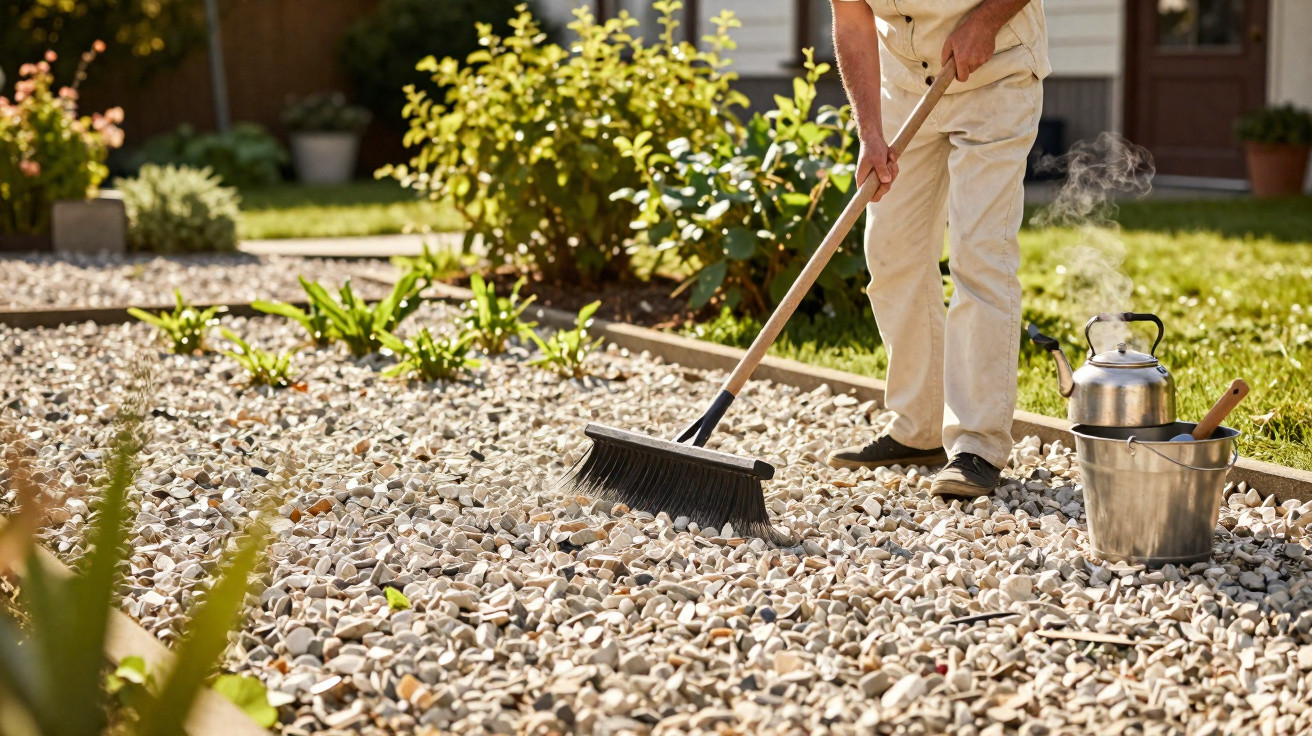
The second piece is remarkably simple: brush regularly rather than pulling weeds out. A stiff brush on a handle, or a dedicated metal path brush, is enough. The key is to work standing up over the gravel - it protects your back and saves time.
Using circular or pushing strokes, you dislodge young seedlings and moss from between the stones before they properly root. This is especially effective when the surface is slightly damp, for example with morning dew.
"If you brush every two weeks, you stop tiny seedlings from turning into full-blown problems."
Good times to brush include:
- early morning, when dew softens the plants slightly
- late evening on hot days, once the stones have cooled
- after a light shower, before the ground dries out completely
Important: always remove the loosened plant material afterwards - with a rake, yard broom or shovel. If you leave it behind, it breaks down and becomes the nutrient-rich base the next wave of seeds is waiting for.
3. Stopping stubborn clumps with boiling water
Some plants act like small-scale pioneers of neglect. Creeping grasses or deep-rooted rosette weeds are not so easily dealt with by brushing alone. Here, something already found in every household can help: boiling water.
Using a watering can or a saucepan with a pouring lip, apply it carefully right at the base of the plant. The heat destroys fine transport tissues in leaves and roots within seconds. Shallow-rooted species often dry out after a single application. Stronger grasses or ribwort plantain may need a second round after a few days.
To keep this method genuinely environmentally friendly, pay close attention to where you use it:
- only apply it where rainwater will not run straight into a gully
- never use it right next to beds or lawn areas, as desirable plants can be damaged too
- work on dry days, so newly freed water does not benefit other seedlings
"Boiling water doesn’t replace regular maintenance, but it deals with exactly the plants that stand up to the brush."
How the three measures work together
The trick is in using them as a set. A well-built gravel layer prevents most growth from starting in the first place. Brushing then keeps small seedlings under control before they can send roots down to the fleece. Boiling water is reserved for the few truly persistent offenders.
If you put one or two days into the structural build in spring, mid-summer usually only requires short maintenance sessions. A quick brush before breakfast every 14 days is often enough to keep the gravel area looking tidy all year.
What makes the most sense during water shortages
Especially in areas with watering restrictions, every litre counts. The approach described here works with almost no extra water. Only the small amount of boiling water used on problem spots matters - and that is nothing compared with keeping a planted, green pathway irrigated.
There is also the legal side: using chemical weedkillers on hard surfaces is, in many places, legally sensitive. They can wash via drains into waterways or pose a risk for pets and children at play. Mechanical methods avoid that issue entirely.
Practical examples from everyday life
On driveways with frequent vehicle traffic, the gravel compacts more quickly. In those areas it is usually enough to brush the edges and the less-driven sections on a regular basis. Under carports, where little rain reaches, moss and occasional weeds tend to establish instead. Because there are only a few plants to tackle there, boiling water applied selectively is particularly efficient.
Narrow paths running alongside house walls also benefit from this three-part method. Reflected heat often makes many species grow faster in these strips. A closely laid fleece combined with angular gravel noticeably slows that growth. You can run a brush over such areas in minutes, and a kettle is enough for two or three especially stubborn clumps.
Further tips for consistently tidy gravel areas
A few extra tactics make ongoing maintenance even easier:
- When planning a new path, choose a width that lets you work comfortably with a broom or brush.
- Remove leaves promptly in autumn, otherwise a thick humus layer builds up over winter.
- Under large trees, consider a different type of surface, as fresh organic material is constantly falling.
- Pick a gravel colour that makes tiny seedlings easy to spot - it simplifies checks.
With these points in mind, the old battle with weeds becomes a quick routine lap that is easy to fit into daily life. That way, even in dry, hot summers, your gravel path stays a neat feature - without poison and without постоян watering with a can.

Comments
No comments yet. Be the first to comment!
Leave a Comment