
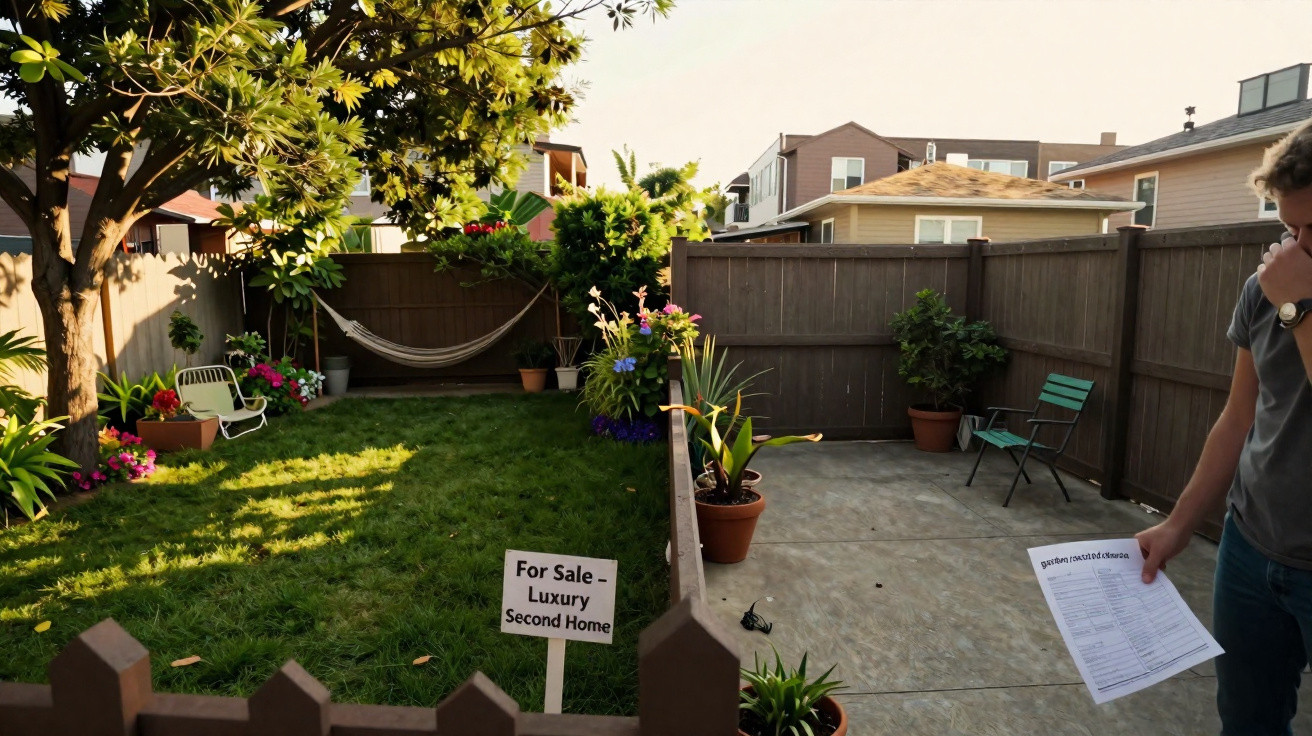
On a wet Tuesday night in suburban Birmingham, the line of back gardens behind Maple Road shone with an unsettling, almost self-satisfied green. One was an unruly thicket of foxgloves and nettles; another had a lawn clipped with military precision; a third was entirely concreted over, save for one forlorn rosemary pot. Steam drifted from kitchen windows while the news murmured in the background: a think tank had proposed a provocative notion - that large private gardens should be treated more like second homes for tax purposes.
You could almost sense people freezing, mugs suspended halfway to their mouths.
Has that piece of grass behind the shed suddenly become a luxury asset?
When a lawn begins to resemble a loophole
Wherever you are in the UK, a garden can discreetly add tens or even hundreds of thousands of pounds to a home's price. Estate agents utter “large south-facing garden” as though it were an incantation, and buyers respond with an enthusiasm rarely inspired by “additional storage” or “newly installed boiler”.
For years, private outdoor space has remained beyond nearly every major political argument about housing inequality. It is simply “your garden”: your roses, trampoline and Sunday barbecue.
But a new term is beginning to enter the discussion: green space privilege.
It may sound faintly ridiculous until the figures are considered. In London, an average property with a sizeable garden can sell for up to 20% more than a comparable home without one. In areas of Bristol and Manchester, developers quietly carve gardens from older properties to create entirely new homes.
Yet this added value is not taxed in the way a second property would be. Capital gains embedded in those carefully hedged rectangles remain unseen by the system.
At the same time, a renter two streets away may hand over more to their landlord every month for a balcony with room for only one solitary deckchair.
This is where the comparison with second homes becomes pointed. A holiday cottage in Cornwall is clearly regarded as an asset, with council tax adjustments, Stamp Duty surcharges and new levies applying to it. A huge private garden in Zone 2 that effectively prevents a potential additional family home from being built? It receives no special treatment.
Critics argue that this is the wrong way round during a housing crisis. When land is so limited, they say, large city gardens are not merely lifestyle benefits; they are underused property acting as a discreet shelter for wealth.
Those who share this view believe tax incentives could encourage owners to release or share land rather than keep it enclosed behind 1.8-metre fences.
Who has the green space, and who only has the view?
Look at any city via satellite imagery and the pattern is clear: substantial private green rectangles sit behind Victorian terraces, gated mews and detached homes set back from the road. Just streets away are tower blocks where a child’s outdoor environment consists of tarmac and a metal slide.
The garden tax argument is not truly about begonias or bird baths. It concerns who has built-in access to something that improves health, wellbeing and property prices, and who must compete for space in the local park.
That is when “green space privilege” begins to feel uncomfortable.
In inner London, around one in five households has no garden whatsoever, and the share is greater among renters and lower-income families. During the Covid lockdowns, that became a quiet divide. Some spent months confined indoors with children in small flats, seeing colleagues' leafy gardens flicker behind them on Zoom calls.
Others found the pleasure of converting their own patch into an outdoor office, gym and wine bar. There was no journey, no membership fee and plenty of greenery. Technically, they were “staying home”, but their experience was far removed from that of a family on the sixth floor with only a window box.
That period changed the way many urban planners and campaigners view gardens. What was once described as a private lifestyle preference now appears increasingly like a structural advantage: less noise, cleaner air, more space for play, improved mental health and a higher property valuation left untaxed for decades.
So, when somebody proposes taxing very large gardens as second homes, they are drawing on a belief that some forms of land hoarding are quietly rewarded. Opponents contend that the proposal would punish ordinary homeowners. Supporters argue that it is about rebalancing who can monopolise scarce urban land.
At heart, both camps are debating what fairness means when land becomes scarce.
Could a garden tax actually work - and what might it involve?
Should any form of “garden tax” ever be introduced, it would not mean a fixed charge for every rose bush. Policy specialists envisage a far more selective approach: concentrating on exceptionally large plots in densely populated urban areas, rather than small lawns in former mining towns.
Under one model, extremely large gardens could be classified as a separate element of property value, rather like an addition to council tax. Another approach follows the second-home rationale more closely: when a home with a very large plot is sold, the part of the gain associated with its land area could be charged at a higher rate.
Designing such a system would not be straightforward, but its mechanics would not, on paper, be dramatically more unusual than existing Stamp Duty surcharges.
The emotional impact would be greater than the technical challenge. People do not see gardens as “assets underutilising buildable land”; they see them as their sole area of calm and control in an anxious world.
Most of us know the feeling: a neighbour objects to the height of a hedge, and it feels intensely personal. Imagine the state entering that same emotionally charged territory with fresh regulations and bills.
That is where resentment would ignite most quickly, particularly among older homeowners on limited incomes who may be rich in land on paper but short of cash in practice.
“Suddenly my veg patch is a revenue stream for the Treasury?” one 72-year-old homeowner in south London told me. “I bought this place when nobody wanted it. Now they say my garden is a problem. For who?”
- Possible carve-outs: Exempt gardens of modest size, particularly beyond high-pressure housing markets.
- Social trade-offs: Connect any charge to clear local gains, such as new parks, playgrounds and community gardens.
- Alternative routes: Give owners incentives to divide or lease parts of sizeable plots for affordable housing or shared green space.
- Political reality: No major UK party currently promises a direct “garden tax”; the proposal remains in think tanks and opinion columns, rather than party manifestos.
In truth, few people read dry land-use consultation documents every day.
Most will only notice this argument when it affects their bill, their road or the outlook from the kitchen sink.
A different way to view the ground behind the fence
The dispute over “green space privilege” will not be resolved by a memorable slogan or one policy adjustment. It reaches into individual hopes for a peaceful back garden, deep anger about housing costs, major concerns over climate and urban heat, and a distinctly British fondness for hedges.
For some, taxing selected gardens as second homes represents long-overdue fairness in places where whole generations cannot afford to buy. For others, it seems like a moral judgement disguised as tax reform, directed at people who merely wanted room for their children to kick a ball.
What the debate does achieve, uncomfortably, is forcing a new look at private green space. Is that long stretch of lawn simply “mine”, or is it part of a limited city-wide resource? Should having a garden be regarded as more of a luxury, or as something that should be shared and planned as carefully as public parks?
There may never be a tidy solution, only untidy compromises: tax incentives in one place, planning restrictions in another, and trials involving community gardens and shared courtyards.
Some readers may look at a tiny patio and feel nothing but frustration; others may glance across a broad lawn and experience a twinge of unease. Both responses belong in the same debate.
Perhaps the real change is not whether the Treasury ever imposes a levy on larger plots, but whether gardens begin to be seen not only as private refuges, but as quiet participants in the question of who gets to call somewhere home.
| Key point | Detail | Value for the reader |
|---|---|---|
| Garden as asset | Private gardens may add considerable untaxed value to homes, particularly in crowded cities | Helps readers understand how their outside space relates to wider debates about housing and wealth |
| Green space privilege | Access to a garden often corresponds with income and housing tenure, worsening inequalities exposed during lockdown | Places personal experiences of green space, or its absence, within a broader social pattern |
| Policy possibilities | Targeted taxes or incentives could apply to very large urban plots rather than every small garden | Reassures readers while explaining what plausible future changes could genuinely involve |
FAQ:
- Question 1: Are UK politicians seriously planning a “garden tax” right now? Not explicitly. The concept appears mainly in think tank reports and opinion articles, often presented as treating certain gardens more like second homes. However, continuing debates about land value, council tax reform and wealth inequality mean it repeatedly returns.
- Question 2: Would small or average gardens ever be affected? Any credible proposal would probably focus solely on very large plots in high-pressure urban locations, where additional homes could realistically be built. Small or standard suburban gardens are the least likely targets because they are politically sensitive and have limited development potential.
- Question 3: How is this linked to second homes specifically? Second homes already attract higher Stamp Duty and, in some cases, council tax surcharges because they remove homes from general supply. Critics say that vast, underused city gardens likewise tie up land that could accommodate additional housing, so they should be treated more like those assets.
- Question 4: What about older homeowners who are “asset rich, cash poor”? This presents the greatest challenge for fairness. Any serious scheme would probably require protections, including options to defer payment until sale or death, income-based reductions, or exemptions for long-term residents, so that people are not forced from their homes.
- Question 5: Is there an alternative to taxing gardens at all? Yes. Cities could encourage owners to share or split large plots voluntarily, support community gardens, ease rules for suitable backland development, or reform wider land and property taxes so that land-based value is taxed more evenly without applying a specific “garden” label.


Comments
No comments yet. Be the first to comment!
Leave a Comment