
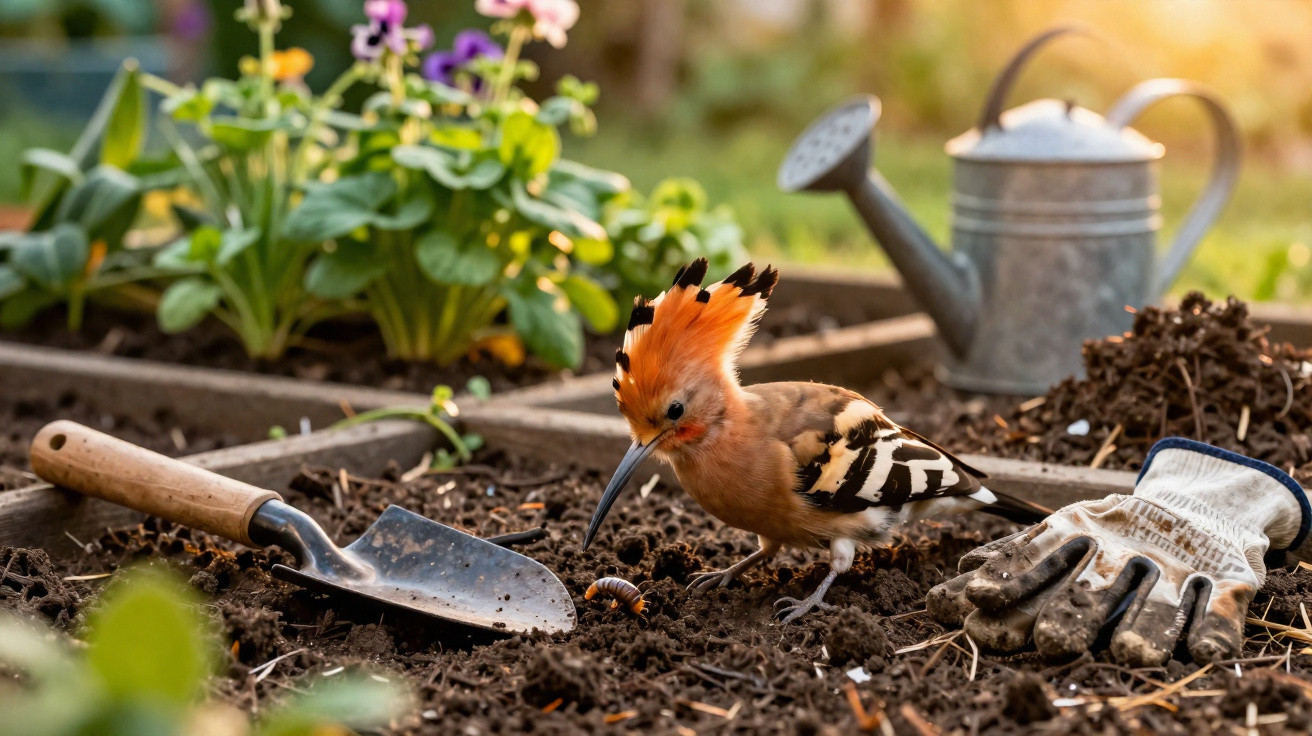
Many amateur gardeners do a double take when a slim bird with black-and-white barred wings and a raisable crest suddenly struts across the lawn. The hoopoe, long a familiar sight in southern Europe, can feel almost exotic in German gardens. If it has chosen your plot, it is rarely down to chance - its visit says a great deal about your soil and can even prompt some people to reflect on what lies ahead.
What a hoopoe’s visit reveals about your garden
A hoopoe makes its living from whatever creeps, wriggles and burrows beneath the surface. Its diet is mainly insects and other soil-dwelling invertebrates, including:
- Grubs (larvae of cockchafers and other beetles)
- Crickets and grasshoppers
- Ground-dwelling beetles
- Caterpillars, such as those of processionary moths
- Worms and other soil animals
To find them, it probes loose layers of earth with its long, slightly down-curved bill. That effort only pays off where the ground is teeming with prey. This is precisely why the hoopoe acts like a living gauge of healthy, active soil.
"If a hoopoe turns up repeatedly in your garden, it strongly suggests the soil is lively, diverse and largely free of toxins."
By contrast, a sterile, tightly clipped and heavily treated lawn with a dense, hard turf offers it very little to eat. So when a hoopoe is present, it usually points to a place where the balance between soil life, plants and helpful wildlife is still working.
How your plot attracts hoopoes - and what that says about the site
For a bird, the hoopoe is surprisingly particular. It prefers open, sunny ground with short grass, alongside patches of bare soil. Ideal settings include:
- Lightly managed meadows rather than a perfect “English” lawn
- Orchards and traditional high-stem fruit meadows
- Vineyards and rough field margins
- Gardens with beds, sand or gravel paths, and unsealed surfaces
If it does more than pass overhead - staying for several days or even weeks - that usually indicates an “insect buffet” in your soil. You only get that where little or no chemical treatment is used, some leaves and plant debris are left in place, and the ground is not paved over completely.
Peace and quiet matter too. Continuous noise, nonstop mowing, or loud music will quickly drive this shy bird away. Anyone who sees a hoopoe regularly is, evidently, offering a relatively calm refuge - a small strip of tranquillity in an otherwise busy residential area.
A migrant with a message: what its arrival hints about climate and region
Hoopoes typically spend winter in the savannahs south of the Sahara. In spring they migrate to Europe, usually remaining from April to around September. In Central Europe, they have traditionally favoured warmer areas. In France, for instance, they are concentrated in the south and are less common north of major cities.
That they are now being recorded more often farther north is linked to several influences:
- Climate warming: milder springs and longer, warm growing seasons open up new breeding areas.
- Changes in crop protection: where fewer insecticides are used, more food is available.
- Nature-friendly gardens: wildflowers, dead wood, patches of open ground and minimal sealing support the insects they hunt.
Spotting a hoopoe in a place where it was rare 20 or 30 years ago is therefore an indirect signal that local conditions are shifting. That may be encouraging (more near-natural habitat), but it can also point to longer-term climate trends.
An ally against pests - why gardeners can be pleased to see it
Ecologically, this bird is more than a signpost; it is also a practical helper. It consumes large numbers of insects that can cause trouble in gardens, such as:
- Grubs that damage lawns
- Caterpillars that strip young trees and shrubs
- Soil pests in vegetable beds
It will not replace a full pest-control strategy, but it can substantially ease the pressure. During the breeding season, each hoopoe family eats thousands of insects. Providing suitable habitat is, in effect, an investment in a stable ecological balance - without poison.
"The bird is a bit like a mobile gardener in feathers: it tidies up without destroying, and it shows where the ecosystem is still functioning."
Myth and meaning: what people see in it
Long before modern nature guides, people were captivated by the hoopoe’s crest and its distinctive, rolling call - a repeated "hoop-hoop-hoop". In older cultures it appears in stories about guidance, gratitude and the search for truth. Because its crest resembles a small crown, it is sometimes seen as a “king of birds” and welcomed as a bringer of good fortune.
Such symbolism does not belong in a scientific report. Even so, anyone who looks out on a spring morning and watches this striking bird walking across the lawn often feels, instinctively, that something is beginning again. After a grey winter, its arrival marks the start of the warm season, when the garden is noticed as habitat rather than merely a green surface.
How to make your garden a safe stopover
If you would like a better chance of seeing a hoopoe more often, there are practical steps you can take:
- Avoid synthetic pesticides: poison kills the insects it depends on - and effectively drives the bird away.
- Allow patches of open ground: not every corner needs dense planting. Sandy paths, loose beds and small fallow areas all help.
- Let the lawn grow longer: a robot-short ornamental lawn is like a desert to it. A mosaic of short, taller and meadow areas creates variety.
- Provide places to retreat: old trees with cavities, wood piles or cracks in walls can serve as nesting sites.
- Keep noise down: constant chainsaws, leaf blowers and party noise will discourage it.
One small peculiarity: to defend its chicks, the species can produce a clearly noticeable cloud of smell. Some people find this unpleasant. The tactic helps protect the young from predators - and tolerating it can support a successful brood.
What the bird reflects about your own gardening habits
A hoopoe’s arrival can also be read as a mirror: how do you treat your patch of earth? Anyone who relies heavily on chemicals, digs out every wild plant and tidies every corner flat is unlikely to see one. Where diversity is allowed to develop, old fruit trees are kept, and leaf piles are not cleared away immediately, it is more likely to feel at home.
Some gardeners say the bird encourages them to be more relaxed about “mess”. Instead of keeping everything spotless, they gradually create wilder corners, stacks of dead wood and flowering strips. That benefits not only the hoopoe, but also hedgehogs, solitary bees and many other species.
Practical perspective: what a single sighting really means
A brief, one-off glimpse is not proof that you have the perfect wildlife garden. Birds on passage will sometimes stop even in less suitable places. It becomes more meaningful if it:
- appears on several consecutive days
- returns around the same time each year
- is clearly foraging intensively in the soil
In those cases, it is very likely your soil is rich in life and your garden functions as a small refuge. In densely built-up neighbourhoods, that can make a genuine difference to the species’ local presence.
Taking this quiet visitor seriously offers a double opportunity: to watch a rare, remarkable bird at close range - and to rethink how you handle soil, plants and insects, step by step shaping a garden with a future for both people and wildlife.
Comments
No comments yet. Be the first to comment!
Leave a Comment