
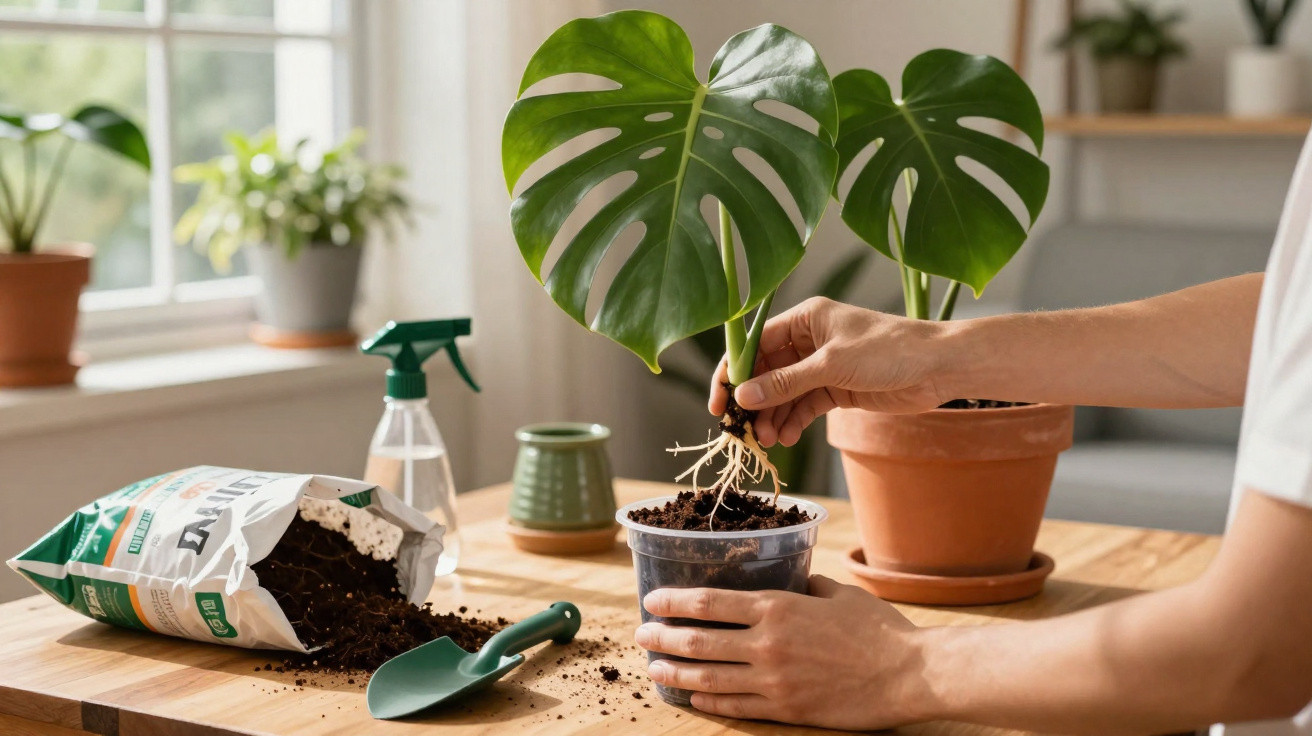
Missing the right moment can leave this trend plant under unnecessary stress.
The Monstera has long since become a fixture on windowsills and Instagram. Behind those dramatic leaves, though, sits a powerful root system that can hit its limits quickly. Repot too late-or at the wrong time-and you slow growth and put the plant’s health at risk. The good news is that a few clear signs make it fairly easy to tell when it’s time.
How to tell your Monstera needs a bigger pot
Your Monstera makes it obvious when it has outgrown its pot-once you know what to look for.
Roots pushing out of the drainage holes
One of the clearest warnings is when roots appear from the drainage holes underneath, or form tight circles at the base of the pot.
"If pale, firm roots are growing out of the drainage holes, the Monstera has completely filled its current home."
At that point the pot is full and the plant is hunting for space. A move is due-now at the latest.
Water runs straight through when you water
Another clue shows up during watering. If the water immediately drains through and comes out of the bottom almost unfiltered, there’s usually very little compost left-the pot is largely root mass.
- Water runs out of the bottom again within seconds
- The pot dries out noticeably faster than it used to
- Despite the same spot and conditions, the plant seems to need water constantly
In other words, the roots have displaced most of the compost, and moisture can no longer be held properly.
Leaves stay smaller and turn yellow
A lack of space also shows above the compost. Common signs include:
- new leaves are smaller than before
- fewer, or no, typical splits and holes
- leaves yellow even though care otherwise seems correct
- growth slows markedly during the active season
Sometimes the compost surface even domes because roots are pushing upwards. The pot may feel unstable, and the whole root ball can seem “compressed”.
The best time of year to repot
Alongside visible signals, timing within the year matters. Monstera is a tropical plant and responds strongly to light levels and temperature.
Spring as the golden window
The best period is March to May. This is when the plant moves into its growth phase, produces new roots, and recovers faster from disturbance.
"If you repot a Monstera in spring, you take advantage of its natural growth surge-stress is handled much better."
During this window it copes best with teasing apart tangled roots and adjusting to fresh compost.
Early summer: possible, but not ideal
Early summer-up to around mid-June-can also work, particularly if the plant is heavily rooted and urgently needs more room. Days are long, temperatures are pleasant, and the Monstera remains active.
It’s best to avoid repotting during heatwaves in high summer. At temperatures well above 30 °C, repotting stress combines with heat stress-an unhelpful combination.
Late summer, autumn and winter: only if you must
From late summer onwards, growth slows. That means the plant regenerates much more slowly.
- Late summer and autumn: repot only if roots are pressing hard or rot is a risk
- Winter: generally off-limits, unless root damage makes immediate action necessary
If you use grow lights and can maintain very stable indoor conditions, you may have a little more flexibility. Even so, spring remains the safest choice by far.
How often you should repot a Monstera by age
How frequently you repot depends heavily on the plant’s age. Younger plants shoot up quickly; older ones focus more on maintenance.
| Plant age | Recommended frequency | Pot size increase | Main aim |
|---|---|---|---|
| 0–2 years | every 12 months | approx. 5–7 cm more diameter | create room for strong growth |
| 3–5 years | every 18–24 months | approx. 5–10 cm more diameter | support continued development |
| 5+ years | every 24–36 months | max. 5 cm or same pot with fresh compost | keep health and stability |
| 10+ years | every 36–48 months | usually compost replacement only | refresh nutrients |
A much larger pot is not a shortcut. An oversized pot holds too much moisture, leaving roots wet for longer and increasing the risk of rot. A simple rule of thumb helps: choose a new pot that’s roughly two finger-widths wider in diameter than the old one.
Step by step: how to repot a Monstera successfully
Preparation the day before
The day before repotting, water the plant thoroughly. This keeps the root ball flexible, and dry roots are less likely to snap. A loose, airy mix for aroids is ideal-for example, potting compost blended with coarse perlite, pine bark, or broken expanded clay.
Releasing the roots from the old pot
For the move, tip the pot on its side, support the Monstera at the lower stem base, and ease the root ball out carefully. If it’s stuck, gently squeeze the pot from the outside to loosen it.
If the root ball is extremely matted, you can make a few vertical cuts into the outer root layer with clean scissors. This encourages new, more branched roots to form.
Checking the root system
Now take a close look. Healthy roots are pale, firm, and smell neutral. Trim away black, mushy, or completely dried-out sections using disinfected tools.
"Every rotten root you remove reduces the risk of fungal infection-less is often more here."
Placing it into the new pot
Add a first layer of fresh compost to the bottom of the new pot. Position the Monstera so the stems sit at the same height as before. Don’t bury the stem deeper, as that can create a damp zone at the base that may rot.
Fill the gaps around the root ball with compost and press it in lightly-without compacting it too much. Roots need air pockets to keep growing cleanly.
Aftercare: what your Monstera needs next
Right after potting up, water generously so the compost settles and any voids close. After that, only water again once the top 1–2 cm of compost has dried out.
Freshly repotted Monsteras are sensitive to too much water because the roots are still adapting to their new environment. Waterlogging is particularly risky at this stage.
Light, temperature and fertiliser
Choose a bright position out of direct midday sun. Strong rays on already-stressed foliage can quickly cause scorching. Bright, filtered light is ideal.
Room temperature should be kept as steady as possible, ideally between about 18 and 29 °C. Draughts from windows or air-conditioning units can unsettle the plant during this period.
Your Monstera doesn’t need fertiliser immediately after repotting. Fresh compost provides enough nutrients. Wait four to six weeks-until clear new growth is visible-then start cautiously with a weak dose.
Recovery time: how long a Monstera takes
After repotting, many Monsteras pause. Two to four weeks without visible growth is normal, as the plant focuses on building roots in the new substrate.
If a leaf droops slightly or looks a bit limp shortly after repotting, that isn’t automatically a red flag. It becomes concerning only if you notice a rotting smell, leaves turning black across large areas, or the pot staying wet all the time.
Practical tips for healthy Monsteras over the long term
If you routinely check the roots and pay attention to watering behaviour, you can avoid emergency fixes. A loose compost mix, pots with good drainage holes, and moderate watering are the foundations.
- Add a support pole or climbing aid early, rather than waiting until the plant is at risk of tipping
- Wipe dust from the leaves regularly so they can photosynthesise efficiently
- Increase pot size gradually, not in big jumps
- After each repot, leave the plant alone for a few weeks and avoid moving it around repeatedly
Terms such as “root ball” or “free-draining substrate” can sound technical, but they’re straightforward in practice: the root ball is simply the whole package of roots and compost sitting in the pot, and a free-draining compost is one that absorbs water well while letting excess moisture run out just as effectively. Once that clicks, choosing the right pot and mixing an appropriate substrate becomes much easier.
With that knowledge, the next repot becomes less of a stressful operation and more of a routine job. Your Monstera will respond with larger, strongly marked leaves and steady, long-lasting growth-staying the eye-catching green centrepiece many people want for their living room.

Comments
No comments yet. Be the first to comment!
Leave a Comment